
Cityscape of early modern architecture 1916-1934
‘Städte bauen heisst mit dem Hausmaterial Raum gestalten’ Albert Erich Brinckmann, Platz und Monument (1908)
The educational hand of the SDAP
Reformers of the Liberal Union before World War I
The Hague experienced significant growth during the period between the two World Wars, particularly from 1916 to 1928, resulting in an influx of new residents. In 1914, The Hague had a population of 301,847, which increased to 344,624 in 1918 and 504,262 in 1940. Over the span of 1914 to 1940, the city gained 200,000 inhabitants. From 1917 to 1927, there was a notable increase in the construction of association houses by new housing associations. The construction of municipal houses reached its peak between 1917 and 1927, with approximately 800 homes built per year in the peak years of 1921, 1922, 1923, and 1924. The peak years for construction were 1921 (approximately 620 homes), 1922 (approximately 600 homes), 1924 (almost 700 homes), and 1925 (1,000 homes), with 1923 being an outlier with only 100 homes built. Another outlier year was 1935, when around 500 homes were constructed (Bakker Schut, 1939).
The Land Company of the municipality experienced significant growth due to various expansions. According to Freijser & Teunissen (2008: 85), the proceeds from ground leases quadrupled during this period. Additionally, the number of homes owned by the municipality and corporations in the new suburbs increased significantly. The housing associations in The Hague had appropriate names, such as: Algemeene Coöperatieve Woningvereeniging, Verbetering zij ons Streven, Volksbelang, Luctor et Emergo, Die Haghe, Patrimonium, De Goede Woning, Nutswoningen, Beter Wonen, Openbaar Belang, Ons Belang, Onze Hulp is in den Naam der Heeren. (Baker Schut, 1939: 232). Names that all breathe the spirit of a new collectivism.
The village’s character and lush greenery along the main roads would be preserved. However, the urban areas and their architecture would undergo changes. The extravagant and vibrant architecture of the late 19th century, which focused heavily on individuality, would be replaced by large residential neighborhoods made of stone and brick with flat roofs (all residential houses would no longer have turrets). In these neighborhoods, it would be difficult to distinguish individual apartments from the overall structure of urban blocks.
Furthermore, the connection between ‘Hausmaterial’ and ‘Raum’ is characteristic, creating a hygienic and compact living environment. In The Hague, this connection is referred to as the ‘Beautiful Unity’ or ‘Schoone Eenheid’ in Dutch. The cityscape of collectivization construction, consisting of brick urban blocks of housing affordable houses in monumental neighborhoods with high densities, was developed between and based on the ideals of equality and commonality cherished by the SDAP party.
This concept, known as Gesamtkunst, as described by Berlage, resulted in the integration of monumental urban spaces, intimate residential squares, plants, and affordable association houses in The Hague’s neighborhoods. The ‘Schoone Eenheid’ was not only concerned with formalistic aspects, but also aimed to achieve hygienic urban planning by ensuring sufficient fresh air and daylight in the homes. Building profiles were carefully recorded and improved over the years. The Hague became known for its double brick blocks with intimate residential squares, which were a response to the severe housing shortages caused by the First World War (Bakker Schut, 1939).
The Liberal Union made significant progress in urban development and housing, which led to the implementation of the Housing Act (1901-1902). This was an important first step. Another major step was the expansion plan by Berlage in The Hague in 1908. However, this plan was not put into action due to a lack of land and finances. The ambitions with Berlage’s plan were no more than for inspiration. The third step involved the actual implementation of the Housing Act and the expansion plan.
Two important figures in this process were Liberal Union aldermen, Dr. Cornelis Lely (1854-1929) and Jacob Simons (1845-1921). Simons served as a councilor from 1895 to 1913 and as an alderman for finance from 1904 to 1913. Lely had a diverse background, having been a member of the House of Representatives, a minister, and a governor in Suriname. From 1908 to 1913, he served as an alderman of Local Works and Properties and Fishing Port in The Hague. The completion of the ideal of affordable and hygienic housing for everyone in the new city was entrusted to Piet Bakker Schut and the red aldermen from the interwar period.
Alderman Simons, a member of the Liberal Union, founded the ‘Gemeentelijke Credietbank’ (1914-1921), which later changed its name to ‘nv Bank voor Nederlandsche Gemeenten’ on 24 January 1922. After becoming an alderman, Simons also became the director of the ‘Association of Dutch Municipalities’ (VNG). The bank provided advances and loans for the purchase of land and the construction of affordable housing. Another alderman from the Liberal Union, Lely, emphasized the need for actual funds to be allocated in order to implement the housing law. Additionally, Lely introduced the concept of leasehold, which laid the groundwork for the land policy of the Social Democratic Labour Party (SDAP) during the interwar period.
SDAP hegemony in the interwar period
On December 12, 1917, the municipal secretary of The Hague announced the introduction of universal suffrage for men and the right for women to run as candidates. In the 1918 House of Representatives elections, all men were granted the right to vote and the proportional representation system was implemented, replacing the district system.
This resulted in a significant victory for the confessional Roman Catholic State Party RK and the SDAP. The SDAP supported Article 23 of the constitution, which granted freedom for special education, in exchange for women’s suffrage from the confessionals. The Liberal Union and Free Liberals suffered major losses.
In the 1919 local elections, women were allowed to run for office and be elected without voting themselves. Later that year, they were also granted the right to vote, and in 1922, they were allowed to vote themselves. In The Hague, the SDAP emerged as the major winner, leading to the rise of red aldermen in cities like Amsterdam (Wibaut, Monne de Miranda), Rotterdam (Heijkoop), and The Hague (Drees, Vrijenhoek).
Young politicians like Willem Drees (1886-1988) and Kornelis ter Laan (1871-1963) emerged in The Hague. Ter Laan served as a municipal councilor in The Hague from 1905 to 1914 and was also a member of the House of Representatives from 1901 to 1914. Drees, on the other hand, was a member of the Hague city council from 1913 to 1941 and held positions as an alderman and party leader of The Hague SDAP from 1919 to 1933. After 1933, he entered national politics.
The SDAP and the confessionals prioritized control and influence over society, leading to a strong focus on public housing and urban planning. This marked the end of fifty years of free enterprise and laissez-faire urban development. The devastation and disorder caused by the First World War, as well as the severe housing shortage, likely played a role in this shift. Consequently, a turbulent period commenced for public housing and urban planning in the Netherlands.
After 1919, the typical reflection colleges of The Hague appeared in the municipality, which continued with a varying composition until 1939. The Social Democrats, along with the ‘confessional’ parties: Roman Catholic State Party, Anti-Revolutionary Party, and Christian Historical Union. The ‘liberal’ group consisted of the League of Free Liberals, Liberal Union, Liberal Democratic League, and Freedom League (from 1921). In the 1919 elections, the SDAP had 14 seats, the confessional parties had 16 seats, and the liberals had 9 seats. The three Liberal parties decreased from 26 to 9 seats. In the 1923 elections, the SDAP had 13 seats, the confessional parties had 19 seats, and the liberals had 8 seats. In the 1927 elections, the SDAP had 14 seats, the confessional parties had 18 seats, and the liberals had 9 seats.
This resulted in 2 alderman posts for the SDAP, 2 posts for the confessional parties, and 1 post for the Liberals. For the SDAP, the most important criterion for participating in a college was the leasehold. The large-scale implementation of the Housing Act ambitions was entrusted to Bakker Schut. After the significant election victory in 1919, the SDAP’s hegemony would be complete, and Bakker Schut would solely focus on implementing the Housing Act.
During the interwar period, the Social Democratic Workers’ Party (SDAP) held significant power. Several individuals within the party played crucial roles, including Piet Bakker Schut (1877-1952), who took over from Lindo in 1919 and became the director of the newly established Department of Urban Development and Housing. Another important figure was Dr. Hendrik Enno van Gelder (1876-1960), who served as a party ideologue, lawyer, cultural official, museum reformer, and archivist. Dr. Hendrik Petrus Berlage (1856-1934), an iconic architect, acted as a special advisor to the College of The Hague. Dr. Willem Drees (1886-1988) served as an alderman for social affairs and later public works, while Machiel Vrijenhoek (1884-1947) held the position of alderman for public works.
According to the SDAP-members, the municipal government had to accept a strong leading role (Buschman & Sman, 1994). This responsibility was given to Bakker Schut, who acted as a central figure in coordinating various aspects. Drees, through his tact, managed to maintain the coalition of SDAP, Liberal Union, and confessionals in the city executive and council of The Hague between 1919 and 1933, ensuring the continuation of the land policy. In the last two years leading up to 1933, Drees was involved in public works.
Vrijenhoek, an architect specializing in housing, became a city councillor in 1919. He served as an alderman for public works from 1923 to 1933 and again from 1935 to 1941. Vrijenhoek was well acquainted with The Hague and its new developments, having received his education at the Academy of Visual Arts and Technical Sciences in Rotterdam and the Teekenacademie in The Hague. He also worked at the Hague office of Broese van Groenou and De Clercq. Vrijenhoek attended numerous international conferences on public housing and urban planning, where he gained insights into the latest advancements in the field.
Some other notable architects from The Hague who played significant roles were Jan Wils (1891-1972), Co Brandes (1884-1955), and later Dirk Roosenburg (1887-1962).
The goal of the SDAP was to improve the living conditions of the urban population living in slums and courtyards in The Hague and Scheveningen. They aimed to provide them with better housing, promote a sense of community, and strengthen the bond between individuals. This was particularly important due to the housing shortages caused by the migration flow from Belgium during the First World War.
The SDAP believed that the individualism and laissez-faire of bourgeois society were responsible for the problems in the city during the nineteenth century. The SDAP’s main policies included land policy with leasehold, which allowed the municipality to carry out their ambitious housing projects, and a system to finance and secure housing for low-income individuals. The initial groundwork for these policies was done by Liberal Union aldermen Lely and Simons.
Land policy of the Hague SDAP 1919-1933
As mentioned, there were significant problems during the First World War. These included: (a) a lack of affordable land for building; (b) a lack of funding for housing law housing; (c) a shortage of raw materials and workers, making housing unaffordable; (d) uncertainty regarding who would build the affordable houses, whether it would be the municipality or housing associations.
In 1911, Lely became the first to implement the leasehold scheme and argued that housing law houses could only be built with additional community funding. Aldermen such as Jurriaan Kok, Droogleever Fortuyn, and Vrijenhoek continued to carry out the leasehold.
In 1916, the problems were mentioned again in a publication called The Building Ordinance and the Housing Issue (De bouwverordening en het woningvraagstuk) by Dirk Egbert Wentink (1867-1940), who was an architect and inspector of public health. This book was a collection of articles from the period 1911-1912 and 1914 that had appeared in the monthly magazine ‘De Gemeenteraad’.
Wentink argued that the building ordinance was hindering the improvement of public housing. He believed that the requirements for land use should include the placement of buildings in relation to the public road, the placement of buildings in relation to each other, and the height of buildings. According to Wentink, the provisions in the Housing Act that should have been included in the Building and Housing Ordinance were as follows:
- Governments were allowed to provide subsidies to recognized housing associations and construction companies that worked towards the development of proper public housing.
- Municipalities were now required to create a building and housing ordinance that contained regulations for new buildings, particularly residential homes. These regulations stated that no construction, renovation, or expansion could take place without a municipal building permit. Homeowners were also obligated to perform certain maintenance tasks.
- If a building was poorly maintained, the municipality had the authority to declare it uninhabitable. In cases where the owner neglected their responsibilities, the municipality could even expropriate the property or clear it.
- Municipalities were mandated to create expansion and zoning plans, and these plans had to be reviewed every ten years.
- Municipalities with a population of over 10,000 or a growth rate of 20% in the last five years were required to expand.
The issue of land had to be addressed and the use of land had to be resolved. Lindo also made this argument, but was not listened to. This problem was at the core of the matter: the interests of building-land-companies that could freely speculate and drive-up land prices in beautiful neighborhoods. It was generally believed that land policy needed to be regulated by the government, but nothing was done. With these publications, Wentink outlined the problems that the SDAP faced and implicitly formulated the party’s program during the interwar period, which included municipal land purchase, construction of municipal or association houses, and the leasing of land. A revolving fund would finance urban development.
The main principle of the land policy was that leasehold was the standard, and land could only be sold in special circumstances. Land that had been purchased was then reissued on a leasehold basis after houses were built. Leaseholders were required to pay an annual ground rent to the municipality, and after 75 years, the land would revert back to the municipality. This leasehold system allowed the municipality to generate income, which could be used to help finance housing and other facilities.
This was made possible through the establishment of a revolving fund for affordable housing, thanks to the financial organization at the ‘Association of Dutch Municipalities’ (Vereniging van Nederlandse Gemeenten) by former alderman Simons from The Hague. In 1914, Simons founded the ‘Gemeentelijke Credietbank’, which later became the ‘Bank voor Nederlandse Gemeenten’ in 1922, providing loans to municipalities for financing housing projects. Thanks to the efforts of Lely and Simons, affordable housing during the interwar period became a reality in The Hague.
The Hague had very few opportunities to expand because it was surrounded by neighboring municipalities. However, at the beginning of the twentieth century, this changed and the municipal boundaries were significantly expanded (Everts, 1918). On December 31, 1900, 252 hectares of Rijswijk were added to The Hague. On December 31, 1902, 666 hectares of Loosduinen were also added, followed by another 508 hectares of Wassenaar and Voorburg on July 16, 1907. In total, The Hague became 4,171 hectares in size. In 1923, Loosduinen was annexed, providing The Hague with a large amount of land for its ambitious plans. Additionally, the municipality of The Hague purchased a significant amount of land in neighboring municipalities through a private law arrangement, although it required cooperation to make use of it.
In 1909, the Municipal Land Company was established. A map from 1913, included as an appendix to this book, shows the plots of land that the municipality of The Hague had already purchased in Loosduinen and Voorburg, in addition to the plots within its own municipality. It appears that the land company, under Lely and Lindo, acquired a substantial amount of land in neighboring municipalities (Gelder H. , Jurriaan Kok, Lindo, Stoffels, & Zuylen van Nyevelt, 1913).
In addition to a lack of money, land, expensive raw materials, and workers, there was also tension in The Hague between Lindo and Berlage. Lindo, who was Berlage’s opponent and predecessor, was given the authority by The Hague politics to judge Berlage’s expansion plan. Lindo criticized Berlage for not considering the landscape and believed that the connections made to the old city through major breakthroughs would ruin it. Lindo presented three options to the council and provided an explanation for each. Ultimately, the council chose option two, which required a more comprehensive plan. Only the main roads and squares needed to be determined in advance, as argued by Sitte in 1889. The details within the main roads would serve as a basis for landowners to focus on, and the municipality had the freedom to approve or reject any deviations. In terms of the aesthetic quality of the buildings, Lindo supported Berlage’s proposal to establish a aesthetic committee. It was decided that the plan would be submitted to the city council in parts, along with comments from Lindo.
In order to buy out private individuals, a significant amount of money was required for practical reasons. This was particularly challenging because, during the second half of the nineteenth century, the city council did not want to infringe upon the rights of private landowners. As a result, the plan was heavily debated between Lindo’s supporters and those who believed in a more detailed planning approach, such as Jurriaan Kok, his predecessor Lely, and the SDAP-member Ter Laan (Boekraad & Aerts, 1991). The debate on the enlargement plan primarily focused on these two extreme positions. There was also a third position from the Liberal Union, which supported the Housing Act and a detailed plan, but was not as extensive as the SDAP’s vision.
Due to a lack of funds and available land, the council postponed the issue and passed a motion stating that they did not want to establish ground rules. The strategy was to let the experts work on concrete plans first and then decide what to do with them at a later stage (Boekraad & Aerts, 1991: 69). With this decision, the municipal council withdrew from the discussion, giving the municipal executive more freedom to act. However, the council’s actions were seen as a delaying tactic to avoid fulfilling the obligations of the Housing Act. Nevertheless, without sufficient land and funds, it is challenging to come up with a comprehensive city plan.
The SDAP took control after winning the 1919 election, which allowed women to vote. Bakker Schut, the new director of the Department of Urban Development and Housing, implemented the SDAP public housing program with his permanent architects starting in 1919. During the period between the two world wars, power and authority were concentrated in Bakker Schut. Starting in 1910, architects were limited by the aesthetic committee, which was tightly controlled by Bakker Schut during this time. Material traders were cut off from the central purchase of building materials by the N.V. Centrale Bouwmaterialen Voorziening (CBV) starting in 1918. Contractors were marginalized by the municipal contractor N.V. Haagsche Bouwmaatschappij (Habo) starting in 1921. Urban planners from outside were excluded by the municipal management through sketch plans that already defined the building outlines, known as the Marlot-method. There were many protests, but opponents were excluded and silenced by arguing that a large number of housing units needed to be built, and contractors’ prices made it impossible (Bakker Schut, 1921) (Leeuw-Roord, 1981).
The architects, The Hague Art Circle and The New Hague School
The Haagse Kunstkring, which was transformed by Berlage and Wils, was a willing body that propagated the ideas of SDAP. Wils played an important role as the secretary of the Department of Architecture and Applied Arts in organizing the exhibitions between 1918 and 1923. He was able to organize various special activities through his contacts with De Sphinx (Leiden Art Association) and De Stijl. Celebrities such as architects B. Taut and E. Mendelsohn, El Lissitsky, mathematician M.H.J. Schoenmaekers, J. Hoffman, J.J.P. Oud, M. Eisler, and F. Schumacher (Deutscher Werkbund) were invited. The permanent members, including Berlage, Huszár, Zwart, Van Doesburg, and Wils, often held exhibitions and lectures there.
The Haagse Kunstkring included not only architects and artists, but also policymakers such as Jurriaan Kok, Bakker Schut, and ir. Henk Suyver, who was an urban planner and deputy director of the Urban Development and Housing Department. Brandes was also involved in club life and in 1918 he founded a magazine called Living Art. When Wils became the editor of this magazine, he had a conflict with Van Doesburg, and as a result, he was only indirectly involved in the De Stijlbeweging movement. The Haagse Kunstkring introduced the innovations of German architecture and urban planning to The Hague.
In 1923, the Amsterdam architecture critic C.J. Blaauw identified and named the ‘New Hague School architecture’ (Freijser & Teunissen, 2008). The New Hague School differed in its composition from many simple affodable association houses and the architecture of Kropholler, for example, which was Bakker Schut’s favorite. However, the architects of both styles shared similar objectives: they aimed to use architecture to bring about societal change (Freijser, 1985) (Freijser & Teunissen, 2008). The simplicity of the brick and the attention to detail brought a sense of unity to this architecture. Additionally, there were many similarities and mutual influences between the New Hague School, influenced by Lloyd Wright and the style movement as seen by Wils and Brandes, and the simple association houses influenced by Kropholler, which Bakker Schut found appealing.
The architecture of American architect Frank Lloyd Wright (1867-1959), who was a contemporary of Berlage, played an important role in the New Hague School. The architects in The Hague became acquainted with Frank Lloyd Wright through Berlage. In 1911-12, he traveled to America and returned with many examples of his new architecture. Jan Wils and Dirk Roosenburg worked at Berlage’s office during the war years. While Berlage had previously been impressed by Louis Sullivan’s projects, his employees were more fascinated by Frank Lloyd Wright. In 1913, Berlage published a booklet titled American Travel Memories. Berlage referred to Lloyd Wright as the most talented architect, but whether he agreed with the new architecture was still uncertain. Eventually, the Gemeentemuseum in The Hague would draw inspiration from Lloyd Wright’s compositions. Its design was characterized by the interplay of horizontal planes and vertical rhythms, similar to the Style movement or the interlocking cubes seen in Co Brandes.
The compositions were often asymmetrical. There were no figurative elements or decorations like in Amsterdam, and the architecture was abstract, strict, and simple. The main materials used were brick and gravel concrete for the horizontal building elements. The masonry surfaces in cubist volumes were also characteristic. Chimneys, eaves, canopies, lintels, and water hammers were used as horizontal and vertical accents. The expressiveness of the building volumes reflected the spatial organization of the buildings, in contrast to the architecture of the affordable association houses in the urban blocks, where the individual houses could not be seen on the façade. Inspired by Frank Lloyd Wright, the transition between inside and outside was emphasized with masonry terraces, garden walls, and pergolas. In the New Hague School, the details were proportionate to the whole, and the whole was integrated into the larger space outside the building, expressing a Gesamtkunstwerk.
Three architects, Wils, Brandes, and Roosenburg, played important roles. All three were knowledgeable about international advancements in architecture and urban planning.
Roosenburg traveled to Germany and Italy from 1909 to 1910. He studied at the Technical College in Delft from 1905 to 1911 under Grandpré Molière, where he was taught by Evers and Klinkhamer in classical aesthetics and the Beaux-Arts tradition. The house of Miss H. Luyt on Kerkhoflaan, built in 1918, is one of the earliest and most beautiful examples of Lloyd Wright houses in The Hague. In 1923, Wils, along with J.J.P. Oud, W.M. Dudok, and Mart Stam, was sent to the ‘Internationale Architektur-Ausstellung im Bauhaus’ in Weimar. According to architectural historian Van Bergeijk (1986, 1995, 2002, 2003, 2007), Wils was considered the Dutch representative of modern Dutch architecture. Despite disagreements and conflicts, Van Doesburg recognized Wils in 1920 as a pioneer of cubist architecture and the use of industrial techniques and products. Even before the First World War, Wils visited Germany and Berlin to stay updated on developments.
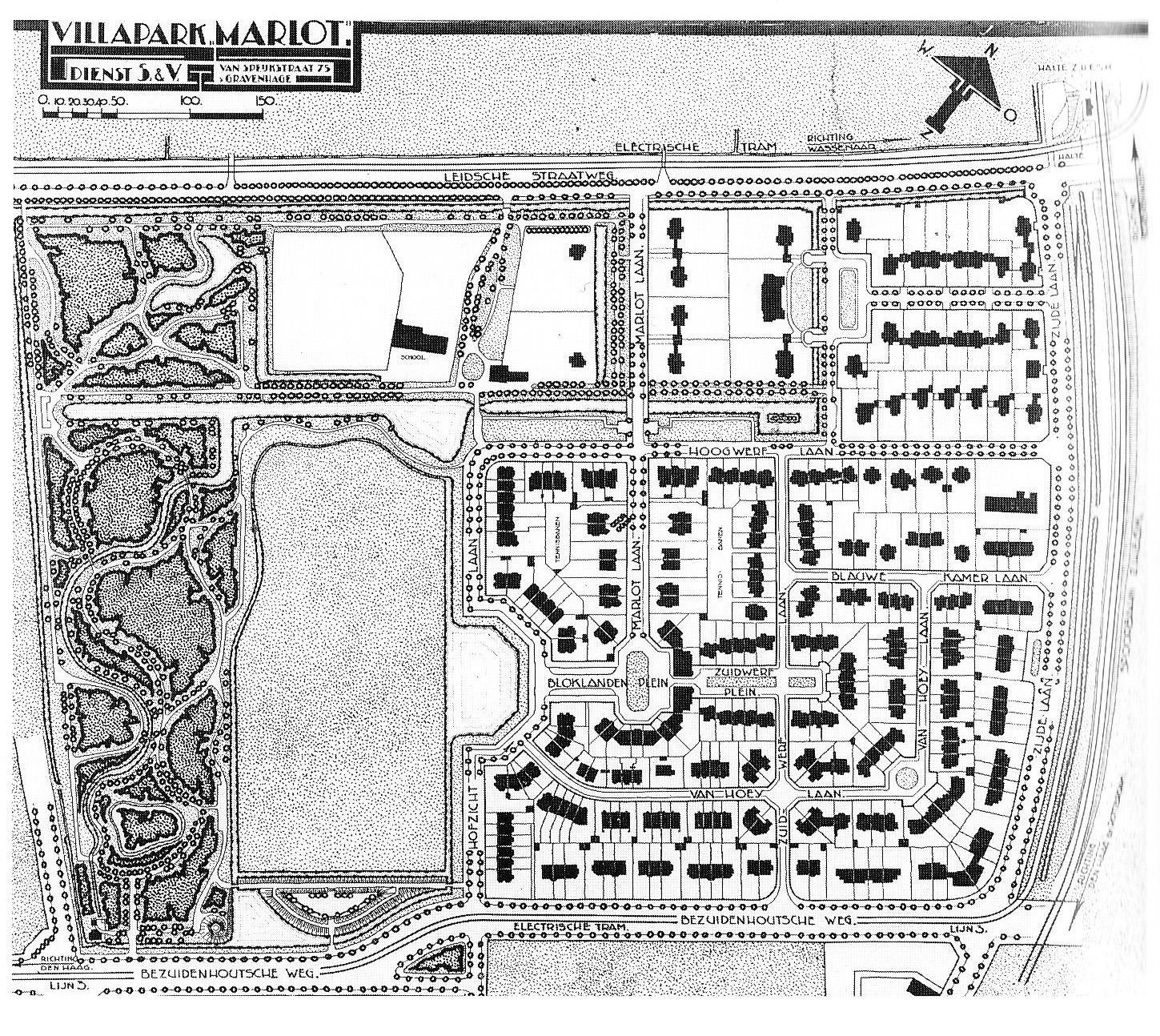
Brandes returned to The Hague from Germany in 1909. Brandes received his training as an architectural draftsman at the Lotz Architectural Institute, which was an arts and crafts and drawing school in The Hague. He became a member of the Haagse Kunstkring and lived with his friend Willem Verschoor, whom he had met at the Lotz Institute. The school was founded by architect Moritz Lotz, who was the superintendent at Gemeentewerken in The Hague. Brandes then gained practical experience working with Van der Steur, who was involved in the construction of the Peace Palace, among other projects. From 1912 to 1915, Brandes worked with the architects Hoek and Wouters, where he held the position of chief-de-bureau. However, due to the war, the partnership dissolved. In 1915, Brandes established himself as an independent architect in Wassenaar, but he remained associated with Wouters until 1918. In 1911 and 1912, Brandes and Verschoor went on study trips to Berlin, possibly to attend an exhibition on modern German architecture at the Kunstkring in 1910. Brandes’ notable works include the beautiful residential park Marlot (1920/25), the Dalton Lyceum (1934) and the surrounding houses, as well as a large number of other houses. He was the most prolific architect during the interwar period. Bakker Schut apparently saw in Brandes a practical architect who could effectively combine new aesthetics with the concept of serial housing.
The New Hague School also included architects such as Bernhard Bijvoet, Jan Duiker, Jan Greve, Jo Limburg, Hendrik Wouda, Frans Lourijsen, Henk Wegerif, Cor van Eesteren, and Jan Buijs. Urban planners from the municipality, such as Suyver, Greve, and Alberts, shaped the monumental districts. Marlot vwith an urban plan by Suyver and house designs of Brandes, and Papaverhof van Wils are the most iconic urban ensembles from the interwar period in The Hague.
The aesthetic committee
The cultural policy pursued by individuals like Bakker Schut and Van Gelder on behalf of the SDAP can be best understood by looking at the role and authority of the Hague aesthetic committee. During these years, the committee was responsible for implementing the political ideals through the evaluation of building plans on municipal land. Initially, from 1910 to 1921, the committee only tested building plans, which was already a significant task. However, after 1921, all building plans were subject to evaluation by the committee. Furthermore, the committee also started evaluating expansion plans at a later stage.
Berlage & Lindo
Based on the advice of Berlage and with the support of Lindo, an aesthetic committee was established on July 17, 1910. The committee consisted of four members. One member was delegated by ‘The Society for the Promotion of Architecture’ (later reformed as the BNA), and another member was delegated by the ‘Board of Directors of the Academy of Fine Arts of The Hague’. The remaining two members were appointed by the municipal executive. In the Hague aesthetic committee, it was customary for architects to present their building plans to the committee in sketch form. Only after the committee’s approval, the plans were submitted to the city council for further approval.
The annual reports of the aesthetic committee did not mention the architects who had produced the plans, nor did they discuss the content of the plans. The committee’s standards were not explicitly written down, but they were implied. However, the annual reports did give some understanding of the standards that the committee members used to evaluate the plans. The selection of committee members itself was a decision that reflected the desired image for The Hague.
Initially, the committee members closely followed the ideals of the SDAP party in The Hague, and their powers were consistently expanding. In 1936, the aesthetic committee (Schoonheidscommissie) was renamed the quality committee (Welstandscommissie). However, the architects appointed by the BNA, who were part of the committee, became increasingly disloyal to the political leaders in The Hague. The committee members started to avoid political control more and more. The committee’s aesthetic advice also seemed to hinder the construction of serial housing, which required a certain level of cost-effectiveness. Eventually, all the powers of the aesthetic committee were transferred back to the Urban Development and Housing Department of Bakker Schut, which was the main center of cultural politics in The Hague during the interwar period.
Caring for the cityscape
In 1918, Wils published an article titled ‘De Zorg voor het stadsbeeld’ in which he argues for granting unlimited power of attorney for prosperity. According to Wils, in the past, it was common for regulations to ensure the preservation of a beautiful cityscape, as ‘A thing of beauty is a joy forever.’ However, currently, we are able to provide our cities with good traffic roads, excellent sewerage, street lighting, and even more comfort, but the aesthetic aspect of the cityscape is not being considered. (Wils, 1918: 213).
Wils was not concerned with the committees and regulatory greed that imposed ‘quality’ on the people through a top-down policy. Wils believed that the innate sense of quality in people needed to be developed in schools and made central to education. Wils also believed that quality should become a part of life, a way of being and contemplating. Wils thought that the daily press should also pay more attention to this. Wils expressed sadness that the public is currently fixated on questions of dubious importance that have a short lifespan, and does not notice the ugly house in which they live, a house that does not meet reasonable requirements.
Regarding the aesthetic committees, Wils stated that: ‘For several years, we have been aware of the existence of aesthetic committees in our country. It is unfortunate to observe that these committees have not lived up to our expectations in most cases. This can be attributed to either insufficient instructions or the incompetence of the committee members. Instead of being a driving force for the development of urban beauty, they have had a hindering effect. The effective functioning of a quality commission primarily relies on having unlimited authority. Additionally, the members should be modern artists who are unbiased and have a keen eye for the architectural value of the designs being assessed.’ (Wils, 1918: 215).
Wils was frustrated that architects were not being held to high standards. Anyone was allowed to submit a design for their lunchroom, as long as it met basic technical requirements. Wils believed that if only competent individuals, specifically construction artists, were allowed to design and construct buildings, it would eliminate the need for committees and building inspections. Wils compared this to the situation in Germany, where architects were held to higher standards.
All building plans, 1921
In the year 1921, there were significant changes. The Building and Housing Ordinance of The Hague was modified, and according to Article 94, it became mandatory to submit all building plans. Article 94 was referred to as the aesthetic paragraph of The Hague Building Ordinance. The city council provided instructions to the aesthetic committee regarding the desired cityscape. The committee was established by the new Alderman for Public Works, Mr. P. Drooglever Fortuyn.
The aesthetic committee was also significantly expanded to include nine members and was given its own secretariat. The ordinary members of the committee were divided into three sections, each with its own neighborhood. The city council appointed six members, the BNA appointed three members, and from the official side, the directors were Bakker Schut (urban planning and housing), Westbroek (parks and green spaces), Van Gelder (art and science), J. Lely (municipality works), and G.A. Meijer (building and housing supervision).
The aesthetic committee was given a significant increase in tasks and gained more influence over the built environment. The advisor of the municipality, Berlage, also presented his plans for the breakthrough at the Prison Gate to the committee. It was noteworthy that Van Gelder, a cultural ideologue and museum reformer from the SDAP, was also a member of the aesthetic committee. Together with Bakker Schut and Berlage, the SDAP ideals were effectively implemented in The Hague, as seen in the new buildings. The cityscape was shaped and colored by the process of collectivization. In that same year, alderman Vrijenhoek also took office. The number of meetings increased to 52 per year. In 1921, Jan Wils’ Papaverhof in the Daal en Berg-garden neighborhood was likely discussed in the aesthetic committee, although no report was made of it (HGA bnr 579-01, inv: P4504.0, Annual Report Aesthetic committee 1921).
In a meeting in 1921, the aesthetic committee, mayor, aldermen (Vrijenhoek), and the Commission for Local Works and Property decided to conduct a trial for cooperation. Their goal was to create a building plan for an unsold municipal site in order to improve urban planning. This proposal was made on July 15, 1921. Bakker Schut’s Department of Urban Development and Housing was given the task of developing a building plan for the sites in Marlot. The department then approached architects Verschoor, Brandes, and Hellendoorn to create the building plans. The mayor and aldermen believed that these plans met the welfare requirements sufficiently, so they deemed it unnecessary to submit them to the aesthetic committee. As a result, the aesthetic committee was no longer involved in the planning process.
After deliberation among the chairman of the aesthetic committee, W. de Vriend Jr., the secretary R.C. Mauve, the alderman Vrijenhoek, and the director of the Department of Urban Development and Housing, Bakker Schut, the board made an additional appointment. Going forward, the chairman and secretary of the aesthetic committee will be involved in all discussions between the department and the architects regarding this type of building plan. The chairman and secretary were given access to the preliminary draft and shared responsibility for the success of the final plans.
Architects’ vs politicians
The divide between architects and politicians, which had been present for a while, became evident in 1923. The annual report of the commission in 1923 described a disagreement between the Urban Development and Housing Department and the aesthetic committee. This led to a new contradiction. (Reference: HGA bnr 579-01, inv: P4504.0, Annual Report Aesthetic committee 1923).
According to the 1925 annual report of the aesthetic committee, the college believed it was preferable for the president and deputy chairman not to be architects. Previously, the committee itself appointed these positions, but this rule was changed. In the future, the municipal executive would appoint individuals for these roles, just as they did in the early days of the aesthetic committee. In 1925, the committee held 54 meetings at its peak. However, the goals of the municipality and the aesthetic committee appeared to diverge rather than align. (Reference: HGA bnr 579-01, inv: P4504.0, Annual Report Aesthetic committee 1925).
The stormy development of public housing and urban planning
After Lindo retired in 1918, the Department of Urban Development and Housing was separated from the Department of Municipal Works in 1919. Bakker Schut became the director until his retirement in 1939. Alderman Jurriaan Kok was responsible for initiating this separation. The land department remained a part of the new department. Shortly after, urban planner Suyver and inspector Van Boven joined the team. Architects Pet, Greve, and Albers were already working there. Suyver eventually became the deputy director and would succeed Bakker Schut in 1939.
During the interwar period, Bakker Schut was responsible for determining the urban planning and public housing in The Hague. Previously, matters such as material trading and contracting were not regulated by the government, but now they became municipal services in order to implement the affordable housing project. The municipality of The Hague took the lead in initiating many changes due to political and social pressure. This was largely influenced by the housing shortage following the First World War. Public housing and urban planning became the responsibility of the municipality, and people started to see cities as interconnected. The developments in The Hague were also influenced by cyclical changes and the evolution of the public housing and urban planning profession.
Central Building Materials Supply (CBV) & The Hague Construction Company (Habo)
After experiencing several failed tenders and witnessing building contractors raising prices and potentially making mutual agreements, the City Council of The Hague decided on 18 March 1918 to establish the Central Building Materials Supply (N.V. Centrale Bouwmaterialen Voorziening, CBV). This provision involved the participation of Amsterdam, The Hague, Utrecht, the Department of Water Management, and the ‘Vereeniging van Nederlandsche Gemeenten’ (with former alderman Simons from The Hague). From 1918 to 1921, the central purchase of materials had a positive impact on price developments in the construction industry. Bakker Schut successfully defended against numerous criticisms from entrepreneurs, the liberal camp, and even the timber union (Bakker Schut, 1939).
The timber union declined to work together with the purchasing center, so the CBV was expanded with its own sawmill, planning mill, and carpentry factory. Eventually, the construction prices would decrease to the point where the purchasing center was no longer necessary. However, at the moment, the unity among the contractors and the price agreements they likely had were disrupted (Bakker Schut, 1921).
After the monopoly on material procurement was broken, social democrats such as Drees, Van Deth, Vrijenhoek, and Bakker Schut also took control of construction production from private entrepreneurs. In 1920, Bakker Schut proposed the establishment of a municipal construction company. There was opposition from various groups, but on July 15, 1921, the The Hague Construction Company (N.V. Haagsche Bouwmaatschappij, Habo) was founded (Leeuw-Roord, 1981). This company, owned by the municipality, mainly built affordable housing. The building land was purchased and leased out. The CBV and the Habo played a significant role in implementing collective construction in The Hague, resulting in a high level of construction production (Bakker Schut, 1921) (Leeuw-Roord, 1981).
Subsidy system affordable houses
During the economic boom following the First World War, obtaining long-term loans for housing was expensive. As a result, private housing development was slow, and the government had to provide support and materials for the construction of housing law houses. In 1920, a crisis occurred which caused construction costs to decrease significantly, while wage costs remained the same. This led to the government reducing the rent contribution and eventually stopping it altogether in 1923. By the end of 1920, the government implemented a subsidy system outside of the Housing Act to encourage private construction and housing associations. Advances and contributions under the Housing Act were no longer given after this change.
According to Bakker Schut (1939), the government’s change in attitude had significant consequences for The Hague. Several requested improvements for a total of five thousand homes, such as in Duindorp, Spoorwijk, and Rustenburg, were ultimately not approved. The municipal administration and the ministry extensively discussed the situation that had arisen. In 1922, the Minister responded by stating that the government had concluded that it was not possible to continue providing funds for housing without causing a general disruption of the state finances. Initially, the granting of subsidy for housing construction by municipalities was excluded, but later municipalities were also allowed to apply for subsidies.
According to Bakker Schut, between 1922 and 1925, a new subsidy system was implemented to determine housing production, resulting in the construction of many more expensive homes. Although the old system had been abolished in 1922, it continued to be used until 1925 due to pending and old applications. From 1925 to 1940, the housing market was mostly controlled by private building contractors, as long as construction had already begun after 1930. This information is supported by Bakker Schut (1939), Nycolaas (1974: 38-39), and Smit (1981: 120-124). Bakker Schut also mentioned that sporadic re-application of the Housing Act took place in 1926 and subsequent years (Bakker Schut 1939: 39).
Netherlands Institute for Housing
The developments in the field of public housing and urban planning were stimulated by various individuals, including SDAP-member Dirk Hudig (1872-1934), for several years. These developments eventually led to the establishment of the ‘Netherlands Institute for Housing’ (NIV) in 1918. This organization, which initially focused on public housing, expanded to include urban planning in 1921 and was later transformed into the ‘Nederlandsch Instituut voor Volkshuisvesting en Stedebouw’ (NIVOS) in 1923. Its mouthpiece was the Tijdschrift voor volkshuisvesting from 1920 and the Tijdschrift voor Volkshuisvesting en Stedebouw from 1923.
The Rotterdam architect and professor in Delft, M.J. Grandpré Molière, who gained recognition for his work on the garden village of Vreewijk in Rotterdam-Zuid, became the director of that institute (Baneke, 2008) (Steenhuis, 2009). Bakker Schut also regularly published in this magazine (Stedebouw, 1930). From this organization, the current ‘Nederlands Instituut voor Ruimtelijke Ordening en Volkshuisvesting’ (NIROV) developed. Hudig and others advocated for social science research as the basis for designing expansion plans. They also highlighted many foreign examples of regional and provincial plans and encouraged learning from them. The concept of regional planning from Anglo-Saxon countries gained significant attention at the ‘Internationaal Stedebouw Congres’ held in Amsterdam in 1924.
Bakker Schut was a member of the editorial board and regularly published in this journal and for this institute. Bakker Schut also contributed to the congress in Amsterdam with the publication: ‘The Need for District Expansion Plans in the Netherlands’ (Bakker Schut, 1924). From the beginning, public housing, such as Bakker Schut in The Hague and Keppler, the director of the Amsterdam Housing Service, knew each other from their studies in Delft and the study association ‘Social-Technical Association of Democratic Engineers and Architects’ (STV). This association was founded in 1904. In 1924, the name changed to ‘Social-Technical Circle of Democratic Engineers and Architects’ (STK). The aim was to promote popular prosperity, the growth of the state system in a democratic sense, and to advocate for the social interests of engineers. When it was converted into the ‘Socio-Technical Circle’ in 1924, the association took on a more private character. In 1935, the STK was dissolved (IISH: ‘Archive of the Social-Technical Association of Democratic Engineers and Architects’).
Workers' housing in the Netherlands
The book that was published in 1921, titled Arbeiderswoningen in Nederland – Vijftig met rijkssteun, onder leiding van architecten uitgevoerde plannen, met de financieele gegevens – Bijeengebracht door DR.H.P. Berlage, Ing.A. Keppler, W. Kromhout en Jan Wils (Berlage, Keppler, Kromhout, & Wils, 1921), demonstrated that public housing was not only a concern for public housing administrators and urban planners, but also for architects.
This book was accessible to architects and it provided guidance on how to construct affordable housing with government support. The drawings in the book were all to scale at 1:200, and each plan included information such as the year of construction, the number of homes, the foundation costs, and the weekly rent per home.
The book did not provide a complete overview of the achievements in public housing because not all architects who were contacted had made their plans available for inclusion. In the preface, Berlage stated that the book did not only showcase good examples, but also included poorly designed plans that were built with government support. These poorly designed plans referred to the individual homes in the garden city or garden district. In reality, the book was a compilation of successful examples of collectivization in architecture. Berlage further argued:
‘As a result of this event, the artistic workers’ house, as a separate house in the garden city and garden city district, as a housing block in the city itself, has already found its realization. And that is undoubtedly of such importance that for those who will later write about the development history of contemporary architecture, the workers’ house will prove to be the most important element in this.’ (Berlage, Keppler, Kromhout & Wils, 1921: IX).
Pay close attention to the term ‘development history’. Berlage referred already to Hegel and the history of development when explaining the Hague expansion plan of 1908.
Architect Willem Kromhout (1864-1940) also advocated for a closed cityscape in his contribution to the book. Kromhout argues that the open nature of the city leads to the loss of the enclosed cityscape and the charming picturesque intimacy found in old towns and villages. Kromhout criticizes his contemporaries who transformed old storefronts into the fashionable styles of Art Nouveau and Wiener Secession, drastically altering the appearance of the city.
‘The emergence of a town or village always gave the sensation of picturesque intimacy, … Old towns and villages are therefore natural monuments of special value, the houses, trees, churches and town halls, everything has grown together into an inviting, inward-luring warm cozy whole and rarely can one escape the oppressive wish when walking through the charming streets, squares and canals, oh, if this remains untouched for a long time! Such a wish does not arise without reason, for here and there we see as rudely intervened by the village carpenter or contractor, who, according to dubious city proposal, erects a fashionable storefront there, where formerly a serious, simple building, unpretentious, of the all-round beauty offered its modest share. The study of the causation of the old intimacy of the town and village architecture, as well as of the town and village agglomerate, had not yet begun, now after years foolish in appearances, much has improved, which will eventually also find its repercussions in the not yet too well started villages and small towns.’ (Berlage, Keppler, Kromhout, Wils, 1921: XIV).
Kromhout was annoyed by the abstention of the The Hague municipal government and indecisiveness that resulted in the closure of the old city (Zeeheldenkwartier, Archipelbuurt) and the subsequent enormous breakthroughs made in the old city to address the accessibility issues that had arisen.
‘Especially of the great cities, for rough was the manner in which they made their way through the old circle. …. ; the Hague saw its indecisive perimeter enrichment with the Zeehelden and Archipel quarters. What a pity of unbridled breakthroughs everywhere! Gone was once the beautiful enclosed nature of cities, ………… Streets without end, which showed no tendency to any swing, planless combinations hatched at the then city offices, without any understanding of urban composition.’ (Berlage, Keppler, Kromhout, Wils, 1921: XV)
This remark was actually strange because, despite being the co-author of the book, Berlage drew the straight breakthroughs while Lindo (Grote Markt) and Van Liefland (Gevangenpoort sketches) made efforts to incorporate curves. It is possible that Berlage and Wils should have informed their colleague Kromhout better about the situation in The Hague.
The plans described in the example book from the municipality of The Hague represent the first generation of housing law houses, which were constructed by the municipality and housing associations.
Berlage and The Hague as Gesamtkunstwerk
‘Oh Rome my country, city of soul’ (Berlage, 1909: 2. Berlage quoted Byron as having these words spoken by the literary character Childe Harold).
The city as the most beautiful work of art
The most important insight that Berlage brought in 1908 was the idea that the city should be viewed as one unified entity, with urban space and buildings interconnected. In a dialectic way the old romantic and picturesque landscape, along with the existing buildings, combined with the new classic and monumental figures of the residential neighborhoods, create a new identity for The Hague. An identity where the past seamlessly transitions into the present and future. The use of double building blocks and bricks served as symbolic representations of this concept.
According to him, urban planning is a form of art and people should strive for a total art (Gesamtkunst) where all experiences come together to create a new feeling. This idea, originally proposed by composer Richard Wagner for opera, was supported by Viennese urban planner and theorist Camillo Sitte. Sitte’s textbook, Der Städtebau nach seinen künstlerischen Grundsätzen (1889), was highly influential in the field of urban planning. Sitte believed that the city was not just a result of civilization, but also a phenomenon that produced civilization. Similarly, for Berlage, the city was a work of art that condensed the culture of society, including science, art, morality, commerce, politics, and economics. Berlage argued that art is power, and power is art. Like Wagner, the integration of music, poetry, movement, acting, and theater architecture creates a sense of unity and harmony with the audience. This applies to both individualistic individuals and those who feel a sense of community.
In his preface, Sitte (1889) started by acknowledging the progress made in urban planning, particularly in the areas of traffic and public health. However, he criticized modern urban planning for its failure in the artistic aspect, as it had not produced anything significant in that regard. He pointed out that modern urban planning prioritized monumental buildings rather than the spaces between them. Sitte describes these areas as lacking elegance and being poorly designed.
‘…, and opposite the beautiful new monumental buildings are the clumsiest square shapes and subdivisions in the immediate vicinity of the squares.’ (Sitte, 1889: 9).
The Department of The Hague of the Society for the Promotion of Architecture asked Berlage to write an explanatory statement in 1909, which he based on earlier lectures. Berlage discussed Sitte’s book enthusiastically in the Bouwkundig Weekblad. Previously, the city was seen as a collection of street plans created by building-land-companies between existing thoroughfares. Now, the city was seen as a Gesamtkunstwerk. In his detailed explanation of The Hague Expansion Plan (Berlage, 1909), Berlage connected Hegel’s conception with his theory of Romantic architecture, as well as the views of Semper, Sitte’s theory (1889), and Brinckmann (1908). Berlage stated in his explanatory statement that:
‘An aesthetic issue as highly important, but above all social as urban planning, first acquires its special value when it is seen in its historical context and explained in its causal development.’ (Berlage, 1909:1).
Bakker Schut argued that the urban ensemble forms a:
‘very close link between urban planning and public housing. The residential areas should not be made unilaterally in one corner of the city. They must connect to the city in such a way that they obtain good connections with the core, where their own intellectual, spiritual needs can also be satisfied. There, the church, public reading room, bathhouse, association building and the main shopping groups must be built and grouped into a whole. The shape of the building blocks must be such that regular construction can take place: building blocks of unfavorable, unmotivated design give rise to twisted building solutions, to expensive houses with an unfavorable floor plan. The course of the streets can and must be such that monotony in the street scene is avoided without resorting to sought or capricious solutions. A map of a new city district must be clear and logical. The simpler and clearer the map on paper, the easier it will be for the resident to orientate himself in the neighborhood, if it is made of stone.’ (Freijser & Teunissen, 2008: 86).
It was not just about the Schoone Eenheid between buildings and urban space. The dialectic of Hegel, which Berlage refers to in his explanation of the expansion plan, goes much further. It also involved the unity between people and ideals, with the city as a backdrop. Additionally, it encompassed the hygienic ideal of healthy urban planning, ensuring light and ventilation in all homes. The Schoone Eenheid also represented carefully designed building profiles, in other words, modern urban planning.
After years of debate and stagnation, Berlage’s plan was eventually implemented in a general form. In many residential areas from that time, the baroque figures can still be easily identified, although they do not exactly match the original expansion plan.
In 1913, Berlage relocated to The Hague, where he lived and worked until his death in 1934. He served as a special advisor to the municipal executive and the SDAP in The Hague and played a role in shaping the affordable and hygienic houses in the numerous monumental residential neighborhoods of The Hague.
The aforementioned theorist Brinckmann would look back on urban planning and architecture in The Hague with his ‘Architectural impressions from The Hague: I and II’ in Het Vaderland of 24 and 25 July 1919. Although they had similar ideas, Brinckmann was diametrically opposed to Berlage. Het Vaderland was the newspaper owned by Lindo’s uncle Martinus Nijhoff (the poet’s grandfather) and was associated with the Liberal Union. Jan Wils, an architect and colleague of Berlage, also wrote for this newspaper.
The stony garden neighborhoods of The Hague
The garden neighborhoods in The Hague are stony and have a different appearance compared to the greener garden neighborhoods found elsewhere during this time period. This difference can be attributed to Berlage’s vision for the city. As point out, Berlage did not agree with the Anglo-Saxon concept of a Garden City that emphasized abundant planting. In The Hague, the focus was on creating monumental garden neighborhoods that seamlessly integrated with the existing city, rather than building garden cities far outside the city. Berlage opposed those who advocated for the abolition of cities. He did not specifically mention individuals like Howard, Unwin, and Parker. Additionally, he did not mention Letchworth Garden City (1903) or Hampstead Garden Suburb (1906), which were idealistic new towns located outside of London in the English landscape.
Berlage painted an inaccurate picture of the garden city here. On the contrary, the concept of the garden city aimed to capitalize on the benefits of both urban and rural areas while minimizing their drawbacks. However, Berlage expressed a rather negative view without providing specific reasons or thoroughly exploring the ideas. Berlage pointed out that:
‘Not long ago I heard someone whose whole life of thought revolves around popular prosperity proclaim that all cities must disappear. That person was one of those socially tiring people, for whom there is no other than social interference, …’ (Berlage, 1909: 2).
Berlage believed, like Schumacher, that cities were responsible for creating great works of art. He believed that art and power were interconnected, and where there was a lack of art, there would also be a lack of power, and vice versa. Despite Berlage’s dislike for the Garden City Movement of Howard, Unwin, and Parker, several garden neighborhoods with wide parkways were lay out around The Hague and other municipalities during the interwar period. The garden districts were always located within cycling and tram distance of the city.
These included neighborhoods such as Marlot, Meer en Bosch, the Rijswijkse Voorde’s, the Voorburgse Vreugd en Rust, and the Vogelwijk. Originally, the Vogelwijk was called the garden city district Houtrust and Segbroek, and it was developed on the estates that Goekoop had purchased from the Grand Duke in 1903. In 1917, the ‘Coöperatieve Woningbouwvereniging Tuinstadwijk Houtrust’ was founded by individuals such as Van Boven, Hoek, and Verschoor.
The green areas, such as Marlot, have symmetrical structures and a monumental design. This is different from the garden districts and residential parks of the previous generation, like Zocher (Agnetapark in Delft, the never-executed proposal for Willemspark, and Van Stolkpark in The Hague), Coppieter (Belgisch Park), and Mutters (Wassenaar and Rijswijk), as well as contemporaries like Henrici’s villapark (Zorgvliet from 1910), which was partly developed at the same time as the monumental garden neighborhoods.
The picturesque and the monumental united
Berlage’s Expansion Plan for The Hague, developed in 1908 (synthesis), aimed to combine to unite of the old romantic picturesque conditions of nature, geomorphology of the landscape and existing buildings (thesis) with new classically monumental residential neighborhoods (antithesis). According to the Hegelian scheme of thesis with antithesis, Berlage thus came to the synthesis, with this scheme Berlage deviated from Sitte. While Sitte, a Darwinist, saw urban transformations without an automatic link and progression from ‘bad’ to ‘good’. Berlage, influenced by Hegel’s idealist philosophy, believed in the continuous improvement and evolution of society and city towards an ideal organic society. It is likely that Hegel had a significant impact on Berlage’s thinking.
Berlage (1909) explained how the true beauty of old cities comes from united the classical and romantic character, as Hegel had argued a hundred years earlier. He also questioned whether new cities should be built and expanded in a way that reflects the past. He suggested that the regular lay out of classical cities could provide inspiration, while the ideas from the Middle Ages could help solve any unexpected transitions. He stated that:
‘If, therefore, the plans of the classical cities could serve as a reason for the regular lay out, those of the Middle Ages gave the ideas to the solution of accidental transitions. In this way, therefore, the spirit of the plan could be kept in classical conception, while the natural conditions provided the picturesque factor, thus a beauty in a romantic spirit. Thus, therefore, the material bequeathed to us in the construction of the old cities could be used not as imitation but as a reason, to its full extent, and to ensure that the forcedness in both directions, both in classics and in romantic spirits, was avoided.’ (Berlage, 1909: 24).
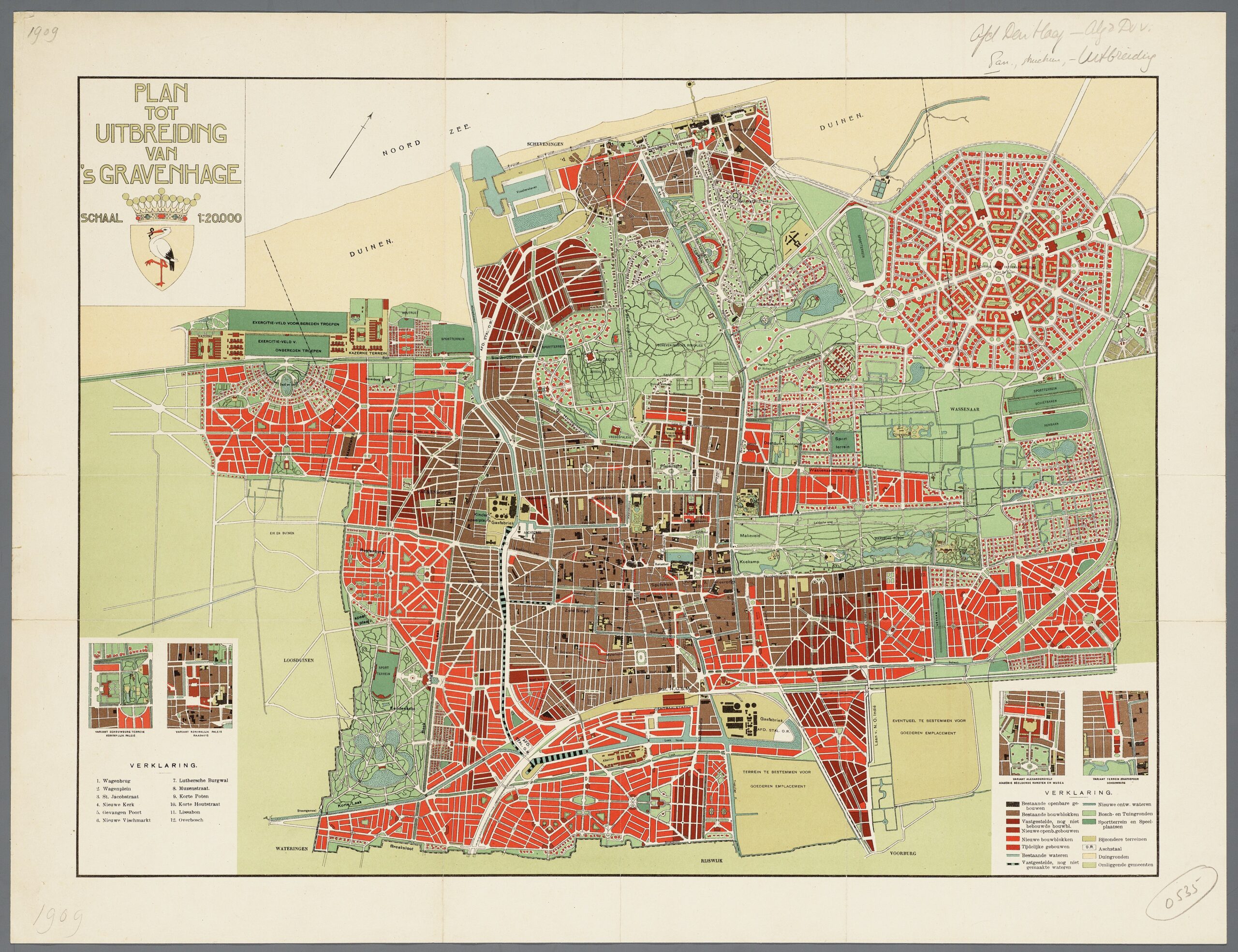
However, it was necessary to examine the existing buildings and the landscape. In Berlage’s expansion plan, the existing buildings are represented by dark brown color, the new buildings are represented by red color, and the surrounding landscape is carefully indicated. According to Berlage, in order to truly appreciate the beauty, we must study the history of cities. The classical urban planning of Greece had a predetermined plan and a preference for regular construction and straight streets, which was also adopted by the Romans. Hegel considered this to be a symbolic art. According to Hegel, romantic urbanism is mainly Germanic and Christian, and it is based on organic growth. Villages were initially founded for economic reasons and gradually grew into cities without a predetermined plan. Berlage, following Hegel, states that Greek cities had a classical character while medieval cities had a romantic character (Berlage, 1909: 8).
Berlage quoted Hermann Muthesius (1861-1927), who also believed that there were two periods of brilliance in Western culture: ‘ancient Greece and the Nordic Middle Ages.’ In 1904, Muthesius introduced English architecture and urbanism to the continent and played a significant role in establishing the first German Garden City, Hellerau, outside Dresden in 1909. Martin Wagner, a socialist city planner and pupil of Muthesius, later laid out large-scale Garden Cities around Berlin between 1924 and 1932. According to Berlage, both forms of architecture were characterized by distinct but opposing spiritual worldviews. Berlage then translated this contradiction, as used by Hegel and Muthesius, into the contradiction he employed as: ‘monumental’ versus ‘picturesque.’ According to Berlage, the relationship between the monumental and the picturesque must lead to beauty. He also states that the monumental, being stylized, is a higher form of beauty. Therefore, choosing between these two directions should not be difficult (Berlage, 1909: 14).
Berlage observed that the old part of The Hague had a naturally organized street grid lay out, with streets running at right angles to each other. This principle was then used as the guiding principle for the expansion plan. Specifically, the streets parallel to the beach walls were well-developed, while the streets perpendicular to the beach walls were somewhat neglected. These streets often had irregularities and did not follow a straight path, which eventually became problematic for car traffic. The essence of The Hague’s expansion plan was that these were fragments of monumental plan parts, which were connected in a romantic and sometimes accidental way (Van Rossem, 1988) (De Klerk, 2008).
The reason why not all neighborhoods were the same was because of various factors, including the geomorphology of the landscape, the existing buildings, and the random development of residential neighborhoods in the past.
‘The ideas developed in the previous lecture were now also the guiding ideas in the design of the expansion plan of The Hague. They led to the principle of regularity, i.e., not of painfully retained symmetry, but of a regularity to which the cities of antiquity, but especially those of the Baroque era, developed. By maintaining such ‘obstacles’, a certain monotony is automatically avoided, which is probably inevitable when a fully regular plan is implemented. The consequence of such a development was the emergence of a system of regular plan sections, which had to be connected by chance, i.e., in the intended sense. This method of partial grouping was also facilitated by the many street plans already laid down by a Council decision, which was generally felt to be an obstacle to the design.’ (Berlage, 1909: 24).
The double urban blocks and brick as a symbol of collectivity
The Schoone Eenheid between buildings and urban space took its most pronounced form with the double urban block with an intimate residential square for social interaction that were built between 1916 and 1922. Urban spaces and brick housing thus acquired a characteristic cohesion within the monumental residential neighborhoods. The desired collectivity was thus brought among the drifting sand of the city dwellers, it was thought.
The double urban blocks were most likely first constructed in Akroyd Model Village in Halifax, England, starting in 1863. This model village was built by Akroyd, a textile manufacturer (Smit, 1981: 124). It became a popular concept among Social Democrats. In red Vienna, between 1927 and 1930, the Karl-Marx-Hof was built as a fortified urban block with its own internal world. Berlage’s expansion plan from 1908 already included several proposals for double urban blocks. Berlage argued in explanation of the expansion plan, echoing Brinckmann that:
‘Because if ‘urban planning is creating space with the housing material‘, then it is clear that with the inadequacy of the material, the space will also be difficult to satisfy. And this difficulty is certainly not diminished for urban planning in the Netherlands, because the relationships here in the country are generally limited. For wide straight streets, in order to create space in the aforementioned sense, also require corresponding means, i.e., a monumental architecture, both in character and in size.’ (Berlage, 1909: 25).
Also, in Berlage’s 1915 Plan Zuid for Amsterdam, there are double urban blocks. These were not present in Berlage’s 1904 plan for the south. The design for the Spaarndammerbuurt in Amsterdam from 1912 by J.M. van der Mey included these double urban blocks. In 1919, architects De Bazel and Walenkamp designed and built two beautiful double urban blocks in Zaandammerplein and Zaanhof.
Similar ensembles can be found in The Hague, such as Duindorp or Molenwijk, characterized by simple solid masonry and pitched roofs. Many of these buildings have been demolished due to urban renewal efforts. However, there are still double urban blocks with intimate residential squares in The Hague, including Windassraat, Meeuwenhof, Gagelplein, Weigeliaplein, Moerbijplein, Vlierboomplein, Schaapherdersstraat, and the most famous one, Papaverhof. The double urban block concept aimed to create a new relationship between green spaces, affordable houses (with fresh air and sufficient daylight), and various types of squares.
The double urban block had a disadvantage in that it took up a lot of space, which made it difficult to achieve the desired number of houses. This is likely why they were only occasionally used in the layout of new neighborhoods. Having a whole city filled with double urban blocks would be invaluable. The architects and urban planners of the municipality were primarily responsible for implementing the double urban blocks with affordable houses of the associations, although the neighborhoods Papaverhof and Marlot were exceptions to this.
Berlage and his followers believed that the symbol of honesty and collectivity was the brick. They saw it as a typical Dutch material that could be used to build a house without any embellishments or unnecessary decorations. In his essay Reflections on architecture and its development, Berlage, influenced by Cuypers and De Bazel, advocated for the use of brick (Berlage, 1911).
‘The unity in the multiplicity of the brick, that multicolored ness of the yellow by comparing the reddish to violet tones, in their range with that of an autumn forest, created by the way in which a brick wall is constructed, makes the operation of the brick unsurpassable. In addition, the decoration, the sophistication of a brick architecture lies in the material itself.’ Berlage argued. ‘The brick,’ Berlage ordered, ‘which as a single person is a nullity, as a mass a power, is the example of the equal social image to which it has to give color and form. Every profile, every formal peculiarity, every expression of whimsy perishes in the tone of the masses, of the whole. Isn’t that socially speaking? Does that not mean that the individual must submit to the whole? Does not brick-building, in such a view, invent the democratic idea, which is growing, the idea, which leads materially and therefore spiritually to generalization? … It may even be said that modern architecture in the brick possesses a material best suited to its mode of expression: it is the essence of contemporary conception of architecture to strive for the style of objectivity, which seeks to develop its charms through the purely businesslike, as practical as possible, solution to the eternal question, on the way one divides and groups, not how one decorates and decorates. So back to the brick.’ (Quote from Berlage 1911, from Freijser & Teunissen, 2008: 37).
In June 1912, the Dutch Association of Brick Manufacturers organized an exhibition of brick at the building of the Society for the Promotion of Architecture (BNA). They stated: ‘This exhibition is very interesting not only for the craftsman, but also for the layman. After all, it was not so long ago that many Dutch architects used materials other than brick for their preference. It was Cuypers and Berlage who changed this.’
The exhibition was accompanied by a competition, which aimed to demonstrate that a house could be built using brick at a relatively low cost. According to a newspaper report, a cast house in Santpoort cost no more than f 2,000, so the challenge was to build a rural house of brick that did not exceed f 2,200. There were over 120 entries, and the first prize was awarded to Willem Verschoor, the second prize to Jan Wils, and the third prize to A.J. Rinsberg, all of whom were young architects from The Hague region.
The new monumental residential areas of 1916-1928
In the first phase, the buildings and urban spaces in The Hague were closely connected and formed cohesive urban ensembles. Some of these ensembles, such as Papaverhof and Marlot, are still considered iconic from the interwar period. Interestingly, the only part of Berlage’s expansion plan that was fully implemented was the Bomenbuurt, which was developed by the building-land-company Duinrust of Goekoop. A map from 1915, which includes the building plans, illustrates the relationship between the buildings and urban spaces (HGA z.gr.1324).
In this first phase, small neighborhoods were mainly built within the network of main roads. These neighborhoods include Bomenbuurt, Duindorp, Molenwijk, Trekweg (today Laakkwartier Noord), Spoorwijk, Bloemenbuurt, and Bohemen. They consisted mostly of three-storey buildings. There were also more open garden city districts with many detached houses, such as Houtrust, Segbroek (later renamed Vogelwijk), and Marlot. Later on, some through roads were located within the districts, such as Laakkwartier, Moerwijk, Rustenburg, Oostbroek, Leyenburg, and during the large expansion in The Hague West. The baroque figures can be recognized in all these districts. In the interwar period, the municipality and housing associations also worked for years within the street plans from Lindo’s time. This was seen in parts of Schilderswijk-Zuid, Benoordenhout, Bezuidenhout, and Transvaalkwartier.
The residential areas were characterized by brick architecture and uniform height, resulting in a brown pancake-like appearance. The neighborhoods consisted of double blocks with apartments and quiet residential squares, reflecting a sense of collectivism and contrasting with the previous period’s neighborhoods.
The urban spaces, such as courtyards or front gardens and residential streets with gates the ends, were intimate in nature. Individuality was stripped away from homes, as the façade did not indicate the size of the apartment or the status of its residents.
Instead of emphasizing individual houses, the focus shifted to the level of the urban block, where individual apartments merged into a collective. Typically, four to six apartments shared a common external staircase, and it was preferred that they no longer had their own front door on the street. Apartment buildings had flat roofs, while ground-level family homes had pitched roofs. Public buildings often had pitched roofs to highlight their presence.
The austere brick architecture of this period did not include any references to the history of the people or the country, or the latest fashions from Paris and Vienna. Through the construction of collective buildings, members of the SDAP aimed to create a unified identity and image that expressed equality among people. The best plans incorporated various international influences, particularly those of Frank Lloyd Wright, the style movement, and cubism. This style of architecture later became known as the New Hague School (Freijser & Teunissen, 2008).
Jan Wils’ Papaverhof was an exception among the urban ensemble in The Hague. Unlike the prevailing brown buildings, Papaverhof stood out with its white color. It was a beautifully designed double building block with intertwined floor plans, allowing for maximum utilization of light and air. This project also aimed to explore the use of concrete in residential construction, following earlier experiments in Scheveningen before 1916. Various techniques were tested to achieve increased and affordable construction production. However, it was discovered that wood was a much cheaper material, both during the tendering process for the first part of Duindorp and at Papaverhof (Kuipers, 1987).
Traffic and monumentality
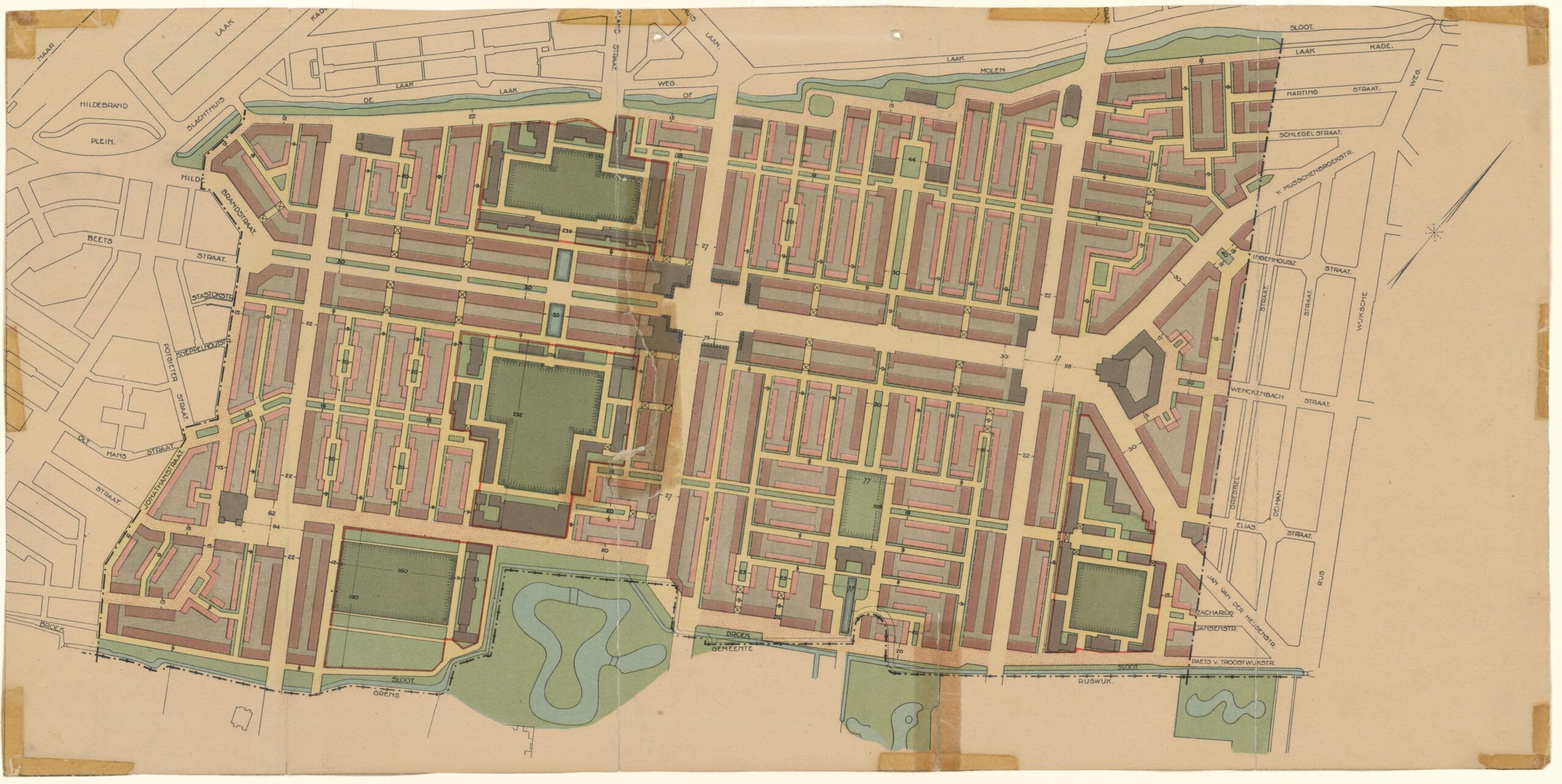
The new neighborhoods of The Hague were like self-contained villages within the extensive network of roads, waterways, and tramways. However, this concept started facing challenges with the increasing presence of cars. The Expansion Plan for Laakkwartier (1922) aimed to address this issue by transforming the main street, Goeverneurlaan, into a significant axis that would provide coherence to the neighborhood, similar to the Expansion Plan of Amsterdam-Zuid. As a result, Laakkwartier ceased to be just a village within the infrastructure network and became an integral part of it. It is interesting to explore the ideas of Wils and Berlage regarding this transformation.
In 1919, Jan Wils delivered a lecture titled The Freestanding Monument in the Modern Cityscape for the Haagse Kunstkring. In this lecture, he discussed a new theory. The lecture focused on two concepts, ‘picturesqueness’ and ‘monumentality’, which were already used by Berlage in his explanation of his expansion plan in 1909. Wils also described a visit he took with Berlage to Brussels and Leuven.
‘For a few weeks I had the pleasure of walking with Dr. Berlage successively through the streets of Brussels and Leuven. Both cities will be known to the majority of you, so that you can follow me there in your mind. In Brussels, we were hit again for the umpteenth time in the vicinity of and also the Parc-Leopold, by the grand design, the pure construction, the management of the situation, the ability to take sides with and introduce new factors to this end, creating a cityscape with a – I do not say ‘monumental’ yet – which impresses us by greatness of operation. And shortly afterwards we were in Leuven, went on the canal along the Dijle, along the Begijnehofje. This neighborhood of Leuven has not suffered anything because of the fire. It is difficult to say how we were moved by the sight of those little houses, plastered white with their red roofs, a tree every time, as all that stood with its foot in the water, quiet and forgotten, as if no man ever came again. If we had not known, it would have become clear to us that we. The Dutch, we felt more strongly about the picturesqueness than by the monumentality. It is not a result of reasoning, but was cool and calm to observe reality. The Dutchman feels nothing of monumentality, on the other hand he sees everything in color: the Dutch architect is more painter than master builder, the Dutch nature is more attuned to picturesqueness than to monumentality. Our cities, with their whole construction and in their entire construction, are there to prove that it has always been so. Does it still make sense, like this evening, to talk about ‘monumentality’ and ‘monuments’?’ (Wils 1919)
Wils adhered to Brinckmann’s previously mentioned quote and starting point. According to the lecture, Berlage also returned with Wils to the concept of ‘reconciliation’ (synthesis) in the expansion plan, which aimed to balance ‘picturesqueness’ (thesis) and ‘monumentality’ (antithesis).
The reason for this was the significant increase in traffic, which had already resulted in a completely different street plan in other countries. The old villages and towns in Holland also gradually adapted to the new situation, which was unavoidable. However, Wils argued that our cityscape should also meet aesthetic standards. People believed that having ‘decorated squares’ or ‘show-off streets’ was sufficient to enhance the city, but Wils believed that more was needed. It was about creating and organizing the entire street system, comprehending the construction of the building masses as a whole.
The neighborhoods described above had a common characteristic: they were all like islands surrounded by main roads. These main roads did not have any significant shops or public buildings, but they were filled with trees and greenery, giving The Hague a typical village-like appearance. The districts themselves were accessed through grand streets that led to a central square within the district. These central squares were where the public buildings, shops, and facilities were located. These districts often had unique architectural features, such as a fan or fork shape, with the buildings following this pattern. The residential streets and squares were wider than usual and had gates or narrow entrances. Most of them had a central area with lawns, shrubs, and trees. Only houses were found on these residential streets and residential squares.
Wils argued that the concept of ‘monumentality’ was rooted in the belief that there should be a unity between action (doen) and thought (denken), which led to the rejection of individualism. According to Wils, a ‘monument’ only held significance if it was integrated into the entire city and primarily served to guide traffic. Wils associated a standalone building with negative individualistic tendencies.
‘Only when the monument cooperates in its place to increase the balance between the mobility of traffic and the tranquility of the structure, does its presence have a purpose, a purpose, which we can call the aesthetic necessity. The creation of a monument does not mean (separately from other considerations) to be a palliative against the spaciousness of the street or square, a medicine for our fear of space, but the monument is then there precisely to increase that spaciousness to a monumentality. This planning, which governed the ground plan of the city, the same planning that was reflected in the construction, will have to determine the place of the monument in the cityscape. From the beginning to the end, the city planner has the floor here.’ (Wils 1919)
Wils quoted from Bruno Taut’s Die Stadtkrone in order to emphasize the connection between the new monument and urban life.
‘The new monument is in the new city, the new city of which our heads are filled and our hands are turned to’… ‘A deep desire drives us all: a deep desire drives us all: we want cities again, in which, according to Aristotle, we can live not only safely and healthily, but also happily. This desire is so deeply rooted that we look ahead and regard what lies behind us as finished.’ (Wils 1919)
The relationship between ‘picturesqueness’ and ‘monumentality’, as originally established by Berlage in the expansion plan of 1908 and questioned by Berlage and Wils in Leuven, was renewed at Wils, with the focus shifting to the movement of traffic in relation to the monuments in the cityscape.
In Laakkwartier, the main street for traffic was located in the middle of the district. The municipality’s Expansion Plan for Laakkwartier (1922) included many private residential squares and gates. However, in the modified version of 1927, these features were reduced. Instead, Laakkwartier was given a design that emphasized monumentality, with a grand through street Goeverneurlaan for traffic and tramways.
Criticism of public housing urban planning of the SDAP
Debate about the Expansion plan 's-Gravenhage-West 1922-1926
With the impending annexation of Loosduinen in 1923, The Hague had a vast area for development, but the problems only worsened. Berlage was asked to modify his expansion plan towards Loosduinen, but the mayor and aldermen rejected this revision in 1921. Under the leadership of Bakker Schut, urban planning and public housing became more professionalized as an engineering science, and the lofty ideals of Gesamtkunst took a backseat. The department used scientific methods to calculate the population demographics, traffic patterns, and the required number of facilities like schools and sports fields.
The planning process shifted its focus from the subjective opinion of one artist-urban planner to research, argumentation, and careful consideration. The municipality decided to initiate a competition for the expansion of Loosduinen towards the west. This competition marked the start of a prolonged conflict in which the service and Berlage eventually felt neglected. Critics of this competition raised concerns about the impact it would have on the cityscape of a collectivization architecture.
Finally, the tug-of-war led to the expansion plan for the modern-day districts of Bohemia, Meer en Bos, Waldeck, and partly the Vruchtenbuurt. This zone is located between the village of Loosduinen and the coast. In the center of this new expansion district is the De Savornin Lohmanplein, which runs parallel to the coast along the Laan van Meerdervoort. From there, the parkways Thorbeckelaan and Groen van Prinsterenlaan extend to the south, and the De Savornin Lohmanlaan extends to the coast.
The competition programme, created by the Department of Urban Development and Housing in July 1921, had only a few functional requirements and components. It did not include any principles or an analysis of the city’s expansion needs. There was no mention of the concept of ’the city as a work of art’ or Gesamtkunst. The competition jury was led by Berlage and included members Bakker Schut, Broese van Groenou (former boss of alderman Vrijenhoek), J. Lely (son of C. Lely and director of the Municipal Works Department), Westbroek (director of the Municipal Plantsoenen Service), and Suyver (head of the engineering department and second-in-command of the Urban Development and Housing Department). The jury consisted entirely of people who had not been able to make a proposal for ‘Expansion for The Hague-West’ according Boekraad & Aert (1991: 74).
None of the thirty-three participants were eligible for a prize, which was expected given the jury’s incompetence. Even with some changes, the jury still couldn’t choose a winner. In 1922, two participants, H. Russcher and A. Pet, only received a second prize. Russcher’s entry included several themes from the old plan of the Department of Urban Development and Housing. Pet, who was the municipal architect of The Hague from 1919 to 1951 and worked for Bakker Schut, had his plan improved and modified in 1926 by the service. After some minor adjustments, it was adopted in 1927 as the expansion plan for The Hague-West.
There was a significant amount of criticism in the trade press due to this competition. The criticism mainly centered around Bakker Schut’s authoritarian attitude, as well as the competition procedure and the outcome. In terms of politics, there was criticism of the SDAP and its centralist cultural policy. Russcher’s plan proposed a cozy garden city-like expansion, where the residents of The Hague and Hagenezen would each have their own designated area (Smit, 1981: 134).
The architect Mart Stam, who was 22 years old at the time, also submitted a plan that was dismissed. His proposal focused solely on mass housing and was reminiscent of the expansion plan on the left bank of the Maas Rotterdam-Zuid from 1921. This subsequent plan, which followed the garden village of Vreewijk, was created by the office of Granpré Molière, Verhagen, and Kok. Stam worked at this office between 1919 and 1922. Stam’s plan was remarkable because it extended the grid pattern that The Hague seemed to be stuck in and then curved it towards the sea. The long roads (such as Laan van Meerdervoort) that ran parallel to the dune walls were given a slight curvature and connected to the beach. This plan represented a departure from the common urban planning style influenced by Berlage (Smit, 1981:135).
During the festive award ceremony, Alderman Droogleever Fortuyn took it a step further and argued that the failure to award the first prize was not due to the participants’ shortcomings, but rather the nature of the task itself. Only the municipal architect was aware of all the requirements that a large district like this had to fulfill. Only Bakker Schut knew the secret formula for success in The Hague.
Despite facing criticisms, dealing with sputtering council members, and scandalous architects, the Department of Urban Development and Housing persevered in drawing plans for a major expansion in The Hague-West. Finally, in December 1926, the result of their efforts became visible. The plan had a striking resemblance ot he architectural style of Berlage (HGA-beeldbank z.gr.1844). According to Smit (1981), the plan was influenced by the ideas discussed at the ‘International Urban Planning Congress’ held in Amsterdam in 1924.
The new extension had a significant fork structure that split from De Savornin Lohmanplein into the curved Thorbeckelaan and Groen van Prinstererlaan. This structure was similar to Berlage’s proposal for the Laakkwartier in his expansion plan. Kromhout was appointed as the supervisor for the central area. The buildings were schematically indicated as closed urban blocks of 30 meters depth and open buildings along the dunes. The transition area between the buildings and the surrounding landscape was clearly marked. Although this plan was also rejected by the council, it was mostly implemented. Particularly, the residential areas in Nieuwe Haagse Schoolarchitectuur appeared northeast of the Groen van Prinstererlaan and De Savornin Lohmanlaan (Boekraad & Aerts, 1991: 74). The remaining parts were only carried out after the war.
The International Town Planning Conference Amsterdam 1924 and the impact on The Hague
The International Town Planning Congress held in Amsterdam in 1924 had an impact on the Expansion Plan ‘s-Gravenhage-West and marked a milestone in Dutch urban planning. The congress was organized by Hudig and the international Association for Garden Cities and Urban Planning. Berlage, the Dutch vice president, was associated with the congress, as well as the Institute for Housing and Urban Planning from Delft. During the congress, Anglo-Saxon ideas about regional planning were introduced, and discussions were held on the concept of satellite cities and the public transport system for the city.
During the opening, Ebenezer Howard (1850-1928) expressed the following profound words: ‘The responsibility for the governance of a great city is a strong incentive. But another more powerful incentive is to bring the people of the city back to nature. Whoever achieves this will build something that goes beyond the civilization of the twentieth century.’ (Smit, 1981: 134).
The Netherlands was represented by Berlage, Granpré Molière, and many civil servants, including Bakker Schut. The issue was that many municipalities had expanded their boundaries, resulting in significant sacrifices to the landscape, including in The Hague. This idea caused great concern among most conference attendees. The goal was for the garden city to be a clearly defined unit within the landscape, and the Regional Plan aimed to limit the city’s boundaries. To preserve nature, there was also a suggestion to establish a clear separation between the city and the surrounding land, reminiscent of a medieval concept of dividing urban and rural areas, as well as culture and nature.
It was argued that, influenced by Berlage, the people in The Hague did not want to expand beyond the garden neighborhoods near the city. The concept of a garden city that was further away from the main city was never discussed. Unlike English garden cities, the Dutch version would never be a self-sufficient economic unit, but would always rely on the main city. The question is whether this criticism was justified. Berlage was also limited by municipal boundaries.
The lecture by American Henri Vincent Hubbard (1875-1947), a professor of landscape architecture at Harvard University, provided new insights. He discussed the concept of ‘parks, park systems, and relaxation’, which encompassed various leisure areas such as nature reserves, regional parks, city parks, sports grounds, neighborhood playgrounds, and parkways.
Parkways were wide roads for both vehicles and pedestrians, lined with trees and lawns, leading to separately built houses and villas. This allowed for a connection between the greenery of the parks and the traffic zones. Hubbard proposed the creation of parks along existing rivers or water features, utilizing their natural gradient to bring greenery into the heart of the city.
The Expansion Plan of The Hague-West was never fully completed. A large portion of it was developed and implemented using a different urban formula between the 1950s and 1980s, resulting in districts like Bohemia II and Waldeck. However, the fork structure and wide green parkways still exist. The clear distinction between the city and the countryside is also evident with the presence of Kijkduinsestraat and Ockenburghstraat (which extend from Lozerlaan). In this way, the garden city movement preserved the old village atmosphere with its lush greenery and gave it a new meaning in the suburbs of The Hague.
Inquisition of the Aesthetic Committee
The criticism of the Hague Department of Urban Development and Housing, along with its subordinate, the aesthetic committee, became increasingly harsh. Some people believed that individualism was resurfacing, while others felt their artistic freedom was being restricted. The conservative-liberals were annoyed and interfered with by the SDAP land policy.
In a review of the Bouwkundig Weekblad from 1924, editor-in-chief J.P.M. Mieras noted that the aesthetic control in our country had caused resentment and resistance. Bakker Schut saw this as a necessary sacrifice in order to achieve the SDAP’s goal of providing affordable housing for everyone.
Freijser and Teunissen (2008) argued that the aesthetic committee was primarily feared because of its elusive power and the implicit standards it used. The architect discussed his plan with the three members, the chairman, and the secretary, and was presented with the desired image. In extreme cases, plans were rejected, and the architect usually had to start over. Under pressure from the client, who typically adhered strictly to the schedule to minimize interest on borrowed money, the plans were then altered. If committee members had objections, they were communicated orally and not in writing. Reports never mentioned specific projects, architects, or explicit welfare standards, but weekly meetings were held. Freijser and Teunissen (2008) referred to an unwritten ‘code’ that was present in the assessors’ minds. There was also behind-the-scenes politics.
Even Berlage, who in 1908 still recommended the establishment of a aesthetic committee, ended up being only a moderate supporter of the committee to which he had to submit his plans. This was especially true now that the committee had become ineffective as a political implementing body. The aesthetic committee was strongly disliked by entrepreneurs. In 2008, Freijser and Teunissen quoted from the Bouwkundige Vereeniging ‘Enterprise and Freedom’ (Onderneming en Vrijheid) from 1933, which discussed a commission that would extend the BNA and enforce a specific architectural style. The aesthetic committee and the SDAP land policy, which involved leasehold, were criticized as being too ‘Bolshevik’ in council discussions. One wonders if the aesthetic committee was always subservient to SDAP cultural politics. In the early days, this was certainly the case, but over time, resistance within the committee grew. The cityscape of collective architecture or early modern architecture faced increasing challenges.
The position of the most powerful man, Bakker Schut, was noteworthy. He maintained a balance between supporters and opponents of the commission. On one hand, he needed the committee to further his ambitions. On the other hand, he believed that the committee should not have excessive powers that would hinder housing production. Bakker Schut prevented the aesthetic committee from interfering with zoning plans (bestemmingsplannen).
As early as 1921, the aesthetic committee had advised the college to draw up global building plans for the new city districts. In 1922, the committee reiterated its recommendation. However, this advice was followed and although the committee returned to it several times between 1926 and 1928, it fell on deaf ears. The aesthetic committee pointed out that the Urban Development and Housing Department was too easily going along with the wishes of the building contractors.
Bakker Schut prioritized high housing production over the Schoone Eenheid, which had been established a few years earlier. The aldermen of the SDAP also agreed with this decision. However, important matters such as the building line plan, building height plan, and zoning plan were not presented to the committee for evaluation. The committee believed that these factors were crucial and should not be left to individual preferences. As a result, the construction of the city and its overall appearance were left to the random desires of the public, according to the committee.
There was no longer any doubt about the efficient and harmonious cooperation between architects and urban planners, as was the case a few years ago with Molenwijk, Duindorp, Spoorwijk, and Marlot. The expansion plan, which specified the types and densities of the buildings within building lines, was developed before the architects started their work. Empty lots were only leased to entrepreneurs and housing associations.
The CIAM versus The Hague brown pancake city
In 1928, the aesthetic committee held 54 meetings throughout the year (HGA bnr 579-01, inv: P4504.0, Annual Report Aesthetic committee 1928). The committee’s report mentioned that they provided general advice to the municipal executive regarding the city’s appearance. They expressed their support for the Director of Building and Housing Supervision’s report on residential house roofing, recommending that open buildings and structures with no more than two floors should have sloping roofs. The issue of high-rise buildings was also discussed.
The municipal executive requested the committee’s opinion. This involved evaluating each building based on its individual merits and considering the impact on the environment. Sometimes tall structures were desirable, while other times they disrupted the cityscape. Additionally, the department of Bakker Schut assigned various Building Plans to Roosenburg, Albers, Brandes, and one of Wils’ employees, Cor van Eesteren, who was given the opportunity to work on a plan at the Molensloot.
One might now question whether the members of the aesthetic committee were united, as not all architects supported the municipality’s new policy of using roof hoods. While The Hague and Bakker Schut returned to using pitched roofs, as mentioned earlier, the first congress of the CIAM took place in La Sarraz, Switzerland, in 1928. Mart Stam, Gerrit Rietveld, and 72-year-old Berlage were in attendance. This new urban planning movement was based on the significant societal changes happening at the time. The conference attendees were clear that they would focus on new materials, new constructions, and new production methods to efficiently shape housing in the new city. Using roof tiles with a pitched roof was definitely not one of their priorities.
Berlage delivered a treatise in La Sarraz discussing the role of government and the contradiction in modern architecture. He was disappointed that the workers did not support the much-needed normalization and rationalization of housing, but instead preferred the ideal of beauty found in the fantastic romantic expressionism of the Amsterdam School. Berlage attempted to bridge the gap between traditional urban design, which focused on beauty and cultural values, and functional urban planning, which was based on scientific management.
The ‘Declaration of La Sarraz’ in 1928 included a statement on urban planning and regional planning, stating that urban planning involves organizing all aspects of collective life in the city and on the land. Aesthetic considerations should not determine urban planning, but rather functional conclusions. Berlage signed this declaration in 1928, although construction production of houses in The Hague had nearly halted. The building profiles designed during the interwar period and regulated by local legislation could be considered functional, as they prioritized daylight and fresh air.
In the beginning of 1930, there was a heated discussion about Bakker Schut’s public housing and urban planning. The criticism was directed towards the cityscape of The Hague, particularly its recent expansion plans in the West near Loosduinen. The Bouwkundig Weekblad Architectura, in a special issue on February 8, 1930, pointed out the shortcomings of these plans. The city was known for its vastness, natural beauty, and tradition as a residential city.
However, these three characteristics were not reflected in the new plans. This was mainly because of a false or two-dimensional sense of grandeur. Although the plans indicated three-dimensionality in various expansion plans, nothing came of it. The result was emptiness, poorly maintained outlines, and unpleasant views of taller buildings, apartments, and roofs randomly placed behind them. The highly praised open buildings of The Hague were transformed by their own builders into groups of ordinary city terraced houses with gaps in between. The numerous examples shown in the weekly publication made it clear that the criticism was valid (Freijser & Teunissen, 2008).
According to the Bouwkundig Weekblad Architectura, the criticism initially seemed to affect the aesthetic committee, which did not control individualism. However, in the end, the Department of Urban Development and Housing was found to be responsible for the problem. The focus was on the one-sided buildings, particularly three- and four-storey portico houses with dark and poorly lit external stairs. If someone wanted to build higher, they were required to have an elevator, which was too expensive for a housing law house. The weekly publication advocated for building with higher density and utilizing more height, which would also promote urban development.
The land of Loosduinen, which was annexed, was mostly filled with three- and four-storey buildings, resulting in too much uniformity. The natural beauty in The Hague area disappeared because the buildings were spread out over a large area with low density. For instance, the beautiful English park that used to be where Benoordenhout is now located, as well as the gardens of the country estates between Loosduinen and The Hague, were all destroyed. Building in a concentrated manner would have allowed for more space for nature and landscape. The editors insisted on using building silhouettes. According to the weekly publication, a significant amount of ancient architectural beauty was also sacrificed. The words of warning at the end of the theme issue were quoted emphatically by Freijser and Teunissen (2008).
‘Finally, we reiterate the danger that threatens the cityscape if housing becomes a mere commercial object. In terms of construction and lay out, this has already led, subject to favorable exceptions, to the fairly general public acceptance of the minimum requirements of Building Supervision as a maximum of achievable solidity and soundness. In terms of cityscape, the general acceptance of the extreme welfare minimum as a standard of achievable results is gradually following. This decline must not proceed any further, and serious means must be devised to reverse the imminent danger of degradation of our finest cities into an ugly city of character. A relegation, which unfortunately is already taking place in the newest parts of the city.’ (Bouwkundig Weekblad Architectura, source: Freijser & Teunissen 2008).
The weekly received a lot of reactions. The new suburbs of The Hague were described as extremely boring and uninteresting expansions that lacked natural beauty and heritage. They were neither urban nor rural, but rather a mix of both. The construction was done by companies that prioritized meeting the requirements of the aesthetic committee, resulting in minimal effort and creativity. The development of the Vogelwijk (garden city district Hourust) after 1917 was particularly disorganized and chaotic. The influence of the building contractor was also evident in the Bomenbuurt.
Many people regretted the demolition of the beautiful English landscape park in Benoordenhout to make way for a boring expansion district. In particular, the system in which the facades were designed and assessed by the aesthetic committee without considering the floor plan was criticized. Brinckmann’s quote, which Berlage used to explain the 1909 expansion plan, ‘Städte bauen heisst mit dem Hausmaterial Raum gestalten’ was now regretted by many. The builders made significant cost-cutting measures on the floor plan. The municipal excutive, which was responsible for the situation that led to the desolate suburbs and disastrous cityscapes, also faced criticism.
The criticism from the BNA and its chairman Mieras was also a contributing factor to the problem. Some members of the aesthetic committee were appointed from their own circle, primarily architects who focused mainly on assessing architecture and did not prioritize urban cohesion. It is possible that the BNA should have appointed urban planners as members instead. The focus at Bakker Schut and the SDAP had shifted too much towards public housing and housing production, neglecting urban cohesion.
The Haagsche Courant also expressed similar criticism of the expansion districts.
‘It is also in line with the criticism that we ourselves have repeatedly made of our urban expansion for years: residential streets that are too narrow; too shallow building blocks; the lack of a large number of safe children’s playgrounds; monotonous straight streets; tasteless rows of the same type of house; ugly and misapplied flat roofs or mendacious false hoods; ugly side facades and views; disproportion between buildings and terrain width; Mindless repetition to the end on the one hand and rattling lack of unity on the other.’ (Haagsche Courant 17 February 1930, source: Freijser & Teunissen 2008)
The end of the public housing urban planning of the SDAP 1933
Committee on the Development and Construction of The Hague (Commissie inzake de Ontwikkeling en den Opbouw van ’s Gravenhage): After the stock market crash of 1929, a worldwide crisis began, resulting in company bankruptcies and unemployment, including in the Netherlands. The national elections for the House of Representatives on 26 April 1933 were won by confessional (RKSO, ARP) and social-democratic (SDAP) parties with a large majority. However, the SDAP was excluded from the Colijn II Cabinet with ARP and RKSP, supplemented by CHU, VDB, and De Vrijheidsbond. The government opted for a harsh austerity policy. As a result, Drees gave up his position as alderman of The Hague in September 1933 and, in addition to being an ordinary councilor, also became a member of the House of Representatives on 9 May. Due to a conflict with the RKSP, the cabinet fell in July 1935.
Locally, there was a debate in The Hague about the future of urban development after all the failed plans and criticisms. In 1923, a vast greenhouse area from Kijkduin and Loosduinen to Wateringen and Rijswijk was annexed. Berlage and Bakker Schut had already made plans for this, but it was felt that the plan had to be adjusted in view of the changed social circumstances.
In August 1931, the municipality of The Hague established the Commission for the Development and Construction of The Hague, (Commissie inzake de Ontwikkeling en den Opbouw van ’s Gravenhage) which some called the Berlage Committee. This committee had the task of informing the municipal executive as thoroughly as possible, and a report was produced on The Development and Construction of The Hague (De Ontwikkeling en De Opbouw van ’s-Gravenhage). The report was prompted by the changing social circumstances and the crisis in which the country found itself. The committee was composed of Vrijenhoek (chairman), Bakker Schut, and seven experts. Representatives from the Association of Dutch Architects B.N.A., the Dutch Institute of Architects N.I.V.A., the department of Roman Catholic artists’ Enterprise and Freedom, and the Association of House and Land Owners Het Bezit were also involved. During council meetings on June 26 and July 10, 1933, contradictions arose regarding the development and construction of The Hague.
In addition, on January 13, 1933, a new provision of the Building and Housing Ordinance was adopted by the council, which is related to this. From now on, buildings were not only assessed based on their intrinsic value, but also in conjunction with the urban environment (Freijser & Teunissen, 2008: 87). This provision read:
‘The construction must be carried out in such a way that, in the opinion of the Mayor and Aldermen, with regard to the external appearance, the requirements of prosperity to be set by them are met. When assessing an application for planning permission, the plan of the building will be assessed not only in isolation, but also in relation to the buildings and the environment. (In addition, in connection with the destination and its classification). The requirements to be determined by the Mayor and Aldermen may relate, among other things, to the nature and colour of the materials to be used, the colours to be applied, the height of the gutter and roof moulding, the roof slope, the ridge height and the placement and height of door and window openings, insofar as a good connection with the buildings makes it necessary to pay attention to this. Where an extension plan designates land, whose buildings are to be regarded as a whole from the point of view of prosperity, account shall be taken of the foreseeable other development of the land in question when assessing the application for the construction of a part.’ (HGA bnr 579-01, inv.nr: P4504.0)
The Committee on the Development and Construction of The Hague was internally divided on the recommendations. The college, consisting of Drees and Vrijenhoek, mostly followed the minority position. Vrijenhoek and Bakker Schut disregarded the majority opinion of the other members. However, the majority of the committee members, including the BNA, received support from critical council members such as Feber, Hartmann, and Van Beresteyn. Particularly, jhr. mr. dr. E.A. van Beresteyn, a member of the liberal Vrijheidsbond and the Bouwkundige Vereniging Onderneming en Vrijheid (association of contractors and real estate developers), opposed the SDAP land policy and the leasehold system, and demanded an end to the land and public housing policy. This demand was especially significant as Drees, who was popular, was about to leave, creating new opportunities.
The Urban Development and Housing Department of Bakker Schut, along with its land company, typically followed the SDAP land policy of aldermen Drees and Vrijenhoek. The aesthetic committee did not discuss zoning plans. Urban planning was a function of public housing. Critics accused The Hague’s SDAP of prioritizing commercial and land trading activities over urban development. As a result, Berlage’s ambitious urban planning ideals were wasted. To summarize, the criticism during the council meetings on June 26 and July 10, 1933, can be summarized as follows:
- There is a lack of a comprehensive Overall Expansion Plan at one pace that includes destinations and outlines for undeveloped areas. The current SDAP urban planning only involves partial expansion or street plans, with too much focus on the appearance of the buildings. This plan was not submitted to the Provincial Executive for review. Additionally, there is no consideration for the city’s economy and its activities.
- There is a lack of an authoritative urban planner who is independent from the Urban Development and Housing Department and the omnipotence of its land company. Currently, everything is controlled by Bakker Schut, and his decisions are questionable.
- The Aesthetic committee is too one-sided, with architects primarily from The Hague. It is also considered inappropriate for this aesthetic committee to impose an architect and building facade on the client.
The critics were not a homogeneous group. One of them, Louis Jean Marie Feber (1885-1964), a structural engineer from the RKSP who had always supported the SDAP-policy, had a very different agenda compared to the arch-conservative Van Beresteyn. In general, their desires were as follows: (a) the creation of a complete General Expansion Plan that designated all unnamed land, taking into account not only the city’s appearance but also its economy and activity; (b) the appointment of an authoritative urban planner with a permanent position, who could independently develop an expansion plan without interference from the Urban Development and Housing Department and the land company; (c) the establishment of an aesthetic committee consisting of architects who preferably did not come from The Hague practice, as well as members with knowledge of economics and activity. This committee would not pre-determine the city’s appearance, and clients would not be forced to choose a specific architect based on the committee’s decision.
In September 1933, Drees was nominated as a candidate for the House of Representatives for his party. He resigned from his position as alderman. The SDAP wanted to nominate the female nerve doctor De Vries-Bruins, but the confessional parties RKSP and ARP did not support this nomination. A vote took place on September 12, 1933, and Feber received the most votes. From 1933 to 1942, Feber served as alderman of Public Works with the land company, the old site of Drees. After the war, he served as alderman from 1945 to 1955 and played a role in the reconstruction. This vote angered alderman Vrijenhoek so much that he resigned from his position as alderman. Eventually, the close coalition between the social democrats SDAP and the Catholic RKSP fell apart. Between 1933 and 1935, there was even a college without the SDAP.
Brinkman quoted Vrijenhoek as saying,
‘In this way, we are paving the way for the land and housing policies of Mr. Van Beresteyn and Mr. Feber. This election is a victory for the land and housing operators, it is a response to the events of 1929 and 1931.’ (Brinkman, 1989: 194).
The question is whether Brinkman’s claim is accurate. After all, under Alderman Feber, there has never been as much construction on leasehold land since the war. Feber has also been a long-time supporter of the SDAP’s policy of allocating funds for municipal housing. Between 1933 and 1935, there was a period without the SDAP in the college, as the close-knit coalition between the SDAP and confessional parties fell apart. In 1934 and 1935, there was a brief increase in construction, but after that, the production of new homes dropped to zero per year, and it remained that way for years to come. (Baker Schut, 1939: 59, 115). In 1935, Vrijenhoek returned as alderman, alongside Feber.
Berlage, who had been the icon of urban planning and public housing in The Hague for many years, died on 12 August 1934. Ultimately, the architect Willem Dudok became the new independent urban planner. In 1935, he presented the Draft Expansion Plan ‘s-Gravenhage Escamppolder Maepolder Ockenburg (Ontwerp-uitbreidingsplan ’s-Gravenhage Escamppolder Maepolder) under the new alderman Feber. This plan was only partially implemented and underwent significant revisions after the war by Feber, Dudok, and ir. Frits Bakker Schut, the new director of the municipal service and son of Piet Bakker Schut.
There was a long period of urban hibernation in The Hague that lasted until 1950. During this time, the cityscape was characterized by collectivization and early modern architecture. The city had its own unique character, with three-storey residential brick buildings featuring porticos and flat roofs. These buildings were sometimes arranged in double blocks and formed monumental residential neighborhoods. The wide green zones between these neighborhoods, such as Thorbeckelaan or Laan van Meerdervoort, were reminiscent of the municipality’s old ‘village in the leafy green’ story.
Cases
Residential Park Marlot
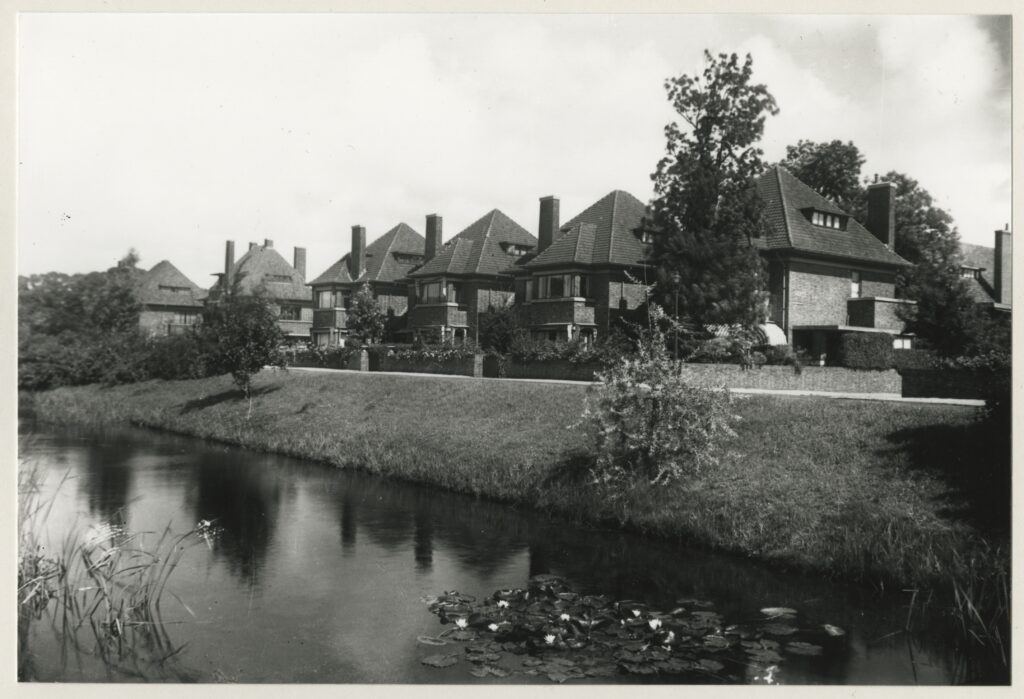
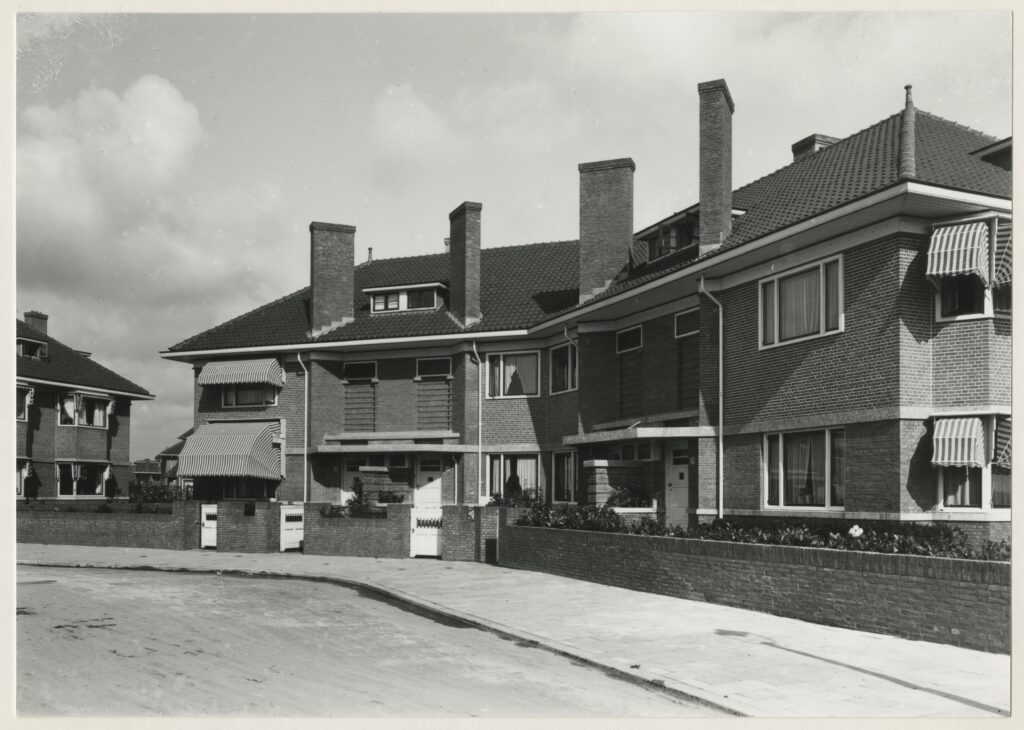
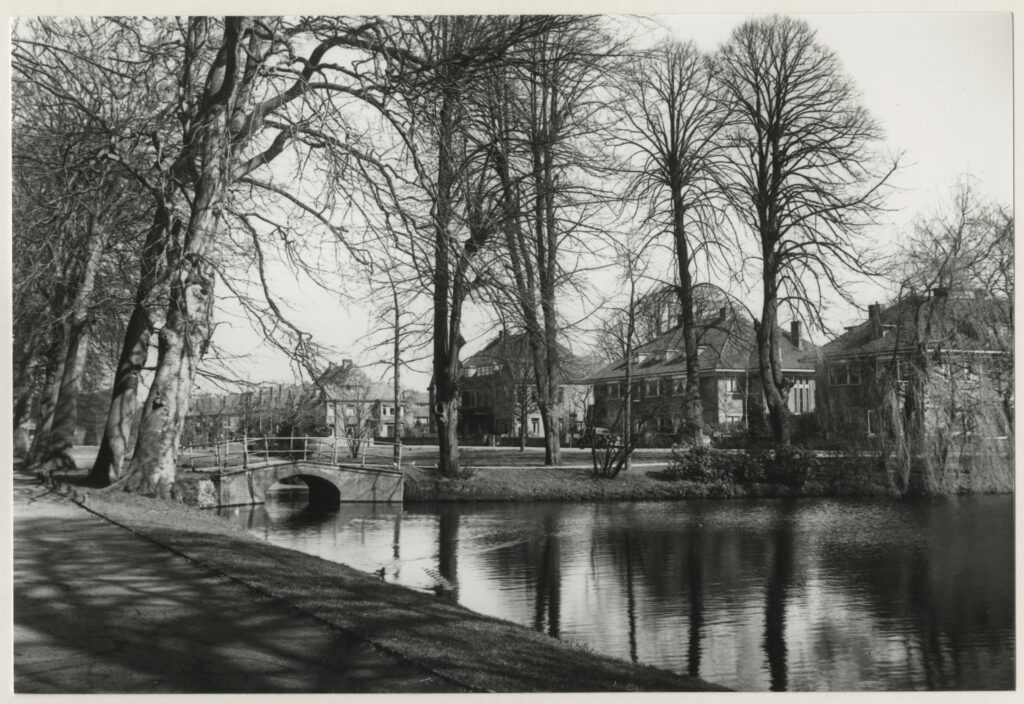
The residential park Marlot (1920/25) was laid out on an old estate adjacent to the former country estate of Reigersbergen. Together with the Haagse Bos, this forms a wooded zone on the beach wall. Adriaan van der Velde built a farm here in 1600, and in 1640, the estate passed into the hands of David van Marlot. The neoclassical manor house was only built in the 19th century, and the forest was transformed into a small English landscape park. The municipality bought the 91-hectare estate in 1917 for one million guilders, of which 36.5 hectares were leased for the plots of a chic residential park. Initially, a garden neighborhood like the Vogelwijk was envisioned, but afterwards, the buildings were found to be too messy, too fragmented, too diverse, and marred by too many garden fences and the backs of villas. Marlot had to form more of an aesthetic whole, a Gesamtkunstwerk.
In 1920, urban planners Ir. H.E. Suyver and W. Schürmann from the Department of Urban Development and Housing (Dienst der Stadsontwikkeling en Volkshuisvesting) designed an urban plan that involved separating the park and the manor house of the Marlot estate from the newly developed residential park with villas. This separation was achieved by a spacious meadow and a large pond. Two squares were created perpendicular to this pond, forming the heart of the district: Bloklandplein, featuring a Roman Catholic church, and Zuidwerfplein. The alignment of these squares created a grand entrance to the garden neighborhood. In the center of the squares, there was a lawn with trees.
The architects Brandes, Verschoor, and Hellendoorn designed the mansion-like villas even before there were any buyers. The number of candidates for Brandes’ designs exceeded that of the other two designers to such an extent that in 1925 it was decided to have Brandes design the remainder of the villa park. The villas were built in different shapes: solitary, semi-detached, connected to each other in different ways or as a residential urban block (Parkflat) around a communal court yard (white car parking). Each house had a front and back garden and a spacious private entrance. Evidently, the collectivist ideal of the commune applied only to the workers’ quarters.
All the buildings were made of deep red brick with steep roofs. The houses had beautiful and elegant exteriors with large roof overhangs. Adjacent to Marlot, there was the Parkflat. Brandes designed it to resemble a spacious manor house, complete with gates and a courtyard. The tower, symmetrical structure, and mirrored ponds created an atmosphere reminiscent of an English country house rather than an apartment complex. Here as well, the deep red brick and steep roofs were prominent. The courtyard featured a sunken area where cars could park in garages. The roofs of the garages were covered with vegetation. The residents of these flats were mainly rentiers who did not have any domestic staff.
During the war, a large part of the original design was destroyed, including the central restaurant. Residential Park Marlot became the most beautiful and successful example of Gesamtkunst in The Hague, in which the interplay of housing and urban planning was central and brought together as a whole; it was an exemplary project of the New Hague School (Bakker Schut, 1921) (Brandes, 1930).
Residential Park Papaverhof
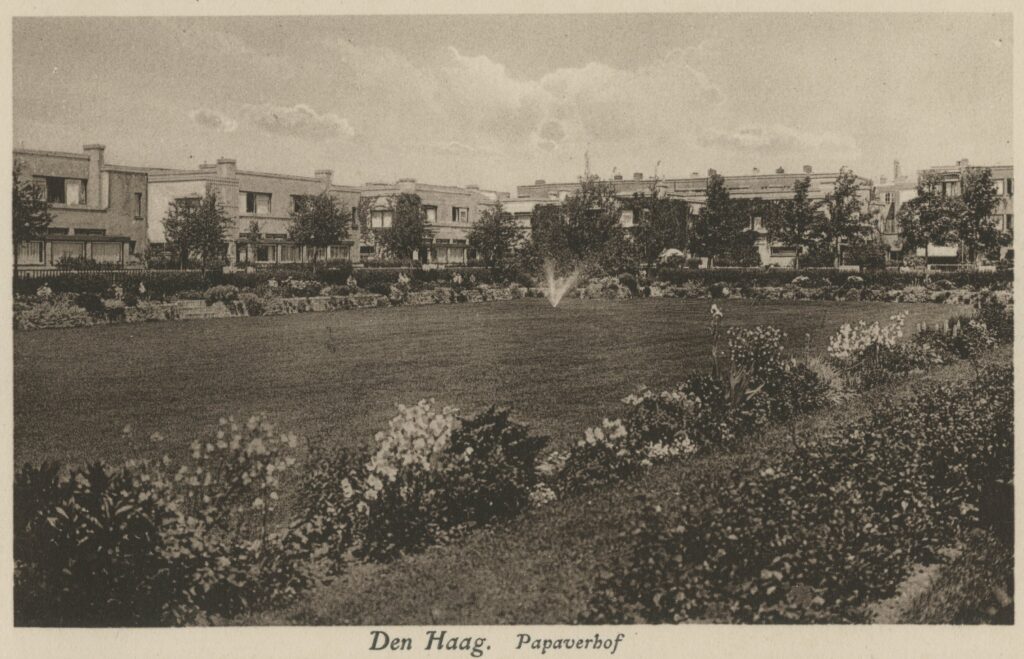
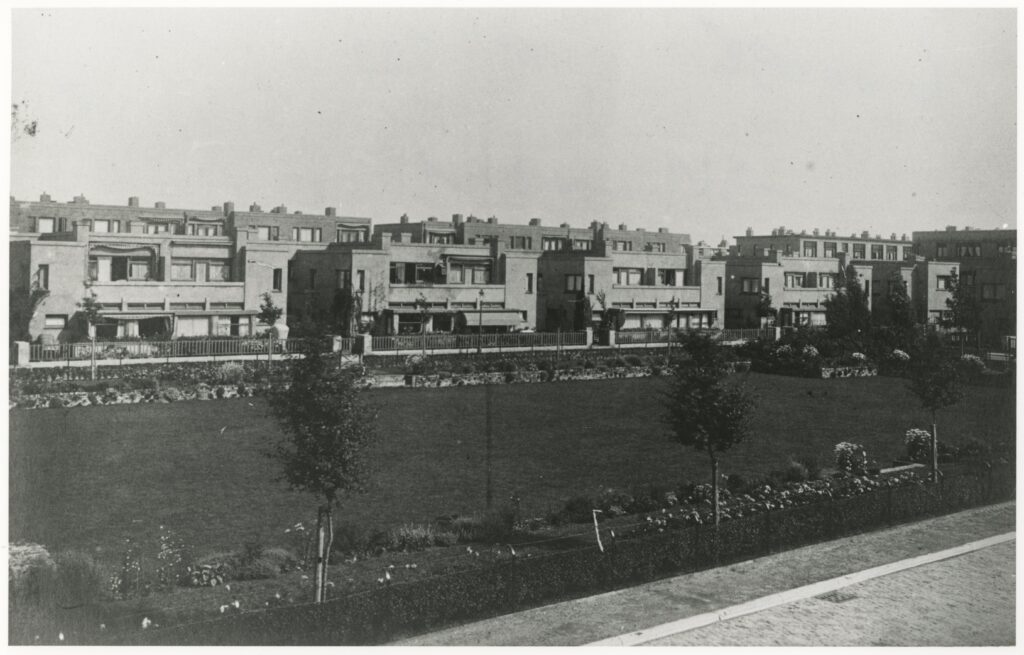
In the residential park of Daal en Berg, Jan Wils achieved a striking result through special typology, morphology, and material experiments with the Papaverhof (1921). There was a departure from the brick tradition, but perhaps the most significant aspect was the extensive development of the double block theme. However, Wils was not the first architect to work on Daal en Berg. On November 14, 1917, notable individuals from The Hague founded the Cooperative Housing Association Tuinstadswijk Daal en Berg (Coöperatieve Woningvereeniging Tuinstadswijk Daal en Berg) to construct a neighborhood with approximately a thousand middle-class houses between The Hague and Loosduinen.
Chairman became parliamentarian and The Hague councilor (1927-39) Van Beresteyn of the Liberal Democratic Union, while Berlage acted as commissioner. Initially, the board also wanted to organize a competition, but Berlage prevented this because he felt that a competition did not guarantee quality. He advised the association to find a young architect who ‘understands the spirit of modernity’ in order to stimulate the further development of modern architecture. Then, together with H. Fels, he compiled a list ‘of some names of architects, who, in their opinion, possess the ability to qualify for architectural leadership.’ This list included Granpré Molière, Verhagen, De Roos, Overeynder, Roosenburg, Van der Meijburg, and Noordlander.
The association commissioned Granpré Molière and Verhagen, who in July 1918 presented a plan that did not possess the Berlagian monumentality or ‘monumental townhouse building’ with urban blocks, but rather resembled Vreewijk in Rotterdam. In 1921, Granpré Molière would argue:
‘A garden city building, which would not be sufficiently rooted in the whole complex of relationships and aspirations that determine society, would eventually have to fail and thus arouse reactions on the other side. There is all the more reason for this because all the current garden village construction leaves certain aspects unsatisfied. There is, not least in Holland, a desire for unity and society in grand style, which seeks expression in a heroic monumental urban design. This aspiration is quite contrary to the ideas known to us and also seeks to establish a connection with quite different values. Initially, it adheres more to the existing schemes of the three- and four-story and also seeks to connect with what constitutes the greatness of our time: mechanical production.’ (Granpré Molière, 1949).
There was disappointment at the municipality, and Bakker Schut criticized this design. In response, he expressed the criticism as follows:
‘…that the architects have completely deviated from the expansion plan that was provisionally adopted by the Municipality for the city quarter in which the proposed land is located. Even the main roads, which were designated as fixed, have not been retained, and the road to the hospital, in particular, should definitely be followed as projected in the expansion plan. Moreover, the streets are too narrow, and Bakker Schut finds it uneconomical that the diagonal street, which is naturally suited for the better houses, was not considered. Instead, only gardens and the end facades of the houses that have their main facades on the cross streets were proposed’ (Bakker Schut, quoted from Bergeijk, 2007: 46, 47).
Whether Bakker Schut was justified in his criticism remains to be seen; however, the symmetry and monumentality were missing from the plan for the current Goudenregenplein by Granpré, Molière, and Verhagen. The low housing density on these plots, only 1,000 (of which 654 are solitary homes and 446 are upstairs and downstairs apartments), will also have been problematic for the financing of the public housing ambitions of Bakker Schut and the SDAP. In addition, the municipal council wanted all new housing estates to be given the same character as the already completed neighborhoods east of this canal. On July 2, 1919, Van Beresteyn decided to abandon this plan of Granpré Molière and Verhagen altogether. The site was divided among several architects and was built with a much higher density.
For the most representative and monumental part of Daal en Berg, they wanted a new architect from The Hague. Jan Wils, a Voorburg architect, was ultimately chosen. As a member of De Stijl and an admirer of Frank Lloyd Wright, Wils was considered one of the most modern architects in the Netherlands. Two years prior, he had published a series of articles in the architectural magazine De Opmerker, focusing on the garden city concept. On October 22, 1921, Wils unveiled the Papaverhof, an ingenious variation of the double urban block that had previously been constructed in Molenwijk and Duindorp.
The houses were not allowed to cost too much, so Wils was tasked with maintaining a lot of greenery and flowers to give the complex a garden city feel. To achieve this, he arranged the houses in rings around a sunken park/courtyard measuring 70 x 100 meters. The complex consisted of 128 middle-class homes, with 60 being storey homes and 68 being family homes. To keep costs low, Wils constructed the 68 single-family homes as compactly as possible, positioned around the park/courtyard. These houses were built closely together, but interconnected in a way that allowed access from both sides, fully utilizing the surrounding greenery. He derived this concept from the 1918 booklet Vom sparsamen Bauen by Peter Behrens and Heinrich de Fries, which aimed to save money and prevent monotony without sacrificing individualism. Frank Lloyd Wright’s Lexington Terraces in Chicago also served as an inspiration (Cooperatieve woningbouw-vereeniging tijdstadwijk ‘Daale en Berg’ te ‘s-Gravenhage en haar eerste bouwplan ) (Wils, 1922) (Franso & Freijser, 1989) (Bergeijk, 2007).