
Cityscape of international significance and allure 1935-1965
‘ … that it used to be and that, we hope, it will soon become again: the city of international significance and allure.’ (Mayor De Monchy, Acts of the City Council of 3 December 1945: 12)
The green village character of The Hague 1933
The rediscovery of local character
On July 10, 1933, following a proposal from the college, the council decided that the draft expansion plan for the southwestern part of the city should be handed over to a competent urban planner. However, the very elderly Berlage renounced his advisory role. The Association of Dutch Architects (BNA) put forward the Hilversum architect Willem Marinus Dudok (1884-1974) as the new city architect for The Hague. A year later, in 1934, The Hague also got a new mayor; the conservative liberal Salomon Jean René de Monchy (1880-1961). Van Gelder, a friend of Berlage and party ideologist of the SDAP, rhetorically addressed the question of ‘individual character’ (Van Gelder & Deventer, ed. 1934). Wils, who took on the architectural part of Van Gelder’s books, argued about the character of The Hague:
‘The Hague was and still is partly a great garden city.’ … ‘The Hague can still be called ’the Green City of the West’. In many streets and even in entire neighborhoods, the trees and greenery dominate the cityscape and give it a soothing rest.’ (Van Gelder & Deventer, eds. 1934: 53). In addition to its green character, Van Gelder also described another quality: ‘There is a second characteristic, which determines the typical city character of The Hague. It’s the predominantly low buildings.’ (Van Gelder & Deventer, eds. 1934: 54). In 1934, Wils advised on future developments: ‘It was undoubtedly an obvious and attractive idea to implement the method of low buildings in the expansion, with the beautiful cityscapes of the city center in mind and based on the tradition that gave The Hague the nickname of ’the largest village in Europe’. Park-like wide roads and, above all, that abundant stock of tall trees and beautiful dune parks almost attracted and forced low houses. Nature had to be the dominant element in the new city.’ (Van Gelder & Deventer, eds. 1934: 56).
According to Wils: ‘Characteristic of The Hague are the many villa parks and garden city districts’ (Van Gelder & Deventer eds. 1934: 58). Especially Marlot of the architect Brandes and the garden city Houtrust (now Vogelwijk) of the architect Verschoor were seen as examples for the new development, but the highlight for Wils was the villa park Zorgvliet that the German urban planner Henrici had worked on. Despite the idea that De Monchy, Vrijenhoek, Wils, and Dudok had about the green village character, The Hague was in a deep hibernation and hardly any construction was taking place.
The choice of Dudok as city architect was a deliberate decision that was influenced by his views on urban development. The architect-alderman of the SDAP, Vrijenhoek, highlighted the contrasting characteristics with Amsterdam. However, Dudok’s position also played a crucial role. It seems that Berlage’s advisory role was no longer desired.
‘The Hague doesn’t have a metropolitan allure. Monumentality will not be achieved at all, or only sparingly: ‘The Amsterdam School’, closely related to the leadership of the BNA, is not the compass on which to set course here. The Hague has its own personal character, and when Dudok is seen as the man who will turn that around, I must warn: that will end in failure! It is in that light that my recommendation of Dudok by the BNA must be viewed. And then the great question remains, which still needs to be answered: Can anyone arrange for the future expansion of the city, which is a continuation of the historical development of our city? … Berlage’s position was a completely different one! That was the position of a consultant, and here we are explicitly dealing with the position of a designer. … It was also clearly stated in the Build-up Report: we have to get rid of the advisory role. We need to have a responsible designer.’ (Vrijenhoek quoted by: Freijser & Teunissen 2008: 76)
With the construction report, Vrijenhoek refers to ‘The Development and Construction of The Hague (1931-33). Relations between the old master builder Berlage, Dudok, and his friends Wils and Oud were good. Wils worked at Berlage’s office, while Oud and Dudok carried out various projects together. Dudok even intended to establish an agency with Wils after World War I. At Berlage’s urging, Oud spent several months studying under Theodor Fischer in Munich, one of Germany’s most experienced urban planners. Fischer emphasized the importance of achieving an aesthetically pleasing cityscape, with one of his principles being ‘die Steigerung des Charakterischen,’ which focused on highlighting the unique elements of a city or district. This principle would also become one of Dudok’s guiding principles, as he always aimed to design with the character of the specific city in mind (Van Bergeijk 1995:17).
The influence of the Hamburg architect Fritz Schumacher on Dudok’s thinking was also considerable. It concerned the positive effect of schools on the ‘Charakter der anonymen großstädtischen Massenbauten’. Following Schumacher’s example, Dudok wanted his schools to spread culture among the broad masses of the population (Van Bergeijk 1995: 28). As the great museum reformer, Van Gelder had been committed to the elevation ideal of the SDAP for years. In his view, the museum had to be brought out of isolation and made accessible to everyone. This was similar to the ideas about ‘Neighborhood Units’ of the conservative Clarence Perry (1929, 1939) a few years earlier in America. Schools and churches were the beating heart of every neighborhood. Dudok was seen as a supporter of the new housing culture as propagated in Germany and Anglo-Saxon countries, in which a strong anti-urban attitude can also be found (Van Bergeijk, 1995: 102).
Analogous to the human body, for Dudok, the city is an organic whole in which there is a logical connection between the parts. This whole must be developed harmoniously and in a controllable manner. Bad spots should be removed and filled in with healthy ones. Above all, care must be taken to ensure that the city does not grow wildly and destroy the surrounding landscape. This is the task of the urban planner, who must first and foremost act as a technician but also ensure that his expansion plans create the possibility of a beautifull city.
Dudok wanted to strengthen the open green village character, not sharply demarcate the city and reinforce the long lines with through roads extending beyond the city. He wanted to maintain and enhance the typical green character of The Hague. Berlage, too, had this intention with his plan from 1908. The starting point to achieve this beauty is the individual character of each city, which can be discovered through an analysis of its historical growth.’ (Van Bergeijk, 1995: 68). This shows the influence of Patrick Geddes (1915), the founder of the ‘regional survey’ and of Fischer. The essence was that the urban planner should first understand the spirit of the city, its historical essence. According to Van Bergeijk (1995: 81), this was the local character that Dudok spoke of in his explanations.
Dudok further developed the characteristics of The Hague from the seventeenth century, particularly emphasizing the open connection of the city with the surrounding land to create a green continuum. This, combined with the low-rise buildings, helped to create a typical village appearance. During the Golden Age, The Hague had always been an open village with stone roads leading to pleasure gardens in the area. The city did not have sharp boundaries of fortifications or city walls. The transition was made smoother by the wide green strips between the neighborhoods and by reinforcing the natural orthogonal structure.
Furthermore, Dudok adopted the urban planning method of Lindo and Berlage: neighborhoods and districts were laid out in a web of motorways (parkways) and tram rails. Residential areas were turned inwards with their own enclosed squares (like the neighborhood unit of Perry). Like Berlage, Dudok wanted to open up the old city further by means of breakthroughs. Dudok opposed stylistic architecture and the copying of historical styles and orders and defended modernism with its objectivity and functionalist principles and its crystalline space art, in which a composition of masses, planes, and spaces in between gave beauty to the buildings, the interiors, and the urban space. Although it had to take utilitarian requirements as its starting point, it had to rise above the question of utility and make possible a ‘characterization of the ideal meaning of the building’. (Van Bergeijk, 1995: 16).
In Dudok’s eyes, the characteristic feature was the connection with history. The traditionalism in Dudok’s work was not concerned with imitating historical styles but stemmed from the view that architecture is a spatial art that embodies traditional and universal values. Architecture had to possess eternal value and be able to express an idealistic meaning (Van Bergeijk, 1995: 121). Dudok was considered the right man in the right place in The Hague; everyone believed that only he could enhance the village and green character of The Hague.
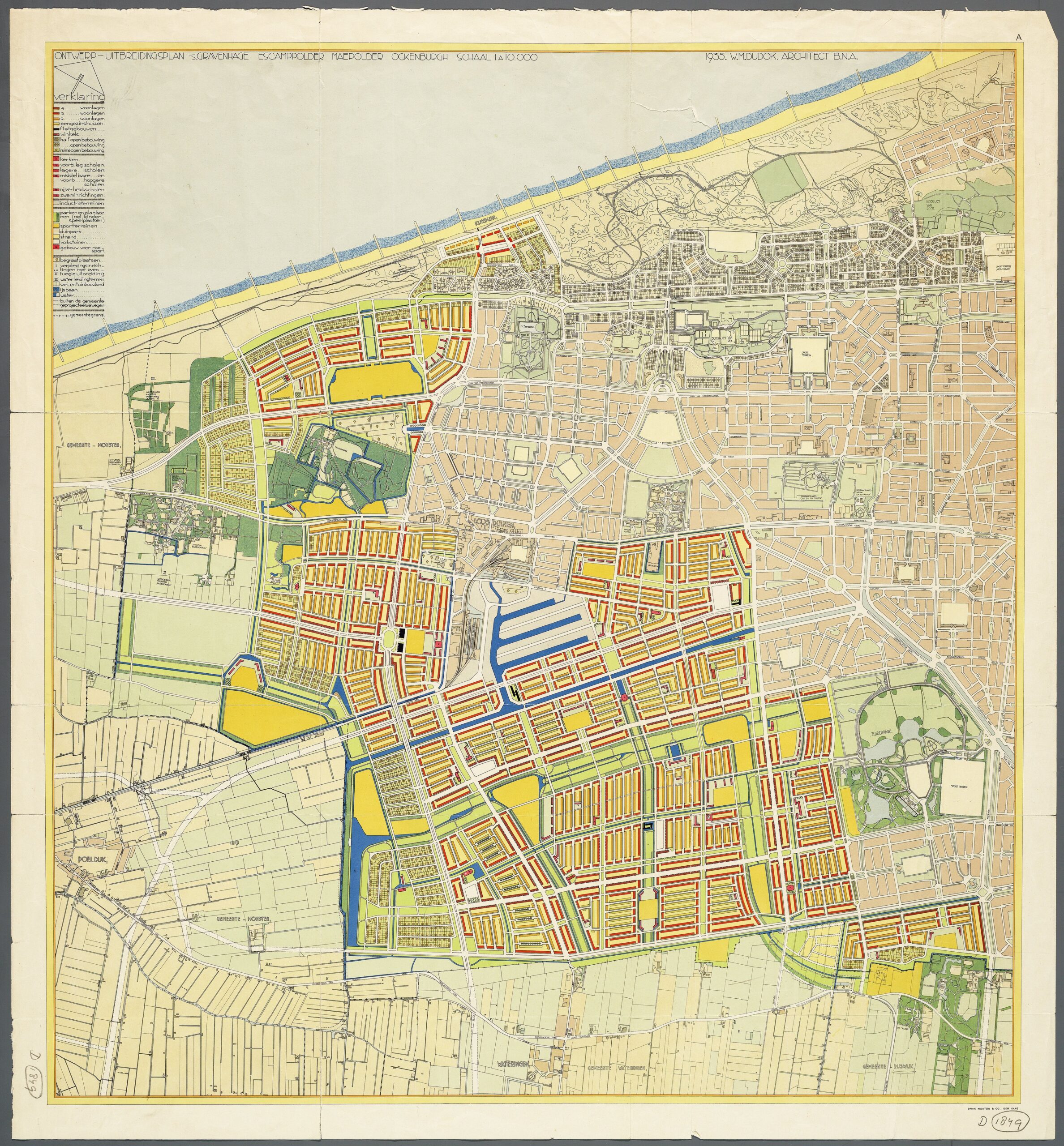
Expansion plan Escamppolder Maepolder Ockenburg 1935
In the 1935 Draft Expansion Plan for The Hague’s Escamppolder, Maepolder, and Ockenburg (the expansion plan for The Hague Southwest), the idea of perimeter urban blocks and monumentality was abandoned, and the concept of a green continuum was emphasized (HGA z.gr.1849). In a memorandum from 1936, Dudok further explained the plans (Dudok W. , Nota van Toelichting op het Ontwerp-Uitbreidingsplan voor het Zuid-Westelijk gedeelte der Gemeente ’s-Gravenhage [Escamppolder, Maepolder en Ockenburg], 1936), stating that:
‘The Hague is first and foremost a residential city: a city that owes its origin and development mainly to its beautiful location. Forest, sea and dunes, and inland: in the Middle Ages, a beautiful Dutch landscape made the counts of the country choose this place as their place of residence. This regal example has been followed by many thousands over the centuries. … In the further development of the city, every effort will have to be made to highlight the advantages of its location, or at least to preserve them.’ (Dudok, 1936: 3)
For Dudok, the forest and dune landscape were preeminently the areas for relaxation, recovery, and upliftment of the urban population. According to Dudok, the expansion of the city does not require the loss of natural beauty. He believed that the main characteristics of The Hague are the grid street pattern that follows the geomorphology of the landscape. This grid pattern is the most obvious choice for a motorway network. The residential, recreational, and working areas are separated by residential streets within the pattern of the traffic routes. The facilities such as sports and relaxation areas, as well as greenery, are located in the residential areas. The open urban blocks are relatively long, spanning more than 300 meters, in order to save on expensive road surfaces. The design of the building profile and block direction ensures optimal fresh air and sunlight in the houses. Dudok proposed four floors along main traffic roads, three floors along green lanes, and two floors in residential streets. High-rise buildings of 10 to 15 storeys were also planned for suitable points in the district. For Dudok, the urban block is the scale of architectural unity.
In his explanation, Dudok specifically mentioned the book De Hedendaagse Stedebouw (1912) by the mayor of Utrecht, Dr. Fockema Andreae, with his reflection on the beauty of cities and their monuments from the past. In his explanation of the green continuum, Dudok argued that: ‘I have thought that I would achieve the greatest effect and the greatest possible freedom to adapt to changing needs by uniting the useful and beautiful greenery in one system. This system should organically permeate the plan, reaching the residents everywhere and vice versa, drawing them from all points.’
In these post-war lectures, Dudok emphasized the importance of incorporating green recreation areas into urban planning. He referred to the systematic veining of the stone city with green spaces as a modern element of contemporary urban planning. Dudok believed that the need for sunshine, greenery, and relaxation near urban homes is an essential aspect of modern living (Dudok, 1950, 1951) (Leeuw-Roord, Rijven, & Smit, 1981). On his seventieth birthday, Dudok reiterated this message, stating that the systematic use of recreational strips that penetrate the city like veins is also a characteristic feature of modern urban planning. Regarding the expansion plan for Southwest, construction had been delayed for several years due to the crisis in Europe. Finally, in 1949, sub-plans such as the second part of Moerwijk (West, East, and South) and Morgenstond were implemented. The first part of the Moerwijk Expansion Plan from 1929, known as Moerwijk-Noord, still followed the tradition of perimeter urban blocks used by Bakker Schut and Berlage. Dudok also discussed the relationship between open green spaces and open urban blocks.
‘I have never been a particular advocate of urban building strips, and I do see some advantage for the residents in the greater intimacy of a rear side. However, my heart goes out to the open and to the great and beneficent systematicness in the development of greenery, in which the greenery within the open urban block can certainly also be involved. I no longer accept the perimeter urban block, with its oppressiveness in the corner solution, in our time. But apparently, there is still a difference of opinion about this in our small country. It is not inconceivable that such differences will be able to live side by side and build a good enlargement plan together into a satisfactory whole. In my city plan for The Hague, for example, I offered a well-considered opportunity to do so.’ (‘Reflections on the work of the Study Group for Post-War Housing’, June 1943, quoted by Van Bergeijk, 1995: 115).
Dudok’s connection with history was a theme that had faded away since the fall of Cuypers and De Stuers with the new ideals of modernization in the interwar period, but it took shape again in The Hague with Dudok, Vrijenhoek, Van Gelder, Wils, and De Monchy. Perhaps the crisis years made us dream of better times. It was only after the war that the layout of what would later be called The Hague Southwest would really begin.
Aesthetic committee curtailed, De Monchy's power politics
‘My all-around green neighborhood / My never enough praised Haegh’
Van Gelder began his much-praised book: ‘s-Gravenhage 1935-1945 hoe het was, werd en worden moge (1946) with the above-mentioned quote from Constantijn Huygens, he described the green village character and the future development of The Hague.
However, the collaboration between the city council and the easthetic commission had cooled. The architects were no longer automatically serving the interests of Bakker Schut and his department, which caused resentment among the municipal executive (HGA bnr 828-01 Municipal Council 1953-1990 Inventory number: 10030). Opinions on the appearens of buildings in the council often differed. In a letter dated April 3, 1936, the munciplaity executive proposed to reorganize the easthetic committee (schoonheidscommissie) into a quality committee (welstandscommissie).
It was believed that this committee should have a diverse composition and should not be an administrative body. In a letter also dated April 3, 1936, De Monchy and municipal secretary Boasson explained the transition from an easthetic committee to a streamlined and limited quality committee. The alderman for Urban Development and Housing at that time was Vrijenhoek. The number of committee members had already been reduced from nine to six, and the mayor’s proposal further reduced it to three.
Although there was hardly any construction during the crisis years, there was still some activity. The municipality executive did not want to dissolve the entire committee, but councillor Guit submitted a motion to immediately abolish the entire committee. Some councillors, however, wanted to limit the committee’s powers with a second motion (HGA bnr 828-01 inv.nr.10030: Proceedings of the council, May 4, 1936). The old easthetic committee consisted of Mr. J.F. van Royen, A.J. Kropholler, B.C. van den Steenhoven, D. Roosenburg, Ir. A.H. van Rood, and H. Hoekstra. The last three would not be replaced until May 1, 1939, and the first three on May 1, 1937 (HGA bnr 828-01 inv.nr.10030: Correspondence municipality and architects and organizations).
The mayor and secretary argued in the letter that an aesthetic assessment could also be conducted by the officials of the BWT service (with the eternal rival of Bakker Schut, G. Meijer, leading the way) and that this could reduce delays and improve efficiency. Changing the members of the committee more quickly was also seen as a strategy for the board to diminish the influence and power of the committee: ‘In cases where there is a need for information, a small committee consisting of three construction experts, as mentioned above, could suffice outside the official context. They should be replaced periodically to prevent rigidity of opinion.’ (HGA bnr 828-01 inv.nr.10030: Letter of 3 April 1936 from De Monchy and Boasson: 1,2).
The municipality executive also proposed that the director of the Building and Housing Supervision Service determine which plans should be submitted to the committee for assessment. Not all plans were submitted to the committee in this way. Only after the pre-selection process did the committee issue a direct recommendation to the municipal executive. According to the proceedings of May 4, 1936, Councilor Van Beresteyn of the Vrijzinnige Democratische Bond (VDB) summarized the situation as follows:
‘As far as the matter itself is concerned, the whole history of the quality and aesthetic scheme has such a bitter aftertaste that, in the end, one does not get where one needs to be with this committee. Aesthetics is not produced by refusing what is ugly, but by architects who understand their profession; I am not saying that one should not say, ‘We do not have to keep out what is ugly, but we must not imagine that we are doing what we can with it’.’ (HGA bnr 828-01 inv. nr. 10030: Acts of May 4, 1936: 341).
There were doubts among council members as to whether it would be okay if all powers and tasks were shifted to the Building and Housing department and the aesthetics committee’s implementation was limited. Van Beresteyn also expressed his concern: ‘I am afraid to give such great power to Building and Supervision. It may not be that bad, but I’ve seen a few cases in which people said: it’s rubbish, it rattles all the way. If you want to know exactly what it’s all about, you only hear a few general terms, and I don’t think that’s right.’ (Ibid.: 342).
The quality would no longer be included in expansion plans, but Van Beresteyn objected to this: ‘Finally, a remark about the opinion of the minority of the committee, who are of the opinion that this quality committee should also judge and advise on the construction of the city. I also think it is of much greater importance that an extension plan meets the requirements of aesthetics than some house in a back street.’ (Ibid.: 342).
De Monchy, Vrijenhoek, Bakker Schut and Dudok thus seized power and gave Dudok space. In the future, the tasks of the quality committee would mainly focus on the buildings designated by the director of the service. This narrowing also meant a cutback; the committee no longer needed a separate office and secretary. Van Beresteyn also noted that the mayor and aldermen simply ignored the implicit criteria used in the assessment.
‘I now come to the main point, which gives me cause to earnestly warn against this system. My main objection to this is that the Mayor and Aldermen are extremely prone to overlooking the question of when something is contrary to quality.’‘ (Ibid.: 342).
The committee had to be able to justify a rejection, according to Van Beresteyn. This was prescribed in the old regulation, but it did not happen. Councillor Vliegen noted that this new lay out of the building was related to the arrival of Dudok in The Hague. He argued, ‘May I remind you that we have appointed Mr. Dudok, he is at work after all. At least we had a lot of expectations when he was appointed, and to put a committee above him now, where is the end? We’ll have to wait and see what comes of Mr. Dudok.’ (Ibid.: 347).
When looking for members for the new quality committee, the municipality reached out to various organizations to gather nominations. However, several important organizations were dismissive of these efforts. In a letter dated September 17, 1936, the BNA expressed its objection to the way things were being handled and refused to cooperate further in appointing members to the quality committee.
More protests from the city
The resistance was not limited to architects and council members. In a letter dated 16 September 1936, the Algemene Katholieke Kunstenaars Vereeniging also objected to this change: ‘… it seems to us that the Committee to be set up has very little say, but gives the impression to the outside world that it bears full responsibility for the interpretation of the quality provisions of the Building and Housing Regulations.’ She, too, did not want to make any proposals for members of this quality committee.
The Haagsche Kunstkring also strongly objected in a letter on September 8, 1936, refraining from cooperating with the municipality and refusing to nominate any members. Only the NIVA (Netherlands Institute of Architects) came up with a proposal. The Haagsche Architecten Club with ir. H. van Vreeswijk and W. Verschoor wanted to submit their own proposals and they requested a postponement in a letter dated August 18, 1936. After eight people were finally nominated, the director G.A. Meijer of the Municipal Building and Housing Inspectorate responded in a letter to the municipal executive on September 29, 1936. He stated that, in his opinion, only ir. H. van Vreeswijk would be suitable for the position.
In the end, Ir. A.H. van Rood, D. Roosenburg, and H. Hoekstra were appointed as members of the quality committee. As reserve members S.J. van Emden, J.W. Janzen, and Ir. H. van Vreeswijk were appointed. On April 1, 1937, the aesthetic committee was definitively changed into the quality committee. In a letter to the alderman dated 5 March 1943, a schedule was created outlining the resignation dates for members. Hoekstra: 1 April 1941, Roosenburg: 1 April 1943, Janzen: 1 April 1945. In 1941, Van Emden declined the position. The archives did not indicate why he resigned or whether this was related to his Jewish background. In April 1943, the NSB municipal executive abolished the quality committee and transferred its responsibilities to an ‘Advisory Council on Urban Expansion and Architecture’. Finally, two Hague architects from the Haagsche Architecten Club, H. van Vreeswijk and M.F. v.d. Gugten, who were both NSB members, were appointed as members of this council. The chairman of this council was dr.ir. G.A.C. Blok. After the liberation, this council was disbanded (HGA bnr 828-01 inv.nr.10030: Regeling inzake de toepassing van de welstandsbepaling der bouw- en woonverordening voor ’s-Gravenhage).
For an architect from The Hague like Roosenburg, who received few commissions as an independent architect in The Hague, the power politics of the communist hunter De Monchy (Harthoorn, 2011), with Bakker, Schut, and Dudok in the background, must have been experienced as offensive, to say the least. After the war, the conflict would take on grotesque proportions in the discussion about the future of the city. The cityscape in the minds of the interwar politicians, urban planners, and architects would come to be at odds with the ideas of a young guard with their own vision of images and the city. Dudok and Roosenburg played a central role in that conflict, and that conflict had more layers. At that time, the major expansion of the Escamppolder, Maepolder, and Ockenburg in what is now The Hague Southwest had yet to begin.
Post-war population pressure and housing shortage 1946-49
The Netherlands to 20 million inhabitants in the year 2000
During the crisis years and the war, The Hague was in a state of urban hibernation. In 1930, The Hague had 432,680 inhabitants, which rose to 520,875 inhabitants in 1942. However, a steep decline followed, and by 1945, the city only had 450,949 inhabitants. Due to the construction of the Atlantic Wall, parts of the city along the coast were evacuated, and Bezuidenhout suffered from a mistaken bombing. The war damage resulted in the loss of many beautiful neighborhoods and thousands of homes. Consequently, The Hague lost its former status as a chic and pleasant city, becoming a problem city with a housing shortage and a weak economy, which would remain vulnerable in the long term.
After the war, there was an explosive growth in the population. In 1947, there were already 523,703 inhabitants, in 1950, 558,849 inhabitants, and in 1959, the peak of 606,826 inhabitants was reached. After that, things went downhill for The Hague and its population size. The turbulent growth of new buildings in The Hague took place between 1950 and 1960 in Zuidwest and, after 1960, in Mariahoeve.
Despite the escalating conflicts, the cityscape of international significance and allure was realized there, especially in Mariahoeve. It became an iconic urban ensemble where all the lines came together during this period. The need to do something radical was great because it had been calculated that the Netherlands might have 20 million inhabitants by the year 2000. The Hague would have to absorb a part of that population. The conflict between Dudok (as the right-hand man of the city council) and Roosenburg (as foreman of architects and corporations in The Hague) focused on the question of what The Hague should look like in the future.
If Dudok’s ideas are the thesis, then The Plan 2000 is the antithesis, and Mariahoeve is the synthesis of mature urban planning and architecture. Dudok and Bakker Schut worked on the structure plan for The Hague, but in 1946 five young ambitious architects from the Roosenburg office, among others, presented a counterplan: The Plan 2000. It was a radical and impracticable student plan that incorporated all the novelties of urban planning and therefore seemed very useful for The Hague. Finally, this resulted in a synthesis of Mariahoeve where the ideas of Dudok and the CIAM came together again in a new relationship.
Thesis: De Monchy and Vrijenhoek's dictate to the council
Administrators such as Mayor De Monchy and former Alderman Vrijenhoek wanted to continue as they had been accustomed to before the war. They likely tasked Dudok with creating a reconstruction plan in late 1944 (Sluijs, 1989: 12,13). This plan focused on restoring the parts of The Hague that were devastated during the war, as well as proposing changes to the existing city area and creating new expansion areas. De Monchy, Vrijenhoek, and possibly other trusted members of the bourgeoisie were involved in the commissioning process. Dr. ir. Z.Y. van der Meer, a civil servant who would later become a member of the national Board of Commissioners for Reconstruction, was also likely involved (Sluijs, 1989).
After the war, the reconstruction of The Hague was discussed in the newly installed council on 3 December 1945. The regentious course of events of De Monchy and Vrijenhoek was met with quite a bit of criticism. Councillor Mrs. Bouma-van Strieland (PvdA) argued about the importance of the reconstruction plan: ‘If there is one thing now, after this war, that we can all agree on, it is that family life will have to be renewed and deepened. In my opinion, we can attribute the general depravity of our youth, the decline in the moral level, to a large extent to the dismemberment of families, to the fact that it is not possible, or only to a limited extent, to have a regular family life in a closed family, in a home of their own, in which the family can live as intimately as possible.’ The councillor argued that it was necessary to expand the advisory committee to include women, as they are ultimately the first to be involved in the design of the new homes to be built. The council member also advocated involving housing corporations in this advisory committee. The nine corporations in The Hague housed a total of 150,000 inhabitants. Furthermore, according to the council member, it was desirable for council members to be included in this advisory committee. For example, there could be more contact between the advisory committee and the council. Bouma-van Strieland also asked who had commissioned the architect Dudok to draw up a general construction plan.
It was revealed during the council debate that the municipal executive had already made the decision to do so, shortly after the war when the council had not yet been installed. It also became evident that it was not the municipality that had invited Dudok, but rather Dudok had invited De Monchy and Vrijenhoek to discuss the reconstruction of The Hague. Further investigations revealed that the municipal executive had commissioned Dudok to design a General Reconstruction Plan for The Hague, and on July 17, 1945, an advisory body was established by the municipal executive to provide guidance to Dudok. This advisory committee included representatives from the state, the municipality, and various groups such as the middle class and industry.
Other council members also suggested changing the members of the advisory committee. The objection raised by councilor Van Praag was: ‘… Is it really desirable that not only the plans for urban expansion, but also for the improvement of the city, the solution of various old problems, in which the whole of The Hague, which has been so violated, is being rebuilt, should be placed in the hands of a single architect who works together with the Mayor and Aldermen?’
Van Praag argued in favor of involving the architectural community of The Hague. These architects were also not represented in the advisory committee, even though they had to carry out the plan for the most part. Representatives from the architects’ organization in The Hague should be involved in the development of the plans in consultation with them. Council members voiced their criticism of the closed nature of the advisory committee on urban planning and called for more openness and citizen, colleague, and council involvement.
The mayor didn’t think it was necessary to expand the committee. De Monchy gave the assignment to Dudok and wanted to keep the advisory committee as narrow as possible, with broad powers for Dudok and the committee, without involving The Hague’s architects, housing corporations, and housing consumers. The directors of Municipal Works and Urban Development were represented in the committee. De Monchy argued:
‘On the other hand, I would like to give the committee a very broad authority with regard to the various questions, and this includes not only the construction of the destroyed districts and the expansion of the city outward, but also internally: the improvements that must be made in the city, the reconstruction of The Hague as necessary to regain its former status as a city of international significance and allure in the coming decades. We hope that The Hague will soon become once again the city of international significance and allure.’
The international significance and allure that De Monchy spoke of could only be realized with Dudok as a figurehead, but there was little support among the council and the architectural community in The Hague. Mayor De Monchy emphasized that Dudok was an architect of international stature and that he knew The Hague well. De Monchy and the municipal executive would have preferred one architect to be on the advisory committee (also known as the ‘urban planning committee’) to exchange ideas with Dudok about the plans, but it was eventually decided to set up a contact committee of five architects. But the council eventually decided on a contact committee of five architects. However, the mayor immediately indicated that, ‘… We didn’t want to commit ourselves to associating with the architects as consultants…’
In consultation with the local BNA circle, five architects were proposed, called The Council of Five, who were assumed to carry out the reconstruction plans for a large part. This council consisted of: Kees Abspoel, Julius Luthmann, Dirk Roosenburg, Romke de Vries, and Henk Wegerif. The last architect, in particular, stood for the line De Monchy, Vrijehoek, Van Gelder, Dudok. However, this sounding board group of authoritative architects from The Hague was ignored by Dudok.
During the debats in the city council on December 3, 1945, the mayor gave the impression that the architectural community of The Hague had resigned itself to this situation. In this way, the mayor, aldermen, the Department of Urban Development and Housing, and Dudok were diametrically opposed to the council, the citizens, the housing corporations, and the architectural community in The Hague.
The later director of the service, and then still young urban planner, Van der Sluijs, outlined the relations between the Department of Urban Development and Housing and the architects in The Hague at the time of the conflict. He explained that the architects in The Hague were unpleasantly surprised by the assignment. They had hoped to finally be able to work on their own city. The pioneers of the Kring Den Haag of the Association of Dutch Architects (BNA) had little appreciation for the Department of Urban Development and Public Housing. Likewise, the department seemed to have little appreciation for the architects. The service systematically passed them by, except when it had specific commissions to give. For example, the department, which also included the municipal land company, issued land on a long lease with the condition that the buildings would be based on a sketch design provided by the department. The architect Co Brandes, who was from The Hague, had by far the lion’s share of these sketch designs. However, his close collaboration with the many self-builders in The Hague, and his only provision of drawings required by the Building and Housing Inspectorate, made him little appreciated by his colleagues. As a result, large parts of Marlot and Bohemen-Geest van Gogh were created. (Sluijs, 1989:13).
Many architects from The Hague were deliberately excluded by P. Bakker Schut. Vrijenhoek did not become an alderman after the war; his old post was taken over by alderman Feber in 1945. In 1947, De Monchy resigned as mayor and was succeeded by Willem Visser of the Christian Historical Union, who had to resign in 1949 because of a foreign exchange affair. De Monchy, the administrator who supported Dudok, was no longer by his side. It was time for a reckoning. The conflict deepened, and Dudok and Bakker Schut found themselves alone with the service.
Antithesis: The Plan 2000
Two ideas about cityscapes came into sharp contrast: the ideas of De Monchy and Dudok about the continuation of the past and the character of the city (supporters of the Schoone Stad), and the new insights according to the CIAM with their own supporters. Given the housing shortage and war damage, it was not surprising that after the war, the debate on this subject became emotionally charged. Reconstruction was high on the agenda. The discussion between Dudok and Roosenburg was not only about stylistic differences (brick or concrete, brown or white), as is often posited with great aplomb in architectural books or about personal issues. In the discussions, it became clear that completely new insights had emerged in the field of urban planning to meet the presumed explosive growth of the population. Reconstruction was an urgent issue and also a great opportunity to realize old ideals or to test new ideas (Freijser et al., 1991: 113). Perhaps the new cityscape was the continuation of the old.
Dudok biographer Van Bergeijk spoke of a cliché that had been portrayed by, among others, Van den Broek and Le Corbusier: ‘The orthodox modernists stumbled over the freedoms that Dudok allowed himself. The form would have been elevated above the function. The technology of building would not be sufficiently public.’ … ‘But the view of Dudok as a late romantic is more than ever a cliché, which was only used to obscure his significance and his architectural qualities’ (Van Bergeijk, 1995: 7).
The terms ’traditionalists’ and ‘modernists’ were often used because they were the names of those movements during that time period. However, both cityscapes had unmistakably emancipatory intentions within their context and can both be seen as variants of modern architecture and urban planning (Van der Woud, 1997).
Architects in The Hague have long debated the distinction between the ‘brown or brick modernists’ and the ‘white modernists’. This comparison contrasted the modern movement of the interwar period with the modern post-war architects. However, this contradiction is flawed, as evidenced by documented reconstruction projects in The Hague that utilized a substantial amount of brown or yellow brick (Valentijn et al., 2002). In reality, one tradition evolved from the other, and Dudok, despite being labeled as a supporter of traditionalism due to the conflict in The Hague, actually served as an intermediary figure. The controversy was about the difference in the cityscape: the spatial motives, the buildings and the urban spaces. Dudok aimed to maintain control over the final image, while the CIAM, Het Plan 2000, and Cornelis van Eesteren believed the final image should emerge from a process.
Post war reconstruction and new neighborhoods had the highest priority, and the five young protagonists of the CIAM offered a growth strategy with The Plan 2000 that the municipality could not ignore. The Plan 2000 did not aim for a final expansion plan of the municipality (with an explicit image) but instead proposed the phased implementation of neighborhoods over a longer period of time. It also divided tasks according to scale level between urban planners and architects, as well as sought to protect the monumental inner city by constructing an inner ring road. This would involve replacing everything outside of this ring road.
However, Dudok had already proposed that the layout of new neighborhoods should be carried out in parts over a longer period of time and by various architects in the Nota van Toelichting op het Ontwerp-Uitbreidingsplan voor het Zuid-Westelijk gedeelte der Gemeente ’s-Gravenhage [Escamppolder, Maepolder en Ockenburg] (1936).
With The Plan 2000, the city was given a volcanic cross-section with the old city and the ring road in the crater, then high-rise buildings and then descending in height to a sharply defined city edge with towers as markings. The city was also given a pure dartboard shape as a map with the old city center surrounded by roads right in the middle. The residential areas followed Perry’s neighborhood unit idea (1929, 1939).
Dudok had a different vision. He aimed to enhance the open village character and avoid creating sharp boundaries that would reinforce long lines with through roads. His goal was to reinforce The Hague’s typical green character. Berlage also shared this intention with his plan from 1908. In The Plan 2000, the city was distinctly separated from the countryside.
The conflict was also about the inner city. Unfortunately, the main roads and breakthroughs in Dudok’s plans did ruin the historic city center, which met with great resistance from articulate and influential citizens. This was already the case with Berlage and Lely (Van Liefland and Lindo tried to save what could be saved), and with Dudok, it was now taking place on an even larger scale. Organizations such as the committee Het Hart voor Den Haag, in which all the notables had united, and even the director of the Cabinet of Queen Wilhelmina was represented, turned against Dudok’s intention to sacrifice the city center.
Dudok was supported by Piet Bakker Schut senior, while his successor in 1949, his son Frits Bakker Schut junior, sided with Het Plan 2000. During a debate at the Kurhaus in 1949, Dudok’s structure plan was presented, while just before that The Plan 2000 had been published in book form with a foreword by Cornelis van Eesteren. Dudok’s work was praised in the council, but the structure plan was not accepted by the municipality council.
In the end, a mixture of ideas formed the foundation for the planning of Southwest that left no one satisfied: Dudok’s concept of an open green continuum with expansive green areas, The Plan 2000’s proposal of ring roads, high-rise buildings, and neighborhood ideas, as well as phased implementation and the division of tasks between urban planners and architects, and Van Gelder’s proposal for neighborhoods to have all necessary facilities. The result was that The Hague ended up with mega neighborhoods in Southwest, each accommodating between 30,000 and 40,000 residents per neighborhood. As a response to the failure of Southwest, the concept of Mariahoeve was developed and laid out after 1960.
Synthesis: Mariahoeve
The young urban planner, Frits van der Sluijs (1919-1989), and the chief architect-head of the municipal housing service, Fop Ottenhof (1906-1968), who witnessed the entire conflict up close, designed the Mariahoeve district after an excursion in Scandinavia. It was an elegant synthesis of the urban planning and architectural ideas of Dudok, Het Plan 2000, and Friedhoff. Mariahoeve was not only a tribute to The Hague’s leafy greenery and a reevaluation of the landscape, but also a public housing experiment that aimed to mix residents from different socio-economic backgrounds. Numerous new building typologies, influenced by Piet Zanstra (1905-2003) and others, were introduced and constructed in a Hague variant of modern brick architecture. For years, Mariahoeve became the iconic urban ensemble that the Roman Catholic-Red coalition in The Hague took pride in. The green village character was preserved thanks to the creative work of young urban planners and architects, resulting in a beautiful synthesis.
The conflict over the future of The Hague, Dudok's structure plan
The fuse in the powder keg: The Hague Builds Up exhibition (1946-47)
The smoldering conflict came to an explosion with the exhibition where Dudok’s reconstruction plans were presented: ‘The Hague Builds.’ The exhibition of lectures and debates at the Gemeentemuseum lasted from 24 December 1946 to 26 January 1947. In the catalogue, The Hague Builds Up, the organizers sketched an optimistic and fresh picture of what had to be done in the battered city (Knuttel, Dudok, & Wegerif, 1946). The exhibition committee included all the important people from the architecture and urban development in The Hague: P. Bakker Schut, Dudok, and Suyver, and the architects Buys and Roosenburg were also present, as well as many other committee members. Prominent in the exhibition were two of Dudok’s plans: the Sportlaan-Stadhoudersplein-Zorgvliet Plan and the Bezuidenhout Plan, including the government center (Dudok, 1946). The young, ambitious architects of The Plan 2000 from The Hague were also members of the committee. This group, J.J. Hornstra, J.G.E. Luyt, J.N. Munnik, H.C.P. Nuyten, and P. Verhave, previously presented an alternative to Dudok’s plans for The Hague.
The Plan 2000 ended up being the most drastic, innovative, and disruptive growth strategy in The Hague’s history. However, this plan couldn’t simply be disregarded as a strange utopia; it presented many completely new ideas and insights that proved to be very valuable in the reconstruction process. For Dudok, Vrijenhoek, and De Monchy, this was an unpleasant situation.
These five young architects were no strangers to each other. From 1940 to 1962, Roosenburg had a partnership on Kerkhoflaan with Verhave (businessman and negotiator), Luyt (the designer), and De Iongh. Luyt had studied at the ETH in Zurich and introduced new ideas, while Roosenburg was the experienced master who secured the projects, and Verhave ensured their realization. The architectural office LIAG in The Hague would later emerge from this office (Hornstra, Luyt, Munnik, Nuyten, & Verhave, 1949) (Hoogstraten, 2005).
The excitement at the exhibition was immediately palpable. The chairman of the committee, Dr. G. Knuttel, tried to reconcile the divergent points of view in the introduction to the catalogue accompanying the exhibition. He mainly defended Dudok and argued that, in addition to the usual functional requirements, society also benefited from a clean appearance. For him, the cityscape and the city as a whole, and the buildings separately, were still works of art brought together in a harmonious group.
It is striking that the contrast was reduced to a difference of opinion about ’the beautiful’, and thus relativized to a subjective experience, while with The Plan 2000, a whole series of new urban planning insights was presented.
The chairman cleverly used the terms ’traditionalism’ and ‘modernism’, which do not overlap. Beautiful architecture versus modern utilitarian architecture. For the chairman, architecture had, first and foremost, a social function, and it had to meet the most practical and primary requirements. Following Berlage and later Dudok, he emphasized: ‘We architects want to serve.’ A non-committal statement, as, after all, the CIAM also only wanted to serve. What architect didn’t want to serve? Implicitly, the chairman meant that the CIAM architects did not want to serve in the kingdom of P. Bakker Schut, and Dudok. It was too easy to ignore the fact that many architects wanted to serve during the interwar period, but they were excluded from building production.
In the catalogue, Knuttel also pointed out another problem that now revealed itself, namely the coherence between the building objects as a condition for a beautiful city (Schoone Stad). The German urban planner Brinckmann was mentioned as well. Perhaps Knuttel foresaw the consequences of thinking according to the CIAM pattern. In the exhibition catalogue, Dudok also warned against the fragmentation of the city into separate building objects, which is understandable because many of the building plans on display were wonderfully beautiful (e.g., by Romke de Vries) but inward-looking. Dudok argued: ‘But a collection of beautiful flowers does not make a beautiful bouquet: one must understand the art of flower arranging.’ Berlage’s ideas about Gesamtkunst were illustrated by Dudok with the bouquet metaphor. He also stated that The Hague was facing an entirely new problem. Nowhere else had the city been able to demonstrate on such a large scale that it was up to this enormous task: to build a beautiful city (een schoone stad te bouwen). Dudok repeated his vision as he would later include it in the explanatory notes:
‘But I would like to emphasize once again that a good and beautiful city no longer arises by chance from more or less good and beautiful buildings, but that it makes certain autonomous demands which we can only meet through very harmonious cooperation. Life is short; the house outlasts man, but the city outlasts the house. The city plan encompasses the constituent buildings and spaces in terms of both time and form (Den Haag Bouw op, 1947:13).’
One of the fallacies that was used, after all, the architects of The Plan 2000 were not against it either. They only felt that this was the task of the architects who elaborated on the neighborhoods, not the urban planners. Architects from The Hague felt that Dudok, as an urban planner, was working on an architect’s final plan for The Hague and that he wanted to control the entire cityscape. They believed the detailed descriptions of materials and imposed shapes went too far.
Dudok’s Beautiful City still reflected ideas from the interwar period and did not address the problems of our time, it was argued. It was said that Dudok did not understand the desirable concept of neighborhoods or neighborhood unit that the municipality had in mind for the city’s structure plan. The new city required a different vision. Not The Beautiful City with a final image to solve the city’s problems, but a radical and grand vision based on research and the dynamics of the city – a phased plan with an open-ended image that would only reveal itself in the future. It was an ambitious goal.
The contrasts between Dudok’s ‘The Beautiful City’ and the CIAM’s ‘articulated and divided city, with the neighborhood units and the ring road’ became painfully clear at the exhibition. The gulf between the two cityscapes was deep. On August 22, 1947, Dudok presented the city council with the final draft structure plan. Dudok opted for an orthogonal road structure that was considered appropriate for the nature of The Hague, in contrast to Het Plan 2000, which had opted for ring road access.
The city as a volcano: The Plan 2000
Why did a utopian student plan, which even Van Eesteren considered unfeasible, have such a great influence on the development of The Hague? It was not just the plan itself, but rather the modern ideas of urban planning and architecture that were described in it, as well as the preservation of the historic core. The plan focused on the gradual development of the city over time, with districts and neighborhoods being built individually, each with its own design. This growth strategy ultimately shaped the cityscape of The Hague.
The cross-section of the city was particularly striking and resembled that of a volcano. In the middle of the crater with the historic center and its monuments. Then, there was an inner ring or dividing ring around that center with high-rise buildings on the outside of the ring. This configuration helped relieve the traffic pressure in the old city within the ring road. The buildings within the ring road were limited to a maximum building height of 20 meters, while the buildings from the inner ring to the outside could be higher, reaching 30 meters, sloping towards the outskirts of the city. The residential areas were built on the volcanic slopes, with towers on the outskirts of the city bordering the meadows. Here is an overview of the most important innovations:
- No final image in the planning in general.
- There is no overall plan, but rather a growth strategy that architects fill in with contemporary architecture.
- The planning is done by different scales: structure plan, district of neighborhood plan, and detailed plan.
- The structure plan now also covers the already built-up area, whereas previously it only applied to areas outside the built-up area.
The focus was now also on the existing city. A ring road was built around the city center to direct traffic along the city instead of through it, aiming to protect the historic city center. Nowhere was the separation between the disciplines of urban planning, architecture, and public housing more consistently implemented than in The Plan 2000. The various disciplines were scientificized. Another crucial point was the monumentalization of the city center. This meant that everything within the inner ring road was elevated to monument status, while everything outside this ring could be replaced by modern and contemporary buildings.
After the plan was presented at the 1946 exhibition, a detailed explanation immediately followed in the journal Bouw (Vol. 2, No. 8, 22 February 1947: 58-67). In 1949, Het Plan 2000 was published in book form with beautiful drawings and typography. Cornelis van Eesteren, the chairman of the CIAM and professor of urban planning in Delft from 1948 to 1957, wrote the foreword. He pointed out that the clear structure and harmonious form were particularly convincing. It was a radical and utopian plan that everyone saw would never be implemented.
Van Eesteren noted that the concepts of growth strategy and division of labor after scale had originated in London during the war period, when the MARS Group conducted studies on the urban structure of the city. The MARS Group (Modern Architectural Research Group), a think tank for modernism from 1933 to 1957, consisted of architects and critics such as Maxwell Fry and Morton Shand. The MARS Group advocated for ‘period planning.’ Through this growth strategy, the architects aimed to revitalize The Hague while also establishing a clear division of responsibilities between urban planners and architects. The entire process was divided into three stages: the structure plan (which included building types, main traffic networks, and green areas), the Neighborhood Plans (which defined key buildings, main roads within each district, and building heights and densities), and the Detailed Plans, which would be created by future architects in accordance with the prevailing architectural trends. No specific visual representation was predetermined for these plans.
In Dudok’s plan, traffic raced right through the city center, over the Voorhout, through the Willemspark, or cut through the Grote Marktstraat. ‘Today’s expansion plans were by no means as ingenious as The Plan 2000,’ Van Eesteren remarked, and the problems in the city are considerable. The Housing Act stipulated that municipalities had to draw up structure plans for outside the built-up area, but there was no innovation within the built-up area. Nevertheless, a rejuvenation process had to be initiated there as well, according to Van Eesteren.
He went on to state that ‘ ‘The Plan 2000’ arose from the conviction shared by many, including the designers, that one must aim for a shared and well-considered vision in order to perceive the form and essence of the city body as a whole and its various components.’
This shows that the ideas about Gesamtkunst had not been completely abandoned. Another old idea also resurfaced: the young architects emphasized the importance of the cityscape. ‘The human eye and mind require variety, accents, and clarity. The disregard of these requirements has led to our desolate and confusing masses of houses. One of the main points of our research was, therefore, to create an articulated city that forms a harmoniously clear whole.’
However, the task set by the architects from The Hague went much further than Dudok’s plans. ‘Above all, it must be a structure plan for the whole,’ according to the architects of The Plan 2000, and not just for the parts affected by war damage. The architects stated: ‘Only when beauty and practicality unite into a harmonious living whole, the ideal is achieved.’ The problem of the city, according to the group, was: ‘To create an organically constructed orderly city in which all elements of city life can come into their own. The possibility of this must be created in the plan.’
The solutions that were proposed were the neighborhood concept (De Wijkgedachte), a concentric growth, open buildings for light and air, separation of traffic types, lots of greenery for recreation, and one clear city center. And the means that would provide a basis for good urban development were a survey, a structure plan for the entire city (existing and new), and then the elaboration in phased district and detailed plans with a gradual remediation of old city districts.
The center within the ring road was considerably smaller than the historic center within the canals. There were mainly mixed-use buildings intended for government, culture, entertainment, and some residential buildings. It was a city center primarily focused on providing services. The plan was to eventually replace all buildings that had no cultural or historical significance with new constructions. The average age of the houses was estimated to be around 100 years. For the architects, this fact justified intervening in the existing city structure through expropriation, demolition (referred to as remediation), and new construction. When people thought of remediation, they usually associated it with cleaning up the worst slums. However, the young architects also aimed to improve undesirable situations in the existing street plan and buildings. According to them, it was a question of principle. Too often, reconstruction and expansion plans were based on the assumption that the existing situation could remain unchanged. This approach would lead to negative impacts on the new parts, making improvement impossible for at least a hundred years.
The Hague, as a city with the characteristics of a volcano, held a dominant role in urban development until 1980. This was due to a combination of factors, including the city’s international reputation, its growing allure, and the ambitious plans for expansion. The administrators, as well as the citizens, were lured by the idea of turning The Hague into a truly global city. However, they failed to consider the detrimental impact this plan would have on the residents and the historic old town. This lack of foresight is understandable, considering the local administrators’ belief that the Netherlands would have a population of 20 million by the year 2000.
Open letter to the city council (18 January 1947)
In an open letter to the municipal executive and council of The Hague, the architects of the Council of Five, appointed by the municipality, vented their frustrations about the difficult collaboration with Dudok, according to the journal Bouw (Vol. 2, No. 3, 22 February 1947: 17-18). The opening speech at De Monchy’s exhibition and Dudok’s speech were both rather polemical, which prompted the architects to inform the city council about the actual state of affairs with Dudok. The Council of Five wrote that, for opportunistic reasons, Dudok had not been commissioned by the municipality to involve the entire city in the study. The council considered it a serious omission on the part of the municipality that no development plan had been made for the entire city, but only for parts of it.
This had been emphasized by architects long before the war, even by the Aldermen Feber, who is now in charge. The municipality also failed to clarify the issues, and it was thanks to Dudok’s personal competence as an architect and urban planner that the urban development plans were of much better quality than those produced between 1918 and 1940. The architects from The Hague also believed that it was crucial to start thinking about developments for the next fifty years. The municipality should clearly indicate the starting points for a structure plan. For example, no decisions had been made regarding issues such as the location of crossroads, the cultural center, and the shape of the neighborhood concept.
With regard to Dudok’s Bezuidenhout Plan, the working group noted that the construction of the underground station restored the connection between the Bezuidenhoutkwartier and the city centre, but that car traffic was now routed through the city. The new station, the new ‘Regeeringsplein,’ and the city are all on a single line along the route. Traffic was forced through ‘De Groote Marktstraat’ between the Bijenkorf and Peek and Cloppenburg. ‘De Groote Marktstraat’ is a shopping street where the large department stores are located. Such a street was not supposed to be a thoroughfare. The second connection of the ‘Regeeringsplein’ via the Amsterdam Veerkade can never become significant as long as Het Heilige Geest-Hofje is at the end of it. The ‘Regeeringsplein’ was not meant to be a link on a main thoroughfare.
The Council of Five also criticized the location where the cultural center had been envisioned by Dudok, along the Stadhouderskade. You can’t expect the city to be enlivened in the evening, as the city center becomes a dead office city. The Sportlaan-Stadhoudersplein-Zorgvliet Plan lacked the obvious access road that connected the City Council Center on Javastraat and the International Center with the Peace Palace, the seaside resort of Scheveningen, and the Government Square. Incidentally, the criticism of the location of the cultural center also applied to the plan of Wegerif (one of the Council of Five) and Van Gelder. The architects from The Hague also missed the realization of the neighborhood unit or idea in Dudok’s plans, an idea that was essential for the future development of the city, according to the Council of Five.
‘Had this idea been taken as a basis, the buildings of social and cultural significance would not have received the random-looking distribution that can now be observed in the plans.’
Votes for and against the Dudok plan (18 January 1947)
However, Dudok also had supporters. J.H. Albarda wrote in the journal Vrij Nederland that Dudok understood the character of The Hague in his plans. The journal Bouw also listed the arguments of the proponents and opponents and quoted Albarda from Vrij Nederland: ‘In this quiet, clean city, there are no fantastic solutions. The designer is too realistic for that, by the way.
This large, characterful village (this is too often misunderstood) does not like the grandeur of huge tower houses or the harshness of densely and highly built-up neighborhoods. Here, the new parts should also provide an openness with lots of greenery. As a residence and seat of government, the city should give a prominent place to government buildings. Important traffic objects should not occupy a conspicuous place in this quiet city. The old core must be spared and preserved.’ (Bouw, Vol. 2, No. 3, 18 January 1947: 19-20).
Albarda also wondered whether the much-discussed neighborhood idea could be seen as ’typically The Hague’. Wouldn’t community life be more appropriate in Rotterdam or Amsterdam, he suggested. Finally, Albarda warned that the traffic problem should absolutely not be neglected, but neither should it be the starting point. First and foremost, a city was there to live, to work, and to relax.
The urban planner W.F. Geyl, who provided the municipality with a preliminary advice on the preparations for Dudok’s structure plan, was less positive and wrote the following: ‘First of all, however, it must be stated that it is an architect’s plan, which has little to do with urban planning…. And more importantly, how can an imposed unity of style that goes against the spirit of the times be real? Unity of style is only possible with unity of lifestyle…. What right does one have, for the sake of aesthetics, to prescribe one style and exclude others? … Every urban planner reflects their time. Dudok thinks that his own reflects the future tense: in fact, his attitude is aristocratic, to avoid the tainted word ‘dictatorial’…. We are entering the as yet undefined borderline between what the democratic majority can and cannot demand of the minority….’ (Bouw, Vol. 2, no. 3, 18 January 1947: 19-20).
A criticism that was harsh and direct, and stood up for the architects from The Hague, but, as Geyl continued, the objections of a planning nature are much more serious. There was no trace of the neighborhood idea desired by the municipality. The articulation in the city was lacking. Thoroughfares intersected neighborhoods and the Government Center. The cultural center that was built outside the center was disastrous for the city. Art and culture belong in the middle of life in the city center, according to Geyl. There was no need to repeat the stupidity of the Gemeentemuseum, which was built in a suburb.
Geyl did call The Plan 2000 by the architects from The Hague an urban development plan that The Hague could use in the future. This plan took into account the dynamics of the city and its social content and seized the opportunity that was now offered to us to make a start on a social urban reconstruction of The Hague, according to Geyl.
The series of lectures that followed in January 1947 as part of the exhibition widened the gap even further. As early as 11 January, Ir. A. Bos, director of the Dienst voor Volkshuisvesting in Rotterdam, gave a lecture on ‘Neighbourhood Concept and Urban Development’. On 17 January, Dudok spoke about his two plans for the reconstruction of The Hague. And on 24 January, a lecture was given by The Hague architects Verhave, Luyt and Hornstra about The Plan 2000, and everything that was wrong with Dudok’s plans.
The exhibition The Hague Builds Up (1946-47), the preliminary recommendations on the structure plan and letters and articles submitted to journals brought two veterans of The Hague architecture from the interwar period into even more conflict with each other: Dudok and Roosenburg. In the years that followed, the struggle developed in journals and local newspapers to its climax in the Kurhaus in January 1949.
Crisis at the Department of Urban Development and Housing and the birth of the Department for Reconstruction and Urban Development
The whole situation of the reconstruction was also exacerbated by the fact that the Department of Urban Development and Housing (Dienst der Stadsontwikkeling en Volkshuisvesting) in The Hague was in crisis and had become rudderless. In 1942, P. Bakker Schut, the major public housing provider of the interwar period, was succeeded by his deputy director Henk Suyver. Van der Sluijs remarked that incidents during a purge procedure concerning Suyver due to the war must have been to blame for the poor relations within the service. In 1945, even before the liberation, the retired P. Bakker Schut was hastily recalled to take over the leadership of the new municipal Reconstruction Service, which was established on 16 June, until 1949 (Huik, 1991).
The service had three main tasks: urban development, land management, and public housing. Suyver’s position was reduced to urban development, while ir. A. Lodder managed the land company, and ir. J.P. van der Ploeg managed the public housing. In 1946, Lodder and Van der Ploeg were appointed deputy directors, but relations within the management were poor (Sluijs, 1989). After some time, relations between Dudok and Suyver also became bad, and contacts were made through employees. The cooperation between the service itself and Dudok, on the other hand, was excellent, according to Van der Sluijs. Nevertheless, the municipal council regularly received a letter from Dudok with advice, followed by a counter-advice from Suyver. These circumstances led to a thorough reorganization of the service after the departure of P. Bakker Schut in 1949 and a further reduction in the position of director Suyver. The service was now split into three departments and given a new name. The Department for Reconstruction and Urban Development (Dienst voor de Wederopbouw en Stadsontwikkeling WOSO), the Municipal Land Company (Gemeentelijk Grondbedrijf), and the Municipal Housing Service (Gemeentelijke Woningdienst)
The director of the National Planning Office, dr. ir. Frits Bakker Schut, the son of P. Bakker Schut, was put in charge of the Department for Reconstruction and Urban Development. Additionally, he was given coordination responsibilities between the other two departments and was appointed Chief Director.
F. Bakker Schut was an outspoken supporter of the CIAM and soon found himself in direct opposition to Dudok. Van der Sluijs remarked about himself: ‘My position remained that of liaison, now between Dudok and Bakker Schut. It soon turned out to be that of a buffer as well because the newly appointed man also had his views’ (Sluijs, 1989: 16).
The commission for the congress building, which Dudok had been promised, went to Dudok’s old friend Oud through the efforts of F. Bakker Schut. According to Van der Sluijs, it was mainly the conflicts with F. Bakker Schut that led Dudok to return the assignment to the municipality of The Hague on 1 July 1951.
Quality Committee, supervisors and the Committee The Heart of The Hague
After the war, the pre-war quality regulation was declared in force again until a new framework was introduced. This framework was renewed annually. Three members were reappointed: H. Hoekstra, Roosenburg, and J.W. Janzen. The ‘Regulation on the Application of the Quality determination of the Building and Housing Regulations for The Hague’ ‘(Regeling inzake de toepassing van de welstandsbepaling der bouw- en woonverordening voor ‘s-Gravenhage) from 1937 was eventually used until the revision in 1954. This regulation of only three pages did not set out any criteria for assessment; it merely described procedures. In a letter dated 17 March 1954, from Mayor Schokking to the Quality Committee regarding the abolition, it was stated that the regulation no.6 from 1937 was no longer applicable. At that time, the three architects from The Hague, Hoekstra, Roosenburg, and Janzen, were still members of the Quality Committee. These three were several times member, from the beginning of 1936 to 1954. Van Emden also returned to the committee after the war (HGA bnr 828-01 inv.nr.10030: Regeling inzake de toepassing van de welstandsbepaling der bouw- en woonverordening voor ’s-Gravenhage).
Step by step, a municipal supervisor will be placed between the Quality Committee and the architects. In a letter dated June 5, 1950 from the archive it says. ‘The Chief Director informs that a provisional (emergency) measure has been taken for certain reconstruction plans; a supervisor has been appointed for this purpose.’ The Council of Five’s consultations with other architects about the new building quality regulation came to nothing because other architects opposed this regulation. ‘The chief director argues that the work of any quality committee is not satisfactory, because such a committee, whatever it may be, does negative work. The work of Supervisors is positive, they actively consult.’ Supervisors would play an important role in the reconstruction plans in the 1950s, until the council put an end to this in 1960 (HGA bnr 828-01 inv.nr.10030: Notitie van 5-6-1950 met betrekking tot de verlenging van de welstandsregeling).
But there was more going on in The Hague. Citizens who had been pushed aside by the city executive and who mainly wanted to emphasize the distinguished character of the royal city had organized themselves into the Committee The Heart of The Hague between 1947 and 1953. There was every reason for this, after all, the Quality Commision of The Hague could not be counted on. The urban planners of The Hague were not of much use either, and only the young architects of The Plan 2000 offered resistance and perspective (HGA bnr 656-01 Comité ‘Het Hart van Den Haag’, 1947-1953 inv.nr.:1-6).
‘In December 1946, a committee was formed here in the city with the aim of maintaining the special character of the Heart of The Hague, particularly around the Hofvijver, which possesses a charm like few other city centers. The committee also sought to accentuate this charm whenever necessary.’ According to the committee, The Heart of The Hague needed to regain its typical, stylish character, reminiscent of The Hague’s old center of government. They wanted to rectify past mistakes, such as the tram track that awkwardly passes through the gate of the Binnenhof. The committee believed that The Hague gave off a neglected impression.
This committee consisted of several prominent figures from the cultural world in The Hague. It primarily constituted of influential citizens rather than city administrators or architects. Among these notable inhabitants of The Hague were professor dr. J.G. van Gelder and dr. J. Kalf, who would become involved in the debate regarding the city’s future between Dudok and Roosenburg. One would expect the committee to support the ideas of Dudok, De Monchy, and Vrijenhoek, and work towards restoring the old values of the interwar period.’
According to the committee, the root of all the problems was the increase in traffic, which was increasingly ruining the specific character of the heart of The Hague. Dudok, who in 1949 had drawn three variants for east-west cross-connections (major traffic routes) through the heart of The Hague, came into conflict with the committee. In the report, this was a negative assessment of the structure plan. In one of the variants, it was proposed to widen the Kazernestraat to the Parkstraat for the benefit of traffic. The committee asked the mayor and aldermen to refrain from doing so. The committee proposed laying the connecting road more to the north in the extension of the Benoordenhoutseweg, along the Nieuwe Uitleg. However, the committee’s request was rejected on financial grounds.
Nevertheless, the municipality did not seem insensitive to the arguments of the committee, as reported in the annual report: ‘In the meantime, the Dudok plan, as far as the breakthrough is concerned, seems to have been shelved for the time being, and people are now more inclined to a main route via Javastraat or Mauritskade.’ Instead of the Lange Voorhout, the Willemspark was now ruined. The committee complained about the traffic interventions around the Binnenhof in several letters to Suyver of urban development and to the city council.
In an undated draft letter, presumably dated 12 October, to the municipality executive, the committee expressed its great concern about the idea of situating the government center on the site of the deer park or the Haagse Bos, an idea proposed by government architect Friedhoff and architect Luyt. The committee strongly opposed any encroachment on The Hague’s green city entrance. The proponents of this plan argued that ‘the deer park would be a strange sentimental ‘relic,’ a forgotten and lost corner.’
In another undated letter to the members of the city council, the committee wrote: ‘that the plans of the architects Friedhoff and Luyt for a new Government Centre would harm a great interest in The Hague because the Bos – which also includes Malieveld and Koekamp – would be affected.’ The committee indicated that it received a great deal of support for the objections, and as a result, the plan did not go ahead.
Was it the invisible powerful hand of the committee or was it public opinion in the city? It has been established that the committee had a clear image of The Hague as a representative city, and its members consisted of the city’s notables. Perhaps Queen Wilhelmina and, after the change of throne, the young Queen Juliana were personally informed about the state of the city by her director of the Queen’s Cabinet, Mrs. Tellegen, who was a member of the Committee The Heart of The Hague.
The pillarization variant of the neighborhood unit
It was not only a personal conflict between two architects of significance, or a generation gap, a disorganized municipal service, a quality committee acting like a secret service, the indecisiveness of SDAP ideologue Van Gelder, exclusion of anyone who wanted to be involved in the reconstruction, and a difference between new and old urban planning insights. The conflict had layers of complexity and acquired its own dynamic, continuing to cause trouble. To outsiders, this may have appeared as an intricate web of interests, sensitivities, and nitpicking. In the end, the conflict centered on the interpretation of the Anglo-Saxon neighborhood unit (De Wijkgedachte). All the architects and urban planners found themselves standing together and opposed to Van Gelder, who aimed to enforce the sectarian division of the neighborhood unit.
The Social Democratic Party, PvdA, and the Catholic People’s Party, KVP, both part of the municipal coalition in The Hague, were the leading parties during this period. Politically, the period between 1945 and 1960 was a stable time for the city, with the social democrats and the confessionals jointly governing. The parties PvdA, KVP, ARP, and CHU remained virtually unchanged during this time.
In 1946, the communist CPN had seven seats, but by 1958 they only had one seat. On the other hand, the liberal VVD’s seats grew from four in 1946 to eleven in 1958. The PvdA, however, remained the largest party after the war, with fourteen seats in both 1946 and 1949, sixteen seats in 1953, and fifteen seats in the council in 1958. Given the challenges of post-war reconstruction, it was important to have a broad as possible municipal executive. One of the aldermen responsible for reconstruction and urban development was ir. L.J.M. Feber (1885-1964) of the Catholic People’s Party (KVP). He had been an alderman before the war and continued in that role from 1945 to 1955. Feber was known for his skill and energy, being a practical building engineer. According to Van der Sluijs (1989), he was someone who never read his documents when he entered the council chamber.
The social-democratic and confessional city administrators were confident that with Feber, the urban reconstruction and extension was in good hands. This Dutch variant of the neighborhood unit could, therefore, count on a large majority in the council.
According to Aardoom (2007) in The Hague, the neighborhoods unit (De Wijkgedachte) was explicitly mentioned in council documents for the first time during the discussion of the budget on 16 and 17 March 1948. The Plan 2000, however, followed Clarence Perry’s idea of the neighborhood unit (1929, 1939) and consisted of neighborhoods with a population between 10,000 and 20,000 people, which were further divided into smaller neighborhoods with around 1,000 inhabitants. Perry envisioned the neighborhood unit as a low-traffic village with social amenities located at its center, housing a population of 6,000 to 10,000 individuals. Access roads would run around the neighborhood, connecting different villages or neighborhoods.
The city thus became a succession of neighborhoods or villages. Perry wanted to use the idea of the neighborhood unit to put a stop to the social fragmentation and massification of housing. The neighborhood unit should bring security and stimulate a rich community life. A person should be able to live in the same neighborhood unit all their life. With the principles of the neighborhood unit that Perry offered, the makeable society found a willing ear among many administrators in the battered post-war Netherlands.
In the Netherlands, the concept of the neighborhood unit was adopted, elaborated, and introduced by the Committee Bos. Ir. A. Bos was the Director of the Housing Department in Rotterdam. This Bos Committee Bos consisted of ten people from healthcare, education, and churches. W. van Tijen was the only architect in this group. During the war, the committee was concerned with the needs of the city’s residents. This resulted in the publication De Stad der Toekomst de Toekomst der Stad (Bos, 1946) in 1946. The core of the neighborhood unit, as expressed by the Committee Bos in its book, was that the isolation of the city dweller would decrease and the sense of community would be promoted. In reaction to the existing chaotic and unclear city, which would lead to alienation and isolation of its inhabitants, the committee advocated for a new urban organizing principle: the principle of neighborhood formation.
In a lecture on 11 January 1947, on the occasion of the exhibition Den Haag Bouw Op, Bos explained the city’s problems and the solutions. The Bos Committee recommended having 30,000 inhabitants per district, as a concession to the various pillars (, so that everyone could maintain their own church community in one district. In The Hague, the administrators, under the influence of Van Gelder, were also keen to do so. In this way, pillarization was integrated into the neighborhood unit, and the mega-districts in The Hague were already prepared in a blueprint.
Between 1942 and 1945, the theory of the neighborhood unit was also studied by the core group of the Housing Architecture Study Group of the Association of Dutch Architects (BNA) in preparation for the post-war task. To ensure broad support, the core group invited architects from various schools of thought to contribute ideas. W. van Tijen was the chairman, and P. Verhagen, J.F. Berghoef, S.J. van Embden, B. Merkelbach, and D. Postel were also members of this group (Van Bergeijk, 1995: 113).
Another vision that emerged after the war was that of Group 32. In their book Bouwen van Woning tot Stad (1946), architects like Piet Zanstra engaged in a discussion that challenged the ideas put forth by Van Eesteren in his Algemeen Uitbreidingsplan van Amsterdam from 1935. They began to view the city as the primary focus, with its plan and form shaping the neighborhood, urban block, and house, and influencing the scale and architecture. According to Van Bergeijk (1995: 115), they sought the integration of a well-defined neighborhood plan within the larger whole. One of the architects from Groep 32, Zanstra, later undertook significant projects in The Hague, designing high-quality post-war neighborhoods such as Mariahoeve, Duttendal, and Leyenburg.
In The Hague, the spiritual values of the population were at the core of the neighborhood study conducted by Dudok for the city’s structure plan (Gemeente Den Haag, 1948). This meant that there had to be one church per denomination in each ward. The size of a neighborhood was adjusted based on the size of the different pillars that coexisted in the district. In addition to this social-democratic pillar, there were the Protestant-Christian, the Roman Catholic and the liberal, neutral or general pillar and humanist pillar. Additionally, the influence on spiritual life was strengthened by locating facilities near the church. The practice of pillarization and the concept of the neighborhood unit mainly focused on the larger churches. An ideal district would have around 20,000 inhabitants, which was 10,000 fewer than what the Committee Bos envisioned for the neighborhood. For local authorities, the neighborhood unit brought about the decentralization of cultural facilities to the neighborhoods, resulting in a more intimate involvement in residents’ personal lives. The neighborhood became the social unit through which society was reconstructed. Bos argued that the large number of inhabitants in the district was necessary to ensure that each cultural pillar could maintain its own social and cultural life and facilities within the district (Bos, 1946: 339).
The ideas of the Bos Committee were further elaborated for the situation in The Hague by the Special Committee for the Neighborhood Question (Speciale commissie voor het wijkenvraagstuk), which was chaired by Van Gelder. Van Gelder’s old ideas about the character of The Hague became evident with the neighborhood unit. P. Bakker Schut was pushed aside. After his retirement in 1941, Van Gelder wrote the book ‘s-Gravenhage 1935-1945. Hoe het was, werd en worden moge (1946), which greatly impressed the council members. In the book, he argued that the buildings in The Hague were too low, but many residents perceived it as “garden city-like and pleasant; the single-family house looks like a Dutch ideal!” The special committee conducted research from 1946 to 1947 and reported to the municipality. Van Gelder believed that, in addition to post-war reconstruction, there also needed to be renewal in the social and cultural sectors. While referring to the Bos Committee, he went beyond its recommendations. Although attempts were made to form a broad committee, most of the members were invited based on Van Gelder’s recommendation. Aardoom (2007) noted that the composition of the committee was influenced by Van Gelder. There was a strong emphasis on cultural aspects, and it was noticeable how much attention was given to the representation of various factions in the committee.
In his (confidential) Amice letter of 18 January 1946, presumably addressed to Mayor De Monchy, Van Gelder proposed to the members of his committee that they publish these reports in compiled subcommittees. In this confidential letter, Van Gelder was not very complimentary about the suggested chairmanship of the former alderman, party colleague, and architect, Machiel Vrijenhoek. Van Gelder stated, “that someone like Vrijenhoek is not the most suitable. I never suspected him of having a broader perspective beyond his immediate surroundings.” This is an oversimplified assessment of an administrator who contributed greatly to The Hague during the interwar period.
Initially, the municipality asked Van Gelder to contribute ideas about the interpretation of the neighborhood unit, but at the first meeting on 27 March 1946, Van Gelder was chairman, and the former alderman Vrijenhoek became a committee member for urban planning issues. It was striking that such an important committee dealing with spatial planning had hardly any experts in that field. Pastors and representatives of the various pillars determined the urban planning policy. The report concluded with a large number of recommendations to the municipality. The most important recommendation was that one community center had to be established in the center of the neighborhood to coordinate all activities. Each neighborhood has a kind of village center, where different religious communities would come together or exist side by side.
On 26 March 1949, a supplement appeared in the Haagsche Courant under the motto ‘The “neighborhood unit” shows you the way to improving your living environment!’ In a personal contribution, the PvdA Minister of Post War Reconstruction and Housing, Dr. Mr. J. in ’t Veld, wrote that: ‘… the question has no longer been looked at solely from the technical side, but from the sociological side and has been put in a much broader perspective.’ and ‘… it is no longer just a question of the big city, but it becomes a matter of preserving democracy and Western civilization.’ (Aardoom, 2007: 132, quote from Haagsche Courant).
On July 5, 1949, the liberal Nieuwe Courant published a critical article about the report of the Special Committee on the Neighborhood Question with the subheading: ‘Voorstellen zijn onuitvoerbaar, omdat weinig of geen rekening wordt gehouden met het bestaande. Oppervlakkige beschouwingen over ingewikkelde vraagstukken.’ According to the author, the committee reasoned too simplistically by making a direct connection between the rise of the ‘asphalt proletariat’ in the metropolises and the outbreak of the Second World War. The unknown author of the newspaper article also accused the committee of having an overly elitist view of art.
In Het Vaderland of October 21, 1952, Prof. Dr. Ir. Van Beusekom published a positive article entitled: ‘Wijkgedachte contra massaliteit, Iedere wijk één Hervormde en één Katholieke kerk. Sociologisch onderzoek noodzakelijk’. Van Beusekom argued that the big cities no longer needed majestic church buildings. Every neighborhood needs an ecclesiastical center with about 600 places and its own neighborhood church council, where the pastor, the vicar, the wika, the deacon, the district nurse, the social worker, the youth leaders, the elderly, the housewives, and the young could also find a place.
In the meeting of the special committee on 8 May 1946, committee members Van Staveren and Buys argued that the neighborhood problem was primarily a matter of urban planning. They believed that with proper urban design, the neighborhood concept would be automatically promoted. Committee member and physician Dr. D.G.G. Van Ringelestein agreed with this perspective, but he had received a warning from Ir. Bakker Schut that the commission should not involve itself in urban planning, as there were other committees for that purpose. The report of the Special Committee on the Neighborhood Question was presented to the municipal executive in December 1947. This report served as the foundation for The Hague’s structure plan. It went beyond the findings of the Committee Bos, emphasizing the cultural and educational significance of the neighborhood unit, with the community center and various pillars at its core.
Dudok, P. Bakker Schut, F. Bakker Schut, and the architects of Het Plan 2000 were all convinced of the neighborhood unit (Gemeente Den Haag, 1948). However, they were unpleasantly surprised by Van Gelder’s far-reaching educational ambitions and pillarization. This became the guideline for Dudok’s structure plan. F. Bakker Schut, who had just been appointed chief director of the Department for Post War Reconstruction and Urban Development (Dienst voor de Wederopbouw en de Stadsontwikkeling), reiterated in the Haagsche Courant of 26 March 1949 the position of his father P. Bakker Schut and Dudok that: ‘from an urban planning point of view, the possibility of the neighborhood unit is certainly present, but primarily the city community, secondarily the neighborhood community’. In doing so, he subtly evoked Berlage’s explanation of his plan from 1909 and the discussion about the city, which should continue to be seen as a whole instead of merely a sum of garden city neighborhoods. F. Bakker Schut also argued that the construction of community centers should only be carried out when the need arose.
Eventually, between 1950 and 1960, all urban planning principles were set aside, and mega neighborhoods with a population of 35,000 to 40,000 inhabitants and inadequate facilities were created in The Hague Southwest. As a result, The Hague Southwest, acquired a half-hearted character as the promised facilities failed to materialize. Once again, The Hague had added another incomplete cityscape to its repertoire.
The debate of 22 January 1949 on the Structuurplan voor Groot ’s-Gravenhage
During the congress on 22 January 1949 in the Kurhaus, emotions ran high on the occasion of the publication of Dudok’s Studie Structuurplan voor Groot ’s-Gravenhage (1949) (Gemeente Den Haag, 1948) (Gemeente Den Haag, 1949). Around that time, The Plan 2000 was also published in book form, which added fuel to the fire (Hornstra, Luyt, Munnik, Nuyten, & Verhave, 1949). At the congress, all the critics, including the architects of Het Plan 2000, the urban planner W.F. Geyl, and the architect Van den Broek, spoke.
Dudok defended his structure plan, but the composition of the city council and the city had changed. Dudok’s plan was called typical of The Hague because the roads followed the geomorphology of the landscape: the orthogonal road network parallel to and perpendicular to the old beach embankments. Furthermore, the city was given a sharp border but remained open to the surrounding land and had a clear rectangular main shape. The wide green strips between the new neighborhoods were reminders of the leafy greenery for which The Hague was so famous. Dudok defended himself against the criticisms, and the debate focused on the following points:
- The final image that Dudok sketches and determines the architecture.
- The realization of the neighborhood unit desired by the municipality.
- The location of the cultural center outside the city center.
- The placement of public buildings in the city.
- The lack of facilities in different neighborhoods.
- The presence of main roads through the center of the city.
Image of the cityscape: At the outset, Dudok agreed with the architects from The Hague, although he considered the cohesion between buildings important and continued to emphasize it. However, according to the architects of Het Plan 2000, Dudok’s other ideas were influenced by his aesthetic preferences and did not adequately consider the articulation within the neighborhood unit. Dudok believed that the neighborhood unit had been misused and overshadowed by Van Gelder and his committee’s pillarization agenda. However, critics argued that Dudok’s aesthetic plan focused more on spatial effects and images rather than the social composition of the city. While Dudok did mention the social organization as an explanation, it was not the primary focus in his approach. In his preliminary advice on the plan, Geyl further pointed out: ‘According to him [Dudok], the location of the most important buildings in the neighborhoods would have been determined more by expected architectural effects than by social considerations.’ (Gemeente Den Haag, 1949).
The neighborhood unit had intentionally been avoided in order to shape the pillarization. Dudok reiterated his previous reservations, which he had expressed two years earlier in the trade journal Bouw, about the optimistic assumption of a sense of community in the neighborhood unit: “But the expectations of a greater sense of community in the future have turned out to be largely illusory” (Gemeente Den Haag, 1949: 40). Dudok doubted whether “our people” felt the need for a unifying neighborhood life. And indeed, there were doubts about this within the city of The Hague. While some still believed in the idea of community (Van Gelder) and the associated concept of equality, Dudok predicted the erosion of that ideal and the emergence of societal individualism: the old specter of individualism against which Berlage and the SDAP once fought.
Dudok warned: ‘Be careful not to stick too much to the geographical pattern when incorporating the neighborhood unit into a structure plan; pay particular attention to the social structure of the population. There should be no division into different cultural centers based on religious or social population structure within neighborhoods, as some critics of the plan would like. In my opinion, this would be disastrous. Instead, seek contact with what is growing in the field of neighborhood life and identify the practical needs for dividing the neighborhood and its belongings. If the municipality decides to implement the neighborhood unit in the structure plan, it is desirable that the architect responsible for the Dudok plan within a given neighborhood familiarize himself with the social structure and all associated factors before dividing the neighborhood on paper’ (Gemeente Den Haag, 1949:10).
Dudok subtly pointed out that the neighborhood associations were not consulted or involved in the lay out of a new neighborhood. The neighborhood unit was a top-down policy in the Dutch variant, which mainly contributed to the pillarization of Van Gelder and others.
The status of the center also played an important role. In the situation in The Hague and also in the case of Dudok, this was spread over a large area. Professor Van den Broek also pointed out that every city has its own character and that for The Hague, it is not always one of joy and openness, as many would like to see. This statement originally came from Dudok. According to Van den Broek, the impression one gets of a city is determined by the concepts of center, inner city, and city, which are not always clearly distinguished by the designer of the plan. In the opinion of this introduction, the actual city center would only cover an area of one-third in length and one-third in width of the area that Dudok refers to as the center. According to Van den Broek, the plan would gain in character if the city was not too large and indeed, an area in which the pedestrian would be ‘king’: the reduced center of The Hague, within the inner ring road of The Plan 2000.
Of course, the historic center of The Hague played an important role. Van der Sluijs says, ‘A plan that thinks it can turn almost the entire city upside down in leaps and bounds in half a century and develops a traffic system which indeed makes such subversive admissions in the central city body necessary proves that the compilers do not understand the essence of the city and are devoid of that which is first and foremost required for an urban planner: realism (…). But even worse is that valuable old city elements, which form the architectural significance of this city, are totally out of place, completely crushed by the scale of these new traffic squares with a building that absolutely disharmonizes with the atmosphere of this beautiful Dutch city’ (Sluijs, 1989:67). Van den Broek, in particular, irritated Dudok with the criticism of the structure plan. This, in turn, provoked a statement by Dudok who believed that in Het Plan 2000, all the old city elements were crushed to death by the scale of the traffic circles and the size of the new buildings.
However, the tide had turned in favor of the possibilities that new tools and techniques provided to urban planning, as demonstrated by Het Plan 2000 and the ideas of the CIAM. The era of the Beautiful City (Schoone Stad) envisioned by Berlage and Dudok was definitely over. Despite the fact that similar ideas resurfaced in projects like Mariahoeve, they were approached in a completely new way.
In the council meeting of 18 and 19 July 1949, Dudok’s structure plan was discussed. The plan was described as magisterial, but it had to be flexible, as housing in more than four floors was not common in The Hague, according to Van der Sluijs (1989) in his retrospective. However, the plan was never adopted by the council but was seen as a guideline (Valentijn et al., 2002: 14). Dudok was also outraged by the Utrechtse-, Leidse-, and Rotterdamsebaan from Het Plan 2000, which was supported by the Directorate-General for Public Works and Water Management (Rijkswaterstaat). The implementation of these roads was being prepared in terms of planning. After Dudok’s old friend Oud received the commission for the Congress Building from the new director F. Bakker Schut of the reorganized Department of Post War Reconstruction and Urban Development, a commission that had been promised to Dudok, he returned the assignment for the structure plan to the municipality of The Hague on 1 July 1951. He retired in 1954, disappointed with the political atmosphere in The Hague.
One of the biggest myths was that when Dudok left The Hague disappointed, the ideas that dominated during the interwar period also came to an end. In fact, the opposite seems to be true. Van Bergeijk said: ‘Unlike in Hilversum, where he had been able to work from a permanent position for years, in The Hague and other cities his authority was constantly questioned. His plans became links in a negotiation process and disappeared into the closet after a while’ (Van Bergeijk, 1995: 124). The myth was that his plans were shelved, which is incorrect. The essence and structure of the plans would form the pattern within which the post-war reconstruction was shaped in The Hague for years to come. The connection between urban design and architecture would also remain a theme in The Hague. The Roosenburg Group (ironically enough) would see this as an important starting point, and in Mariahoeve, they even played an important role, just as the green strips appeared in the later expansions around Loosduinen. However, Dudok and P. Bakker Schut, both not traffic engineers, underestimated the consequences of traffic for The Hague. The inner city would be ruined if the structure plan was to be implemented. They closed themselves off too much to new urban planning insights. Dudok and Bakker Schut’s tenacity brought the controversy to a head, creating the image of the hard transition in The Hague in 1950.
Cases
The Southwest District
The vigorous approach to the development of The Hague Southwest (currently the district De Escamp) with crane tracks and prefab building systems was mainly due to the triumvirate of Alderman Feber (1945-1955), General Director F. Bakker Schut (1949-1961), and real estate developer and contractor Zwolsman (Bakker Schut F., 1950, 1955) (Sluijs, 1989) (Provoost, 1991). The years 1950 to 1961 saw a peak in the number of homes built in The Hague. After the war, construction came to a virtual standstill. In 1949, 1,446 homes were completed, but by 1950, that number had already risen to 3,109 homes. Between 1950 and 1961, between 3,000 and 4,000 homes were completed annually. In 1961, there were 2,640 homes. After that, housing production declined sharply, falling back to about 1,000 homes per year, with peaks in 1966 and 1976 with 2,289 and 2,280 homes, and in 1972 and 1973 with only 695 and 846 homes (Sluijs, 1989: 56).
The number of inhabitants in Southwest were a decisive factor for the entire city of The Hague. In 1945, The Hague had 450,949 inhabitants, which grew to 558,849 inhabitants by 1950, and reached its historical peak in 1959 with 606,825 inhabitants. Eventually, neighborhoods were built in The Hague Southwest to accommodate large numbers of residents.
- Moerwijk: 35,000 inhabitants (urban design by Berlage and Dudok).
- Morgenstond: 35,000 inhabitants (urban design by Dudok).
- Berestein and Vrederust-Bouwlust: 40,000 inhabitants (urban design by Van den Broek).
In total, a sea of houses with 110,000 inhabitants was built in a short period of time, mainly in four-story affordable houses of housing associations. After the departure of Feber in 1955 and F. Bakker Schut in 1961, construction production came to a standstill. It is unclear whether their departure is one of the causes or whether the social and economic situation also played a role, or perhaps The Hague had exhausted all its building land. All these factors probably played a role. After 1960, the population of The Hague rapidly declined, and almost all old neighborhoods depopulated to a low point that lasted until the year 2000.
The structure of Southwest district follows the long lines of the existing polder and road structures that run parallel to the geomorphological structure of the landscape. Some examples of these long lines are Meppelweg, Hengelolaan, and Erasmusweg. In between these long lines, there are shorter cross-connections such as Dedemsvaartweg, Lozerlaan, and Leyweg, which sometimes jump and sometimes continue.
The differences in urban development in The Hague Southwest are mainly due to the neighborhoods being built in different periods. Step by step, the closed perimeter urban block (by Berlage in Moerwijk) was transformed into the open urban block composed of four linear buildings around a courtyard (by Dudok in Moerwijk and Morgenstond) and the repeating urban ensemble in the free greenery (by Van der Broek in Berestein and Vrederust-Bouwlust). The height of the buildings in these neighborhoods is generally four stories, as the use of expensive lifts was not allowed in affordable housing provided by housing associations. However, an elevator was mandatory for buildings above four stories, as specified by F. Bakker Schut in 1955. Additionally, the minimum height of four stories was maintained to ensure a sufficient housing density and the development of proper urban amenities. The architectural style of the Dudok neighborhoods is characterized by mainly vertical articulation in the façades, with roofs covering the building strips. On the other hand, the repeating urban ensembles designed by Van der Broek predominantly have horizontal articulations in the façade, with more freedom in the façade compositions and flat roofs. The landscape of Zuidwest is defined by its green continuum, giving the area a park-like appearance. In addition to concrete, a relatively large amount of brick was used in the buildings (Oerlemans, 1990) (Valentijn et al., 2002).
Neighborhood unit? Due to the vastness of The Hague Southwest and the relatively low residential density, not much came of the amenities. Little came of the high-minded ambitions of Van Gelder and the Special Committee for the Neighborhood Question. The lamentations of the urban planners about the interference of Van Gelder and his group apparently made sense after all. In the end, the community center, which was the focus of the committee, was never built in Morgenstond, and facilities were limited to the most essential schools and churches (Aardoom, 2007: 145). Historian and local resident Aardoom argued: ‘The interviews give the impression that life in Morgenstond was experienced very positively by most residents in the first ten years. This corresponds to the writer’s own memories of living in this neighborhood and to previously obtained impressions from conversations with local residents. The neighborhood unit as such was hardly known, but people praised decency and the sense of community, made use of the schools and shops in the neighborhood, and had many contacts in the immediate vicinity. Morgenstond was perceived as spacious and green, and the small houses, which are now considered to be small compared to current standards, were usually a big improvement compared to the previous living situation. Finally, the activities in the community gardens are positively etched in everyone’s memory.’ (Aardoom, 2007: 145). In the year 1955, behavioral scientists such as the sociologist J.A.A. van Doorn distanced themselves from the neighborhood unit (Tromp, 2007). Originally, Tromp points out, the neighborhood unit was influenced by a Christian and conservative community mentality. Clarence Perry was a well-known conservative in the United States at the time. The neighborhood was by no means a self-evident integration framework, and the expectations about community life at the neighborhood level were unrealistic and mainly testified to an anti-urban mentality. According to Tromp, people’s identities are based on various factors such as family, friendship, age, profession, household composition, sports, culture, and religion, rather than just the place they live. Dudok also observed this in the discussions about the neighborhood unit.
The Chief director of the Department of Urban Reconstruction and Development, F. Bakker Schut (1955), also criticized the one-sided composition of the housing program in The Hague Southwest, with only apartments in four-story tenement apartment buildings. He argued, ‘The word will be to the future, to the generations that will come after us. It is the heavy responsibility of the urban planner that he forces future generations to live in a certain way of living without knowing the way of life of these future generations. Many questions may arise here. Shouldn’t we build higher? On the other hand, shouldn’t we build more single-family houses? Is the flag-waving along the rear facades [drying laundry] in sight acceptable? Won’t the gray concrete facades of part of the system building eventually become dirty and inhumane? Aren’t neighborhoods of this size becoming too monotonous? Will the distances from home to employment not become too great if we continue to build in a southwesterly direction? Etc., etc.’ (F. Bakker Schut, 1955: 41). He concluded that every country and every time got the homes it was willing to pay for, and that the Dutch, as individuals and as a whole, were not willing to dig deep into their pockets. This applied to urban planning and housing. In his eyes, the ground-level single-family house was the most attractive solution. What was now being produced was not optimal from a social point of view. The municipality failed to build in different heights and densities. Taller buildings could have been interspersed with family homes. Bakker Schut was of the opinion that lessons should be learned from the mistakes of The Hague Southwest and that attention should be paid to a mix of homes in all categories and building types, such as ground-level houses, residential buildings with apartments, and tower houses with an elevator. The province was also scathing in its assessment of the approach in Southwest, according to F. Bakker Schut.
The architect, Fop Ottenhof, who was the head of the housing department at the Municipal Housing Service and worked with Wils on many residential buildings in these districts, offered a different explanation for the failure of The Hague Southwest. In an unpublished manuscript for an article in Bouw in 1957, he wrote: ‘It is not the excessive uniformity of urban blocks, building heights, lack of window variety or colors, or the use of bricks or tiled rooftops. The cause lies in the planimetric part of the urban development plan’ (Ottenhof, 1957: 9). After years of working on the new neighborhoods, he argued, ‘It is clear that a lay out like Moerwijk-Morgenstond-Bouwlust with over 100,000 inhabitants cannot be a village. The deliberate attempt was not to create a garden village’ (Ottenhof, 1957: 11). In Ottenhof’s perspective, it is neither a neighborhood nor a city but rather ‘an in-between thing, which we, as laymen or experts, do not fully understand, and which lies between the village and the city. It has the greenery of a village but the buildings of a city… This has created a half-hearted thing that we will all have to adapt to… Personally, I believe that there will always be an unsatisfactory feeling of emptiness, baldness, and lack of direction’ (Ottenhof, 1957: 11). According to Ottenhof, the amenities were insufficient. ‘These three parts of the city, with a population of over 100,000, correspond to a housing apparatus comparable to cities like Maastricht, Nijmegen, Hilversum, Leiden, Arnhem, or Enschede. Imagine these cities, with street surfaces 3 or 4 times the current size, and then remove essential features such as town halls, post offices, cinemas, theaters, club rooms, secondary schools, art installations like statues or fountains, companies big or small, leaving only 3 cafes, one with a terrace, one Catholic church, and a few auxiliary and emergency churches’ (Ottenhof, 1957: 11). A collection of houses is not yet a city, and there was a lack of atmosphere and urbanity. In Ottenhof’s eyes, Southwest was an ‘in-between’ place.
The government’s architecture of Friedhoff
After the war, the government and related organizations built many iconic ensembles in and around The Hague, taking inspiration from Scandinavia. Chief Government Architect Gijsbertus Friedhoff (1892-1970) left his mark on the architectural image of The Hague during his tenure from 1946 to 1958. This influence can be seen in the numerous office buildings, inner-city projects, and new neighborhoods such as Mariahoeve, Duttendel, and Waldeck that emerged after the Zuidwest district. Friedhoff, a traditional architect who had previously worked for architect and former government architect Daniël Knuttel, designed the city hall of Enschede, which was constructed between 1930 and 1933 and bears a strong resemblance to Stockholm City Hall designed by Ragnar Östberg. Friedhoff was evidently well acquainted with the Hague architect Luyt (of Het Plan 2000), with whom he devised a plan to construct ministries on the Malieveld. During Friedhoff’s tenure, government architecture in the Netherlands possessed a distinctive character that extended to other works, such as the schools designed by Sjoerd Schamhart and Rutger Bleeker in The Hague, as well as the housing projects by architects Zanstra and Ottenhof. This architectural style was a post-war evolution of the Delft School, influenced by modern Scandinavian and American examples, as well as the works of Le Corbusier. The Hague saw the addition of several monumental buildings in this style, including the Ministry of Transport, Public Works and Water Management (formerly KLM headquarters) by architects Roosenburg, Verhave, and Luyt (1936-1949), the Ministry of Agriculture and Fisheries by Friedhoff (1951), the Ministry of Defense at Kalvermarkt 28 by Friedhoff (1961-1963), the main post office at Kerkplein by Friedhoff (1955-1967), Rijkswaterstaat Koningskade 4 by architects Kuiper, Gouwetor, De Ranitz, and Bleeker (1954-1970), the ANWB head office at Wassenaarseweg 220 by architects Berghoef and Klarenbeek (1958-1962), the AEGON office building at Churchillplein 1 by Van der Steur (1955-1961), the Bataafsche Import Maatschappij head office at Wassenaarseweg 80 (Shell) by J.P. Oud (1938-1946), the BPM office at Carel van Bylandtlaan 23 (Shell) by Roosenburg, Verhave, and Luyt (1950-1954), and the Central Laboratory PTT in Leidschendam (1950-1955) by S. J. van Embden. These buildings featured diverse architectural styles, incorporating elements such as ornaments, brickwork, and béton brut.
Duttendel and Waldeck
The influence of Le Corbusier and Scandinavian architecture, and the atmosphere and image of national architecture were also visible in the new neighborhoods after The Hague Southwest, such as Duttendel, Waldeck, and Mariahoeve (Groot, Oorschot, & Vught, 2011). These neighborhoods were considerably smaller than Southwest district but were given a peripheral development that clearly marked the neighborhood, as well as a variety of housing types with differences in building heights. The neighborhood unit was still closely adhered to. F. Bakker Schut argued, ‘The design of the new districts is consistently based on a clear formation of neighborhoods and residential areas, which are recognizable to the residents by their appearance and facilities. In the latest plans (Mariahoeve and Waldeck), the neighborhood shopping center is exclusively for pedestrians, while unloading, loading, and parking takes place at the rear of the shops’ (F. Bakker Schut, 1955: 12).
On February 25, 1952, the council adopted Duttendel’s expansion plan, which was an elaboration of the draft zoning plan from 1951 by Van der Sluijs. The area is located in the corner of the Pompstationweg and the Van Alkemadelaan (Valentijn et al., 2002: 138-140). After a conflict and legal dispute with local residents, street construction could only begin in 1954. The supervisor for Duttendel was the architect Luyt, and the residential buildings were built by the Hague real estate developer and contractor B. Meijer, based on designs by the Amsterdam architect Zanstra. Most of the buildings were constructed in the late 1950s and early 1960s.
The Waldeck neighborhood was built between 1961 and 1967, according to the 1956 expansion plan by Van der Sluijs and the Department of Post War Reconstruction and Urban Development. Like Mariahoeve, the strict allotment was abandoned, allowing for freer placement of urban blocks and buildings in relation to each other. The plan incorporated the long lines of the geomorphologic structure of the landscape, as well as the irregular shape of the available terrain (similar to Dudok’s approach with Moerwijk South). The wide Beethovenplantsoen divided the plan into two neighborhoods with a relatively independent status. In the 1970s, this green area was further extended in Nieuw Waldeck. The most significant buildings in the neighborhood include The Great Wall of China by Ottenhof and Wils, a long and high curved wall that sharply borders the outskirts of the city. The Roman Catholic Church of Pastoor van Ars by Aldo van Eyck, built in 1966, was constructed amidst greenery next to the neighborhood. Waldeck was not as upscale as Duttendel, but together with Mariahoeve, it still held a certain status among the people of The Hague (Valentijn et al., 2002).
Mariahoeve
Scandinavian Ethics and Aesthetics in The Hague
Mariahoeve became the great exemplary project of the municipality of The Hague during that period. It was considered the most iconic urban ensemble, comparable to the much smaller Hansaviertel (1957-61) in Berlin, which was also built during this time with the exhibition Interbau 57. Van der Sluijs’ friend, Van den Broek, also realized a residential tower in Hansaviertel. Mariahoeve learned from the mistakes made in Southwest. While many international European architects built in Berlin, the buildings in The Hague were mainly constructed by Dutch architects, who shaped the distinct image of Hague modernism. It was here that Zanstra designed and B. Meijer built the most iconic buildings (Valentijn et al., 2002).
In the autumn of 1953, F. Bakker Schut, Van der Sluijs, Ottenhof, and other officials of the municipality of The Hague traveled to Denmark and Sweden to study new developments in housing and urban planning. Immediately after the war, social democrats worked hard to build up the welfare state. Cities such as Stockholm and Copenhagen were guides for many developments (Hall, 1998: 842-887). An illustrated report was made of this trip and presented to the municipal executive as an example of where The Hague should go (Gemeente Den Haag, 1953). Van der Sluijs looked back and concluded that the Scandinavian excursion had a major influence on the planning around Mariahoeve: ‘It is true that the chosen plan only showed a directly copied building form on a few points, but the influence of that journey is clearly visible: jumps in building strips, which in themselves do not have to be parallel to the street’ (Sluijs, 1989: 94-95).
Ottenhof studied the different types of housing. With this knowledge, he formulated the housing program of requirements for Mariahoeve (Ottenhof, 1953). This introduced a large number of new housing types in The Hague, including high-rise buildings with an elevator and two stairwells, split-level homes with raised living rooms, and star flats with three apartments around a staircase. Above all, many different houses in different categories were built to stimulate a diversity of residents in a natural way. They deliberately wanted to introduce variation and differences into the homes and purposely placed workers next to the well-to-do. Mariahoeve was therefore not only an urban experiment but also a public housing experiment in which the mixing of residents with several socio-economic backgrounds was central (Gemeente Den Haag, 1953).
After the excursion, the Department of Post War Reconstruction and Urban Development organized a competition among its urban planners in 1953 (Sluijs, 1989). The urban planners in The Hague, who were busy with the layout of Moerwijk, Morgenstond, Bouwlust, Berestein, and Vrederust, knew exactly what could go wrong with the CIAM principles, the pillarization neighborhood unit according to Bos and Van Gelder cum suis, and the uniform type of buildings and socio-economic structure of the residents in the neighborhoods. There was already persistent criticism of this in the media.
From the six designs submitted by young urban planners from the department, F. Bakker Schut selected the plan created by the thirty-four-year-old urban planner Van der Sluijs. Van der Sluijs demonstrated the best understanding of how to adapt Scandinavian ideas to the situation in The Hague. The design stood out for its diverse range of building heights, variation in housing types, less rigid placement of buildings within the grid, and the inclusion of many unique architectural features that gave the overall plan a lively and romantic shape. Van der Sluijs purposefully incorporated these architectural features by following the natural ditch patterns in the landscape. This more flexible approach to design, which deviated from the CIAM principles, resulted in a significant amount of pleasant and open space at the micro level. The development plan included a total of 6,800 homes, which would consist of affordable housing provided by housing associations, subsidized private houses, and houses from the private sector. It was anticipated that approximately 26,000 people would eventually reside in Mariahoeve. Although this number was considerably lower than the recommendations put forth by the Bos and Van Gelder committees, the project maintained a focus on providing quality housing options for residents. Under the supervision of Feber until 1955, and later F. Bakker Schut until 1961, the team of urban planner Van der Sluijs, architect and head of public housing Ottenhof, and architect and supervisor ir. R.D. Bleeker (1920-1960) collaborated on the development of Mariahoeve.
One of the first principles in the program of requirements for Mariahoeve was that it was not a ‘final plan’, as urban development plans have a natural tendency to change. With the new cityscape, they were also looking for a visual language that gave the neighborhood character. The program of requirements further stated that: ‘This research, carried out by the Dienst voor de Wederopbouw en de Stadsontwikkeling and the Woningdienst van de Gemeente ‘s-Gravenhage, arose from the wish of this municipality to give each new neighborhood in The Hague a clearly expressive character of its own.’ (Ottenhof, 1953). The plan for Mariahoeve was adopted by the city council in the summer of 1956 and approved by the province in January 1957. After it was approved by the Crown in 1958, it became irrevocable.
As mentioned, if Dudok was the thesis and The Plan 2000 was the antithesis, then Mariahoeve is the synthesis. Everything had changed radically since 1933, but the framework remained stable with the question of the character of The Hague. The cityscape of The Hague, to which administrators and residents are so attached, was given shape again with Mariahoeve.
But there was more; after the endless conflicts, discord, and personal feuds, people wanted peace, trust, consultation, and unity in the community of The Hague that was engaged in post-war reconstruction. The amiable Van der Sluijs was the right person in the right place. He had been working for the service since 1946, witnessing and enduring the quarrels and questionable advice of the Bos and Van Gelder committees while working on numerous expansion plans in Southwest. According to Bleeker and civil servant Ruud Ridderhof, who worked directly with Van der Sluijs, he was a pleasant person to work with, communicative, and with a sense of nuance. There were never any problems in Mariahoeve, and cooperation was constructive (Oorschot, 2010) (Groot, Oorschot, & Vught, 2011).
A playful urban design with a divers housing program
Influences from Scandinavia included clear neighborhood edges, distinct neighborhood centers, intentional placement of residential areas, a mix of housing forms (building typologies and housing categories) at the neighborhood level, and variations in building heights. Further characteristics referring to Scandinavia are the free composition of building volumes in green areas and the high quality of the layout of spaces. High-rise buildings were designed to gained ground greenery, thereby emphasizing the connection between architecture and landscape. The design of Mariahoeve was particularly influenced by the Kortedala district in Gothenburg, designed by Sven Brolids and Jan Wallinders in 1951. Additionally, the influence of the campus in Aarhus, which preceded Mariahoeve by a few years, is also visible. Both Kortedala and the Aarhus campus utilized large areas in coniferous forests, incorporating the existing hills into their designs. The buildings were positioned in accordance with the contour lines of the site, resulting in irregular positioning and kinks in the building masses. The design was not based on a rigid grid, but rather on the natural topography of the land.
The neighborhood of Mariahoeve was divided into clearly separated residential areas. Each residential area had a green central area, with three tall buildings of twelve floors in between where the sun shone on the greenery. There were also a few local shops, a school or public building, and closed four-story linear urban blocks along the northwest and northeast edges of the residential areas. On the south side, there were single-family homes. This residential area was repeated or stamped five times, but not in the same way each time (as the urbanist Van den Broek did in Southwest), as emphasized by Van der Sluijs. Due to poor drainage, a lot of open water needed to be brought into the neighborhood. It was incorporated into the plan in a playful way, with bends and angles like the blocks. The edges of the neighborhood consisted of linear urban blocks. In the original design, the long curved linear blocks along the Bezuidenhoutseweg were executed with a slight kink by Bouwbedrijf B. Meijer and their regular architect Zanstra. Van der Sluijs was happy with this alteration afterwards. The 1946-1947 star-flats from Gröndal in Stockholm, which were initially planned to be built and imported directly from Scandinavia, were not constructed due to high costs. Instead, straight linear urban blocks were used as replacements.
Mariahoeve was a public housing experiment, inspired by public housing in Sweden. Feber, F. Bakker Schut, and Ottenhof believed that all income groups should be able to live in Mariahoeve, which is why they wanted to mix different social classes in one neighborhood. According to Van der Sluijs (1989), Bakker Schut was immensely annoyed by the large social and spatial difference in class in The Hague. A daughter of a craftsman could not marry the son of an uneducated person, a schoolmaster who became a headmaster had to move to a better neighborhood on the sand in those days. At that time, Mariahoeve was the last major site in The Hague, and the municipality had also been allocated a highly mixed building quota by the government at that time. Affordable housing of housing associations, premium owner-occupied housing, and private sector housing were all given a place in Mariahoeve. Well-to-do people and workers met in the shopping center, at the schools, and the sports fields. In his schedule of requirements, Ottenhof made a proposal for a wide variety of homes and housing types, in financial categories and in the form of space. In 1951, the mix at the neighborhood level was set at: 24% affluent class, 40% middle class, and 36% working class. The low number of workers’ houses in Mariahoeve was due to the fact that almost only workers’ houses were built in The Hague Southwest. The well-to-do came to the low-rise buildings, the middle class and the workers to the apartments. This was criticized; after all, the middle class and workers also had to be able to live in low-rise houses (Gemeente Den Haag, 1953) (Ottenhof, 1953) (Sluijs, 1989) (Groot, Oorschot, & Vught, 2011).
The shopping center of Mariahoeve
The neighborhood shopping center of Mariahoeve was located on both sides of the central access road, Het Kleine Loo, just like in Morgenstond on the Leyweg. As a result, the concentration of shops took on a different character than those in the middle of the residential area, as had been customary up to now. The tram also ran in Mariahoeve, so the entire neighborhood was optimally accessible by public transport.
Van der Sluijs also described the private deals that aldermen of the Roman Catholic Party (KVP) made with the entrepreneur Zwolsman (who supported the KVP financially) about the shopping center. ‘Yet another completely different ‘client’ was Mr. R. Zwolsman. At a certain point, when municipalities themselves had to borrow money for housing on the market but could not do so at the interest rate allowed by the government, he had managed to help The Hague with a considerable amount of money. This was officially done at the permitted percentage, but the difference with the real percentage was capitalized in a lump sum from the loan to the lender. In exchange for this service, Zwolsman was given the right to build the neighborhood shopping center.’ (Sluijs 1989: 98).
Reports from America have highlighted the remarkable growth of the retail sector, with the introduction of self-service, supermarkets, discounters, and large pedestrian-oriented shopping malls. To explore these developments, a group consisting of representatives from chain stores, banks, directors, individuals from the Zwolsman group, the Rotterdam architect Groosman, and Van der Sluijs organized an excursion that lasted several weeks. During the excursion, the group visited Dayton, Ohio, where they learned about the latest retail practices and explored new shopping malls. Inspired by this experience, Zwolsman suggested transforming the Mariahoeve neighborhood shopping center into a more elaborate and prominent facility, positioning it as the central hub for the entire district.
A conflict between Zwolsman and the leader of the chain stores’ representatives, Drs. A. Dreesman (V&D), led to a completely different development. Zwolsman wanted rent based on turnover, following the American model. However, Dreesman was not willing to agree to this under any circumstances. As a result, the chain stores moved across the municipal border to Leidschendam, where they were provided with land and space to construct the Leidschenhage shopping center. The center opened in 1973, just a short distance away from Mariahoeve. Zwolsman’s claim on Mariahoeve stalled negotiations with the municipality regarding the shopping center, preventing other developers from proceeding with its construction. Consequently, shops in residential areas began to thrive in various locations throughout Mariahoeve. These shops only disappeared when, after extensive negotiations, the shopping center was eventually built. Following the near-collapse of the Zwolsman empire, construction company B. Meijer, in collaboration with architects Lucas and Niemeijer, constructed the current shopping center between 1968 and 1969 (Sluijs 1989).
The critics of Mariahoeve, why not Pendrecht?
The reactions to Van der Sluijs’ plan for Mariahoeve were varied. Of course, the Dutch polder landscape did not have the gentle undulations of the Ice Age landscape near Aarhus and Gothenburg. As a result, the kinks and angular twists of the blocks appeared somewhat unnatural. The tight grid of the original allotment would have been more ‘natural’. The Provincial Advisory Committee for expansion plans was very positive. A number of architects in The Hague were shocked by Mariahoeve and wondered whether there should be a counter-action. At a meeting with his old teacher Dudok, he expressed his horror to Van der Sluijs about his plan: ‘How can anyone put such a thing on paper! And that it is taken seriously too!’ (Sluijs, 1989: 95).
Mayor Schokking also expressed surprise during a presentation at a meeting of the municipal executive, saying, ‘Mr. Van der Sluijs, more than 7% of the homes are single-family homes!’ This was in contradiction to the municipal guidelines. However, Van der Sluijs responded by stating that 35% of large families already lived in flats of 7 or more stories (Sluijs 1989: 95).
The residents of the nearby affluent neighborhood of Marlot were completely outraged by this new plan. During an information evening at the farm restaurant ‘De Hoogwerf’, emotions ran high and the atmosphere was fierce. They were unhappy with the encroachment of the lower socio-economic classes into their area, and believed Marlot’s cherished seclusion would be forever disturbed. Sarcastically, Van der Sluijs pointed out that two of the most vocal protesters were directors of large insurance companies in The Hague that were eager to include the entire edge along Bezuidenhoutseweg in their investment portfolio (the kinked linear urban blocks of Zanstra).
The established circle of urban planners was also not happy with this new development, according to Van der Sluijs. After all, the new concept was Pendrecht in Rotterdam South. There, fixed stamps were rehearsed with a mix of single-family houses and apartments in three to four stories, as Van den Broek was doing in Bouwlust and Vrederust in The Hague Southwest.
Another important principle of the neighborhood unit had also been violated. The access road from Mariahoeve crossed the district and divided the center in two. This access road should have been located on the outskirts of the district according to the guidelines of the articulated and divided city and according to the ’traffic-safe’ neighborhood unit as Perry saw it. The much-praised tree structure in the road plan was missing.
The invisible hand of the alderman
The roof tile affair and the conflict over The Hague's architectural politics
The relationships between the municipal executive, the city council, the aesthetics committee, supervisors, and citizens became crystal clear during the municipal council meeting of 12 December 1960, as documented by the Hague Municipal Archives. In one folder, a major conflict is documented. Supervisor Bleeker provided a detailed explanation of that conflict, highlighting the ridiculous situation and shedding light on the relationships during the post-war reconstruction (Groot, Oorschot, & Vught, 2011) (HGA bnr 0828-01 Gemeentebestuur 1953-1990 inv.nr.: 10030, stukken betreffende de samenstelling en het opheffen van de Welstandscommissie en de Raad van Advies inzake stadsuitbreiding en architectuur).
The ‘roof tile affair’ in Mariahoeve took place between 1959 and 1960. The reason for this was the plan of the energetic PTT inventor and occasional architect Van der Toorn, who came into direct opposition to supervisor Bleeker and the architectural establishment in The Hague. This conflict started over roof tiles at a few rows of houses in Mariahoeve and ended in a clash about and rejection of the crystal-clear architectural policy of Catholic aldermen trained in Delft.
In 1960, this controversy was a compelling argument for several council members to definitively end the system of the Quality Committee (De Raad van de Welstand), Aesthetics Committee (Welstandscommissie), and Supervisors. This system, which was controlled by architects from The Hague, was a stronghold that councilors and the business community had no control over. Instead of Dudok, an invisible and elusive force made up of committees and supervisors took over, tightly directing the cityscape under the close supervision of the mayor and aldermen Feber and Van Lissa Nessel. However, this time the disagreement was not noisy and public but rather private, with direct conversations taking place between the directing architects and the alderman, who once again had commissions to grant.
With the roof tile affair, as mentioned in council documents, it became clear what was really going on in the assessment of building plans and where the power lay. It was questioned how a ‘judicial council of architects’, the Quality Committee, could have members from the executive bodies, such as ‘supervisors’ and ‘aesthetics committee members’. This, according to council members, denied citizens and businesses legal protection. Alderman for Urban Development and Housing, Van Lissa Nessel, argued that while there may be objections to the aesthetics committee or the quality committee, without them, the city could be vulnerable to all sorts of odd ideas without any means to address them, which could potentially harm the city’s reputation. Inspired by the business community, several council members saw this affair as an opportunity to end the centralist cultural policy as it was being pursued in The Hague. For ten years, a closed stronghold of architect-civil servants had dominated The Hague’s aesthetics, giving the new neighborhoods a strongly Scandinavian appearance, with policy formulated vaguely in the Regulation of Aesthetics Supervision in the municipality of ‘s-Gravenhage (regulation 1953/16).
The PTT inventor, Van der Toorn, aimed to construct highly industrialized houses in Mariahoeve and disrupt the traditional construction industry. However, despite employing advanced production techniques, the houses in the picture appeared to be traditional low-rise buildings made of red bricks with a tiled gable roof. This disappointed the post-war architects. Although a gable roof was included in the urban plan, architects Bleeker and Van der Sluijs were not satisfied with it. The supervisor was also displeased. Nonetheless, when the PTT inventor proposed using concrete tiles instead of ceramic ones, the supervisor firmly rejected the idea (Gemeente Den Haag, 1960).
The expansion plan for Mariahoeve described a specific section of the development as two-story family houses with either a gable or top floor. The gable roof was required to have an incline angle ranging from 30 to 40 degrees. Similar plans had been made before, but the municipality executive deviated from the regulations and allowed for flat or shed roofs instead. They argued that this option was more financially and technically feasible than a house with a gable roof.
The supervisor also believed that this was appropriate in terms of architectural quality. The supervisor’s main argument was the cohesion with the other buildings. After all, Article 94 of the Building and Housing Ordinance (known as the ‘welstandsartikel’) states that the building plan will also be evaluated in relation to the surrounding buildings and the built environment. Additionally, according to Article 3 of the Quality Regulations, the supervisor had to ensure that all objects being assessed fit into the cityscape and align with the intentions of the urban development plan.
Supervisor Bleeker’s opinion on the flat roof was also shared by urban planner Van der Sluijs and the municipal housing service, Mr. Van der Vlist. Only flat roofs or roofs with a very slight incline were considered, while tiled gable roofs were deemed too expensive, according to Bleeker’s letter to Van der Toorn on February 12, 1959, which was later included in the council documents.
According to Van der Toorn, the flat roof was not cheaper at all, and the three-layer bitumen paper was a fire hazard as a roofing material and did not last as long as a tiled roof. A house with a gable roof, on the other hand, offered more extra space and was therefore relatively cheaper per square meters than a house with a flat roof. Unless the supervisor made that impossible again by requiring the roof to be lowered to the point where the attic space became unusable. In his letter, Van der Toorn also cited the objection that there was in the media against the built uniformity in The Hague. ‘There are already so many complaints about the uniformity of the new city districts. We are very surprised that the supervisor wants to be the promoter of such uniformity,’ according to Van der Toorn in a letter to the Quality Committee (Raad voor de Welstand) (dated 27 February 1959: 8), which was attached to the council documents.
The conflict came to a head, and the municipality executive ruled in favor of Van der Toorn. Contrary to the wishes of the Quality Committee and the supervisor Bleeker, concrete tiles would also be used instead of ceramic tiles. The supervisor, who was only an adviser to the municipality executive, then resigned from his position. A few months later, Bleeker was reappointed as supervisor.
Already 606,825 inhabitants in The Hague
The cityscape of international significance and allure tried to restore the intrinsic character of The Hague, especially in the pre-war period. However, gradually these ideals fell into oblivion and the post-war reconstruction degenerated into a well-oiled construction machine. All ideals seemed to have been forgotten in the Southwest. Mariahoeve was an attempt to restore the cityscape and apply the neighborhood unit in a pure way. Together with the Quality Committee (De Raad voor de Welstand), aldermen steered the image that people wanted to see in the new neighborhoods.
Around 1960, The Hague reached its peak in terms of population. After that, a great exodus of residents from the city began. This occurred despite the fact that the construction of Mariahoeve had not yet begun. In 1959, The Hague had a population of 606,825 inhabitants, but by the year 2000, only 441,097 remained.
In 1957 with a conference and publication The Hague, a Rapidly Growing City (Den Haag Snel Groeiende Stad) marked a turning point in the post-war reconstruction of The Hague. After the period of rudder lessness of the service and the municipality between 1945 and 1950 and the noisy discussions between Dudok and the architects from The Hague, the period 1950-60 was a tightly directed construction process and visual policy, which was deliberately kept out of the media and excluded from official reports.
On 1 January 1955, Van der Sluijs was appointed Director of Urban Development, followed a year later in 1956 by the appointment of Deputy Chief Director under Bakker Schut. Feber’s successor as alderman in 1955 was ir. R.C.A.F.J. by Lissa Nessel (K.N.P. – Catholic National Party). However, this appointment did not lead to any significant improvements. This time, a contractor friend named Mr. Lonnée was given preferential treatment and allowed to build the entire development in Kijkduin. Van der Sluijs stated that there was a friendship between the engineers from the Dutch East Indies, such as Feber, Van Lissa Nessel, and Lonnée (Sluijs, 1989: 128). As a result of this, a conflict arose between the officials and the alderman, which led to Van Lissa Nessel not returning to the municipality executive and the council.
After the departure of F. Bakker Schut in 1961, construction production in The Hague immediately fell sharply. All the empty locations in the municipality were full, and the attempts to renew the existing city, such as in Scheveningen, seemed to have yielded insufficient results for construction companies. As a result, the workers’ and middle-class areas in the city deteriorated even further.
Between 1962 and 1970, the new aldermen who took office did not come from the construction industry. They were former goalkeeper of ADO and lawyer Jeroen Dankelman, and teacher Gerard Wolter Hylkema. They had different perspectives on the city compared to Feber or Van Lissa Nessel. Van der Sluijs succeeded F. Bakker Schut and served as the director of Urban Development from 1962 to 1983 (Sluijs, 1989) (Provoost, 1991). Van der Sluijs was close friends with architect and urban planner Van der Broek, and together they worked on the development of the last neighborhoods in The Hague Southwest and the boulevard in Scheveningen.
How was this architectural politics organized? How did this mysterious Quality Committee (De Raad voor de Welstand) function and what was the role of the alderman and the architects? The number of members varied, but usually 15 members sat on this committee that ruled in the event of a conflict between supervisor and builder/architect. The members were: the eight supervisors, three members of the aesthetics committee (Wesltand), and one representative of the business community. In 1959, the independent chairman with an advisory role was Mr. J.H. Hehewerth, and there were also two special members who were officials with advisory roles. In the 1970s, the media portrayed the council as a secret service that lacked relevant powers and was mainly deployed when decisions had already been made, such as with projects like The Hague police station, The Hague Central Station, Westeinde Hospital, and apartment slabs in Kortenbos.
This aesthetics committee assessed the spatial and aesthetic aspects of buildings and granted approval (municipality council discussion of 12 December 1960). According to Alderman Van Lissa Nessel, a Delft engineer like Feber, it was problematic to find architects who wanted to sit on the aesthetics committee. Therefore, it was necessary to include the supervisors. In the event of a dispute between the architect and supervisor, the supervisor may speak but may not participate in the deliberations.
It is striking that the aldermen Feber and Van Lissa Nessel, both of Catholic character; the Chief Government Architect Friedhoff from the tradition of the Delftse School; de Groep Roosenburg (which took a different position with regard to the Amsterdam-oriented BNA); project developer, contractor, and financier Zwolsman, Catholic since 1946 and sponsor of the KVP, with ex-Prime Minister Beel (KVP) as commissioner in his construction company, and F. Bakker Schut as director, had such great influence on the cityscape.
Architect’s (semi-)civil servants, such as Friedhoff (Chief Government Architect), Ottenhof (Head of Housing for the municipality), Bleeker (supervisor), C. Pet (architect for the municipality), and Luthmann, built an endless number of buildings in The Hague, while the other half of the architects struggled to make ends meet. Ottenhof alone constructed several buildings, such as Beresteinlaan 267-467 (1964) and 469-557 (1960-62), the Chinese Wall (1960-63), Hengelolaan 1172-1266 (1960-62) with Jan Wils from 1960-63, housing complexes Meppelweg 1180-1484, Beresteinlaan 1-35, Hoogveen 1-387 (1957-1958), and Leyweg, Burgemeester Jansenstraat 1-36 (1956), Loevesteinlaan 361-467, Melis Stokelaan, Denekampstraat 5-103 (1952-1953), among others. Bleeker commented in an interview on the use of brick, stating, ‘There was much more government influence on the buildings back then than there is now’ (Groot, Oorschot, & Vught, 2011)
Supervisors each worked on a specific neighborhood. Romke de Vries was in charge of Waldeck from 1959 to 1970, Ottenhof worked on Meer en Bos, Luyt was responsible for Duttendel, and Luthmann oversaw the development of the City Hall/police station at the Alexanderveld from 1953 to 1957 (Valentijn et al., 2002). The role of the supervisor was to maintain aesthetic control of the projects. The supervisor, who was an architect appointed by the municipality, was responsible for ensuring the quality of the building plans within the context of urban and public housing. Van der Sluijs and Ottenhof, along with Bleeker as the supervisor, proposed an urban development plan for Mariahoeve, which included a comprehensive public housing program.
No vision document or architectural quality plan was created in advance. The appearance of the buildings resulted from dialogues between the architects and the supervisor. Some architects from The Hague, as well as from Rotterdam and Amsterdam, like Zanstra, worked there. Architects were given the freedom to come up with proposals, which were then discussed with Bleeker and Van der Sluijs. These discussions occurred both individually and in a broader context. Van der Sluijs focused solely on urban planning and was not concerned with materials and houses. Bleeker, on the other hand, was responsible for materials, details, and facades, while Ottenhof handled the floor plans. Bleeker had no involvement in urban planning and housing. The architects’ relative freedom eventually led to heterogeneity in the appearance of Mariahoeve. In an interview on February 16e 2011, Bleeker commented on this by stating:
‘The cohesion we now see in Mariahoeve has more to do with our current sense of unity rather than an actual homogeneity. Mariahoeve desired to be modern, but this ambition was hindered by the city government, who insisted on traditional materials. The city goverment influenced the decision-making process by providing advice, setting conditions, and ultimately making the final call. In particular, Alderman Feber and the supervisor [Bleeker] were adamant about using brick in modern architecture.’ (Groot, Oorschot, & Vught, 2011).